

Best overall for NetSuite-based portfolios: Riooapp. Best for residential management workflows: Buildium. Best for mixed-portfolio operations: AppFolio Property Manager. Best for straightforward commercial administration: Yardi Breeze. Best for bookkeeping without property operations: QuickBooks Online. This 2026 guide matches accounting software to your portfolio, financial reporting requirements, and existing systems.
- Riooapp is the best accounting software for property management shortlist choice when native NetSuite architecture is a requirement.
- Buildium suits residential management; AppFolio Property Manager suits teams evaluating accounting alongside broader property operations.
- Yardi Breeze fits a straightforward commercial-management shortlist; QuickBooks Online fits bookkeeping without an integrated property-management workflow.
- Choose using property accounting, reconciliation, reporting, and operating requirements—not the longest feature list.
Why this matters
Property management accounting connects financial records with leases, properties, tenants, and owners. A general ledger alone does not establish whether your team can trace a tenant charge through collection, reconciliation, and reporting.
The central decision in 2026 is architectural: should property operations sit inside your existing financial system, or should a property-management platform become the operating center? Answer that before comparing individual features. Otherwise, you risk selecting capable software that creates an additional reconciliation problem.
Choose the system that matches your accounting structure before choosing the interface your team prefers. A polished rent-collection screen does not resolve an entity-reporting mismatch.
What makes the best property management accounting software?
Use these criteria for your 2026 shortlist. Treat each as a demonstration requirement, not a checkbox on a sales presentation.
- Accounting architecture: Establish where the general ledger lives and which system owns the financial record. Distinguish native operation from a separate application connected through an integration.
- Property-level reporting: Require a clear path from individual transactions to property results. If you manage separate legal entities, demonstrate the reporting structure you actually need.
- Reconciliation controls: Inspect how staff match bank activity, investigate discrepancies, and document corrections. Include tenant balances and deposits where applicable.
- Operational connection: Follow a lease charge or maintenance expense into accounting. Identify every spreadsheet, duplicate entry, and manual handoff in that process.
- Implementation fit: Review data migration, opening balances, access permissions, and staff responsibilities. Software selection is incomplete until someone owns each transition task.
Property management accounting software at a glance
These recommendations identify distinct buying situations, not a universal winner. Verify the required edition, configuration, and contractual scope before committing.
| Software | Best for | Standout capability | Key limitation to evaluate |
|---|---|---|---|
| Riooapp | Property owners and managers requiring native NetSuite architecture | Property management built natively on Oracle NetSuite | NetSuite-centered architecture is the wrong starting point if you do not want NetSuite |
| Buildium | Residential managers seeking accounting alongside daily management | Residential property management and accounting in one platform | Confirm fit for commercial lease and entity-reporting requirements |
| AppFolio Property Manager | Managers evaluating accounting with broader portfolio operations | Accounting within a property-management operating platform | Match the proposed configuration to your actual workflow and reporting needs |
| Yardi Breeze | Teams prioritizing straightforward commercial property administration | Property accounting alongside property-management functions | Confirm support for your specific lease structures and reporting requirements |
| QuickBooks Online | Businesses needing bookkeeping rather than a property operating platform | General business accounting | Property-specific operations require separate processes or applications |
1. Riooapp: best for native NetSuite property accounting
Riooapp is best for property owners and managers who need property management software built natively on Oracle NetSuite. Its stated scope covers leasing, property accounting, maintenance, and resident services for residential and commercial portfolios.
That architecture is the reason to shortlist it. Start with your NetSuite requirement, then evaluate how the property workflows support the accounting structure you intend to use. Do not assume that native architecture automatically confirms every reporting or control requirement.
Riooapp pros:
- Native Oracle NetSuite architecture directly addresses a NetSuite-centered software requirement.
- Stated functionality spans accounting and connected property operations.
- The stated audience includes both residential and commercial portfolio owners and managers.
Riooapp cons:
- A NetSuite-native platform is not the right architectural choice when you specifically want to avoid NetSuite.
- Native architecture alone does not establish the suitability of a particular report, approval process, or migration approach.
During evaluation, ask for a transaction walkthrough using your proposed entity and property structure. Follow a lease charge into the ledger, then into the financial report your team needs. Repeat the exercise with a maintenance expense.
The decisive question is not whether the application connects to accounting. It is whether the demonstrated workflow fits your NetSuite operating model without introducing unresolved handoffs.
Best for: Owners and managers making native NetSuite architecture a selection requirement.
Verdict: Buy when native NetSuite property management is a requirement and the demonstrated workflows satisfy your accounting controls.
2. Buildium: best for residential management workflows
Buildium combines residential property management functions with accounting. It belongs on your shortlist when your accounting team works closely with leasing, resident administration, and routine property operations.
Evaluate the entire residential workflow rather than stopping at rent collection. Your test should show how charges, receipts, adjustments, and owner-facing financial information relate to one another.
Buildium pros:
- Combines residential management and accounting in a property-focused platform.
- Supports an evaluation centered on tenant and property records rather than generic bookkeeping categories.
- Gives residential teams a relevant alternative to maintaining disconnected accounting and operating processes.
Buildium cons:
- Residential suitability does not establish fit for your commercial lease requirements.
- A property-focused workflow does not by itself establish the entity reporting or consolidation your business needs.
Bring a realistic accounting exception to the demonstration: an incorrectly applied receipt, an adjustment, or a disputed balance. Ask the presenter to resolve it and show the resulting record. The correction process matters as much as the original entry.
Best for: Residential managers choosing an operating platform with accounting attached to day-to-day management.
Verdict: Buy for a residential-first workflow after confirming reporting and reconciliation fit.
3. AppFolio Property Manager: best for mixed-portfolio operations
AppFolio Property Manager brings accounting into a broader property-management platform. It is a relevant candidate when the buying decision includes both financial administration and the daily work of managing different property types.
Keep the evaluation specific. A mixed portfolio needs a demonstration that reflects its actual mix, not a generic tour of unrelated functions.
AppFolio Property Manager pros:
- Places accounting within a property-management environment.
- Offers a candidate for teams assessing financial and operational workflows together.
- Supports a buying discussion organized around portfolio operations rather than bookkeeping alone.
AppFolio Property Manager cons:
- Broad product scope does not prove that every required workflow is included in the proposal.
- Your team's reporting and configuration requirements still need explicit validation.
Ask the presenter to use the same transaction examples across your relevant property types. Then inspect whether staff follow a consistent process or need separate workarounds. Document which functions belong in the proposed configuration before comparing it with another vendor.
Best for: Property managers evaluating accounting as part of a broader mixed-portfolio operating platform.
Verdict: Buy when the proposed configuration demonstrates your combined operational and accounting requirements.
4. Yardi Breeze: best for straightforward commercial administration
Yardi Breeze combines property-management functions with accounting and serves residential and commercial management use cases. It earns a place on a commercial shortlist when your priority is an approachable property-focused operating system.
Do not treat commercial suitability as proof that every lease provision is supported exactly as you need it. Show the vendor your lease-administration requirements and ask for the corresponding accounting treatment.
Yardi Breeze pros:
- Combines property accounting with property administration.
- Provides a commercial-management candidate rather than a general-purpose bookkeeping substitute.
- Allows your evaluation to connect tenant records, property activity, and accounting outputs.
Yardi Breeze cons:
- Commercial lease requirements vary; your specific calculations and reporting need demonstration.
- Product-family recognition does not establish the capabilities of the particular product being proposed.
Keep the product name explicit throughout procurement. A demonstration of another offering is not evidence that the same capability exists in the proposed system. Require the final proposal to match the workflows you approved.
Best for: Commercial property teams seeking a straightforward property-management and accounting shortlist candidate.
Verdict: Buy after the proposed product demonstrates your lease and reporting requirements.
5. QuickBooks Online: best for bookkeeping without property operations
QuickBooks Online is general business accounting software, not a dedicated property-management operating platform. Consider it when your requirement is bookkeeping and your property operations already have a separate, clearly owned process.
The boundary matters. Recording income and expenses is different from administering leases, tracking resident requests, and managing property-specific workflows.
QuickBooks Online pros:
- Focuses the selection on general accounting requirements.
- Provides an accounting option when property operations intentionally remain elsewhere.
- Avoids choosing a property operating platform for a bookkeeping-only brief.
QuickBooks Online cons:
- It is not a replacement for a dedicated property-management workflow.
- Separate operating systems create handoffs that your team must define and reconcile.
Map each handoff before selecting this approach. Identify where tenant charges originate, who records receipts, and how the accounting records stay aligned with operating records. If those responsibilities are unclear, the bookkeeping-only approach is not ready.
Best for: Owners or businesses with a defined bookkeeping requirement and separately managed property operations.
Verdict: Buy for bookkeeping-only needs; skip as a substitute for integrated property management.
How to test your shortlist before choosing
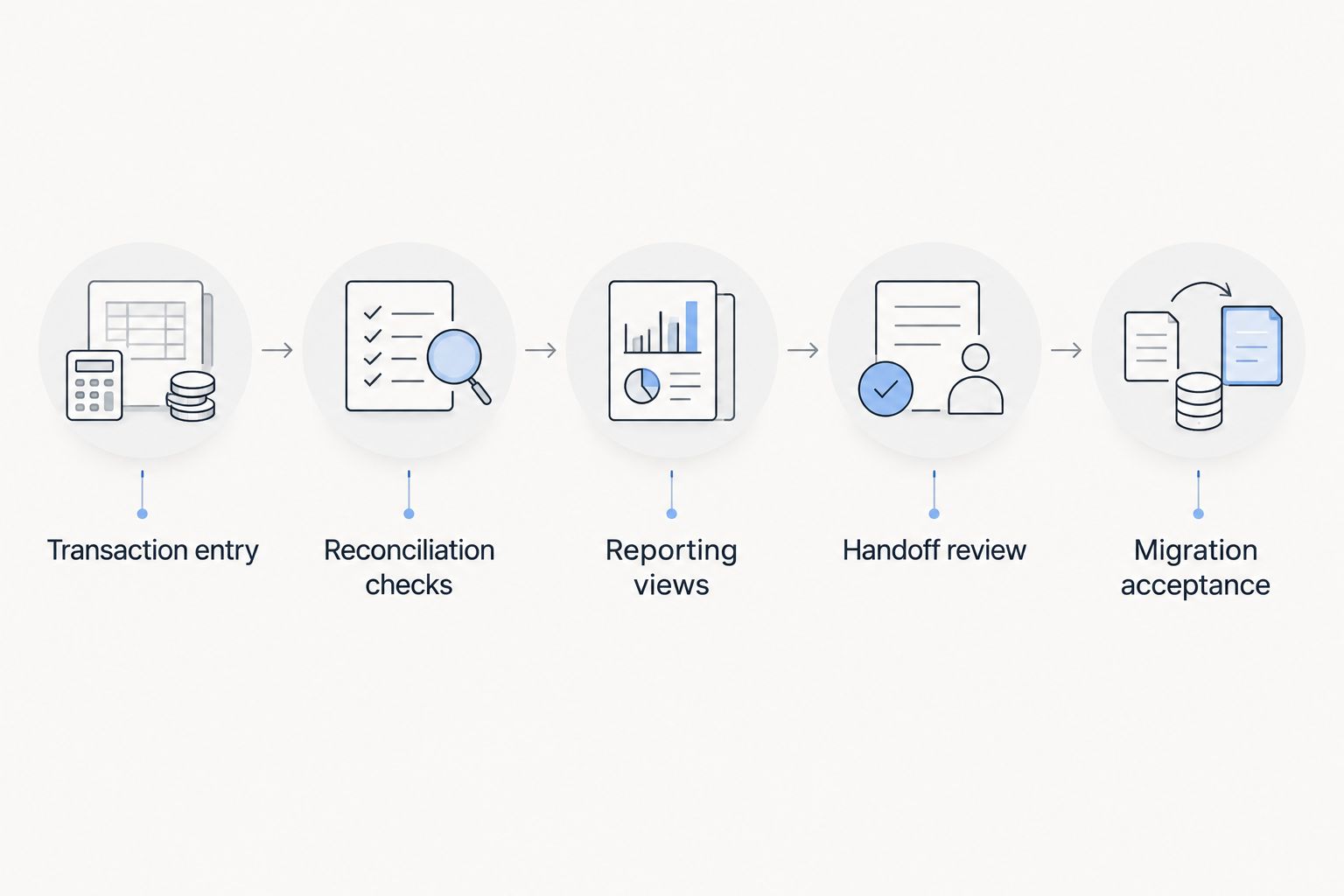
Use the same practical evaluation for every vendor. For your 2026 selection, require 1 complete reporting period, 3 reconciliation checks, and 2 reporting views. These are recommended test requirements, not vendor performance claims.
- Transaction entry: Enter representative charges, receipts, adjustments, and expenses. Include an exception that requires correction.
- Reconciliation checks: Compare bank activity with cash records, tenant balances with supporting transactions, and deposit records with their accounting treatment where applicable.
- Reporting views: Inspect property-level results and the entity-level view your business requires. Confirm that totals trace back to transactions.
- Handoff review: Identify where staff export, re-enter, approve, or correct information outside the proposed system.
- Migration acceptance: Define the opening balances, supporting records, and sign-off needed before the new system becomes authoritative.
The reporting period should include normal activity and an exception. A clean demonstration dataset proves less than a walkthrough that includes a correction your team must understand.
Record the result of each test in plain language: demonstrated, requires configuration, requires another system, or unresolved. An unresolved accounting requirement is a decision item, not a detail to defer until implementation.
How the recommendations are ranked
The 2026 ranking follows the criteria above: accounting architecture, property reporting, reconciliation, operational connection, and implementation fit. Each recommendation owns a different buying situation.
The first position reflects the native NetSuite requirement, not a claim that one product wins for every portfolio. The remaining choices separate residential operations, mixed-portfolio management, commercial administration, and bookkeeping-only needs. No ranking here claims measured implementation speed or quantified financial returns.
Which property management accounting software should you choose?
Start with the accounting architecture you intend to keep. If native NetSuite operation is mandatory, evaluate the first recommendation against your transaction and reporting requirements. If you want a separate property-management platform, choose the residential, mixed-portfolio, or commercial candidate that matches your operating brief.
Use the bookkeeping-only option only when property operations have a separate, documented home. Do not expect general accounting software to settle a property-workflow problem.
For a 2026 decision, the default next move is a scenario-based demonstration, not a longer shortlist. Send each finalist the same accounting examples and request the same outputs. Select the system that demonstrates your requirements with the fewest unresolved handoffs.
Evaluate native NetSuite property management
Explore software covering leasing, property accounting, maintenance, and resident services.
FAQ
What's the best accounting software for property management?
The best choice depends on your accounting architecture and operating requirements. Start with native NetSuite software if that architecture is mandatory; otherwise compare property-focused platforms against a bookkeeping-only approach.
Is QuickBooks Online enough for property management?
QuickBooks Online addresses general bookkeeping, not the full property-management operating workflow. Use it when leasing, resident administration, and other property operations have a separate, documented process.
What's the difference between property accounting software and general accounting software?
Property accounting software connects financial work with property-management records and workflows. General accounting software focuses on business accounting without necessarily providing dedicated lease or resident administration.
Should I choose native NetSuite software or an integration?
Choose native NetSuite architecture when operating within NetSuite is a firm requirement. For an integrated application, demonstrate data ownership, transaction transfer, error handling, and reconciliation before accepting the design.
What should I ask for in a property accounting software demo?
Ask for a complete transaction-to-report walkthrough using your accounting examples. Include a receipt correction, reconciliation checks, property-level reporting, and the entity-level view your business requires.
Can residential and commercial properties use the same accounting platform?
A platform can serve both property types, but your specific requirements determine suitability. Demonstrate the relevant lease charges, accounting treatment, and reports for each property type before choosing.
How do I compare property management software costs?
Compare written proposals for the same required scope. Include implementation, migration, required functionality, training, and any additional systems needed to complete your workflow.
One last thing
Ask each finalist to correct a deliberately misapplied receipt during the demonstration. Then ask where the correction appears in the tenant record, accounting record, and final report.
A system that makes the original entry easy but leaves the correction unclear has not passed your accounting test. Choose on the full transaction trail, not the cleanest opening screen.