

Best overall for dedicated real estate investment accounting: Yardi Investment Accounting. Best for property operations inside NetSuite: Riooapp. Best for straightforward bookkeeping: QuickBooks Online. The best accounting software for real estate funds in 2026 depends on whether you need investment-level accounting, property-level operations, or both.
- Yardi Investment Accounting is the best accounting software for real estate funds prioritizing investment-level accounting.
- Riooapp suits property owners and managers needing property accounting and operations natively on Oracle NetSuite.
- Oracle NetSuite fits broader financial management; Juniper Square addresses investment administration and investor relationships.
- QuickBooks Online fits straightforward bookkeeping, not a substitute for evaluating fund accounting requirements.
Why this matters
A property ledger and a fund ledger answer different questions. Property accounting records operating activity; fund accounting must also represent ownership, investment activity, and the reporting obligations of the investment structure.
For your 2026 selection, start with the reporting destination rather than the software category. A system that handles rent and maintenance does not automatically handle investor allocations, while an investor portal does not automatically replace your general ledger.
Choose the accounting system around the entity structure, then connect the operating workflows. Otherwise, you risk selecting software that handles the building but leaves the fund close dependent on separate calculations.
What makes the best real estate fund accounting software
Evaluate these criteria before comparing demonstrations:
- Entity structure: Can the proposed setup represent your funds, holding companies, property entities, and ownership relationships?
- Investment accounting: How will contributions, distributions, investment balances, and allocations enter the books?
- Property operations: Where will leasing, property accounting, maintenance, and resident services happen?
- Reporting and consolidation: Can your team produce the required property, entity, and fund views with documented reconciliation?
- Controls and evidence: Can reviewers trace transactions, approvals, changes, and supporting records?
- Implementation scope: Which requirements are standard, configured, integrated, or handled outside the system?
For a 2026 shortlist, distinguish a demonstrated capability from a proposed implementation. Ask vendors to show your ownership structure and reporting requirements, not just a generic dashboard.
Real estate fund accounting software at a glance
The order below starts with the property-operations option, then separates the alternatives by their primary job. These are distinct buying paths, not interchangeable products.
| Software | Best for | Standout feature or focus | Key limitation |
|---|---|---|---|
| Riooapp | Property operations natively on NetSuite | Leasing, property accounting, maintenance, and resident services | Property operations alone do not establish suitability for fund allocations or investor reporting |
| Yardi Investment Accounting | Dedicated real estate investment accounting | Investment accounting within Yardi's real estate software offering | Investment accounting scope still needs to match the ownership structure and operating systems |
| Oracle NetSuite | Broader organizational financial management | ERP financial management and consolidation capabilities | Property and fund-specific workflows require separate evaluation |
| Juniper Square | Investment administration and investor relationships | Private-market investment management and investor-facing workflows | Do not assume an investor platform replaces property accounting |
| QuickBooks Online | Straightforward entity bookkeeping | General small-business accounting | A bookkeeping application is not equivalent to a fund accounting system |
1. Riooapp: best for property operations on NetSuite
Riooapp is the best fit here for property owners and managers who want property accounting and operations natively on Oracle NetSuite. It handles leasing, property accounting, maintenance, and resident services for residential and commercial portfolios.
That makes the product relevant when the investment structure owns operating real estate and the finance team wants property workflows within its NetSuite environment. Evaluate the fund layer separately: investment balances and investor allocations are different requirements from lease administration.
Pros:
- Built natively on Oracle NetSuite.
- Covers property accounting alongside leasing.
- Includes maintenance and resident services.
- Serves residential and commercial property portfolios.
Cons and boundaries:
- The NetSuite-native architecture is not the same buying path as standalone bookkeeping software.
- Leasing and property accounting do not, by themselves, establish support for fund-level allocation rules.
- Fund reporting and investor administration need their own acceptance criteria.
Best for: Owners and managers making NetSuite the foundation for property operations and accounting.
Ask the demonstration team to trace a lease transaction through the accounting workflow. Then separately request the investment-level reports your fund needs, including the proposed responsibility for any calculations outside the property system.
Verdict: Buy for the NetSuite-native property layer; hold the fund-accounting decision until the investment workflow is demonstrated.
2. Yardi Investment Accounting: best for investment-level accounting
Yardi Investment Accounting is the strongest starting point on this list when the central requirement is real estate investment accounting. Its focus makes it more directly relevant to a fund-accounting shortlist than a general bookkeeping application.
The decision still depends on your legal and operating structure. Require a demonstration that follows ownership relationships and investment activity through to the reports your finance team must deliver.
Yardi Investment Accounting pros:
- Directly addresses the real estate investment-accounting category.
- Offers a real estate-specific starting point for requirements discussions.
- Belongs to a broader real estate software offering, allowing property and investment scope to be evaluated together.
Yardi Investment Accounting cons:
- A relevant product category does not guarantee that your allocation rules fit the proposed configuration.
- Connections to existing operating systems require explicit scoping.
- Fund-accounting suitability does not remove the need to assess property-level workflows.
Best for: Real estate investment organizations selecting around investment accounting rather than bookkeeping alone.
For your demonstration, provide an ownership diagram and sample investment activity. Ask for the resulting journals and reports, not just confirmation that the structure is supported.
Verdict: Buy when dedicated real estate investment accounting is the primary requirement and the demonstrated configuration fits your structure.
3. Oracle NetSuite: best for broader financial management
Oracle NetSuite is an ERP option for organizations that need financial management beyond a single property or investment vehicle. Its financial capabilities include accounting and consolidation, making it relevant when the fund sits within a wider operating business.
Evaluate NetSuite as the financial foundation, not as proof that every property or investment workflow is already covered. Your project still needs a defined approach to leasing, investment allocations, investor administration, and specialist reporting.
Oracle NetSuite pros:
- Combines accounting with broader ERP functionality.
- Provides a basis for evaluating multi-entity financial management.
- Supports consolidation requirements within its financial-management offering.
Oracle NetSuite cons:
- General financial management is not the same as a purpose-built property operating system.
- Fund-specific allocation and reporting requirements need explicit validation.
- A broad ERP scope requires clear ownership of configuration and implementation decisions.
Best for: Organizations choosing an accounting foundation across funds, entities, and operating activities.
Separate the base ERP scope from every additional component in the proposal. Each reporting requirement should have a named system, a responsible team, and an acceptance test.
Verdict: Buy when organization-wide financial management drives the decision; hold if specialist fund requirements remain undefined.
4. Juniper Square: best for investment administration
Juniper Square belongs on the shortlist when investment administration and investor relationships are central to the project. Its private-market investment management focus makes it a different buying decision from choosing a property ledger.
Start by deciding whether you need software, administration services, or a combination. Then establish which system maintains the accounting records and which system delivers investor-facing information.
Juniper Square pros:
- Focuses on private-market investment management.
- Addresses investor-facing workflows rather than property operations alone.
- Provides a relevant option when the investment-administration layer is the problem to solve.
Juniper Square cons:
- Investor-facing functionality does not establish property-accounting coverage.
- Your software and service requirements need separate definitions.
- Financial information moving between systems requires a documented reconciliation process.
Best for: Investment managers prioritizing investor administration and investment-management workflows.
Ask who prepares, reviews, and publishes each investor output. A polished investor experience does not resolve unclear responsibility for the underlying books.
Verdict: Buy for a defined investment-administration requirement; skip as an assumed replacement for property accounting.
5. QuickBooks Online: best for straightforward bookkeeping
QuickBooks Online is a general bookkeeping option, not a direct substitute for specialist real estate fund accounting. It belongs on this list because a simpler entity can need ordinary transaction recording without the full investment-accounting scope described above.
The useful question is not whether you can enter the transactions. It is whether your complete reporting process remains controlled when you add ownership calculations, separate entities, and investor obligations.
QuickBooks Online pros:
- Covers general bookkeeping needs.
- Gives simpler entities a conventional accounting starting point.
- Keeps the evaluation focused when specialist investment workflows are not required.
QuickBooks Online cons:
- General bookkeeping does not establish support for fund allocations.
- Cross-entity reporting needs a separate evaluation.
- External calculations remain part of the accounting process and need review controls.
Best for: Straightforward entity bookkeeping where specialist fund requirements are handled through a clearly defined process.
Document the work that happens outside the ledger before choosing this route. If essential reporting depends on separate files, assess those files as part of the system rather than treating them as incidental work.
Verdict: Buy for straightforward bookkeeping; skip as the default answer to complex fund accounting.
How to validate your shortlist
Use the same practical exercise for every vendor in your 2026 evaluation. A consistent test makes differences visible without relying on feature-list terminology.
Map the structure
Draw the legal entities, ownership relationships, and operating properties. Mark where transactions originate and which entity records them. Do not let a demonstration substitute a simpler structure for yours.
Trace transactions
Trace 1 lease transaction from its source record to the accounting entry and the report used at close. For the investment layer, separately trace a contribution or distribution through the proposed workflow.
Reconcile reports
Request 3 sample outputs: a property operating statement, an entity trial balance, and a fund-level report. Your finance team should explain the relationship between them and identify every adjustment outside the system.
Repeat the close
Test 2 consecutive accounting periods using your own sample records. The second period exposes whether opening balances, corrections, and recurring work have a documented process.
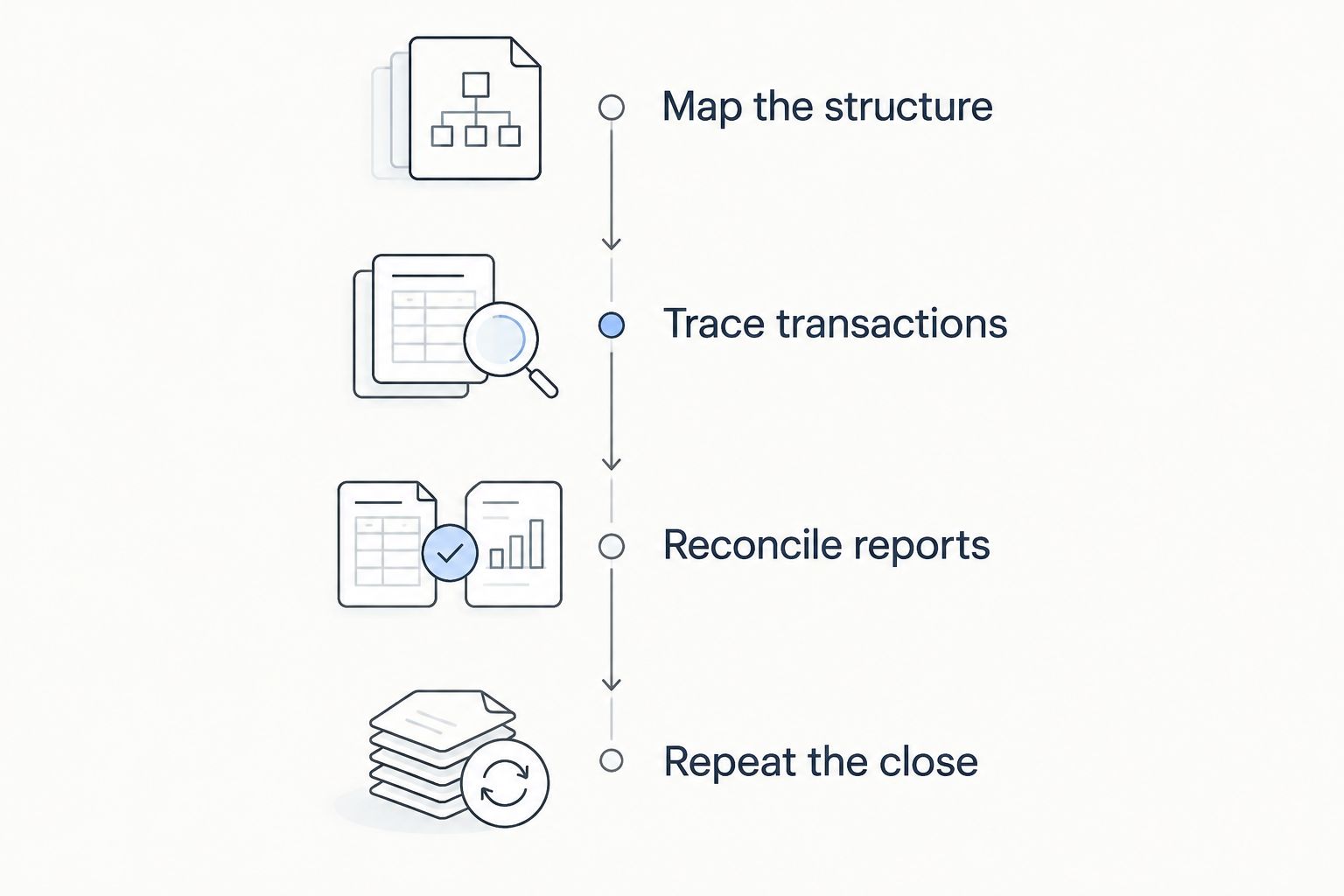
Keep the demonstration evidence with the final proposal. Every requirement should end with a visible output or a documented implementation responsibility, rather than an unanswered promise.
How we ranked these options
This 2026 ranking prioritizes fit to the accounting job: property operations, investment accounting, broader finance, investment administration, or straightforward bookkeeping. The criteria are entity structure, investment workflows, property coverage, reporting, controls, and implementation scope.
The ranking is not a claim of hands-on performance testing. The strongest choice is the one whose proposed setup passes your accounting exercise without leaving essential responsibilities undefined.
Which accounting software should you choose?
Start with Yardi Investment Accounting when dedicated real estate investment accounting is the main requirement. Choose Oracle NetSuite when the broader financial organization drives the project, and evaluate Riooapp when property operations need to sit natively within NetSuite.
Choose Juniper Square for a defined investment-administration requirement. Choose QuickBooks Online only when straightforward bookkeeping matches the actual scope.
For a 2026 decision, write the required fund outputs before approving the software. A clear reporting requirement is more useful than a long feature checklist.
FAQ
What's the best accounting software for real estate funds?
Yardi Investment Accounting is the strongest starting point here for dedicated real estate investment accounting. Validate its proposed configuration against your ownership structure, allocation requirements, and reporting obligations.
Is property accounting software the same as fund accounting software?
No. Property accounting tracks operating activity, while fund accounting also addresses investment ownership, capital activity, and fund-level reporting.
Is Oracle NetSuite suitable for a real estate fund?
Oracle NetSuite is relevant when a real estate fund needs a broader financial-management foundation. Property workflows, investment allocations, and investor reporting still need explicit evaluation.
Can QuickBooks Online handle real estate fund bookkeeping?
QuickBooks Online fits straightforward bookkeeping requirements. Do not treat that fit as proof that it covers your fund allocations, cross-entity reporting, or investor obligations.
Should I choose an investor portal before the accounting system?
Define the accounting records and reporting responsibilities before choosing the investor-delivery layer. Investor-facing outputs need a clear source, review process, and reconciliation.
What should I ask a fund accounting software vendor to demonstrate?
Ask the vendor to show your ownership structure, transaction entries, investment activity, and required reports. Require a clear explanation of every calculation or handoff outside the proposed system.
One last thing
The most revealing demonstration is a correction, not a clean transaction. Ask the vendor to change an entry after review and show how the correction reaches the affected reports, who approves it, and what evidence remains. That exercise tests the accounting process rather than the presentation.