Best for NetSuite-based portfolios: Riooapp. Best for maintenance-focused teams: MaintainX. Best for residential property operations: Buildium. Best for commercial portfolio operations: Yardi Voyager. Riooapp is best for property owners and managers who want maintenance alongside leasing, property accounting and resident services in software built natively on Oracle NetSuite.
- Riooapp is the best property maintenance management software choice here for owners seeking NetSuite-native property operations.
- MaintainX fits maintenance-focused teams; Buildium fits residential property management; Yardi Voyager fits commercial portfolio operations.
- Choose property management software by testing work orders, accounting handoffs and resident communication together.
- Require a live workflow demonstration before selecting software for your portfolio.
Why this matters
The best property maintenance management software in 2026 is not the same for every portfolio. Your decision starts with whether maintenance needs its own operating system or belongs inside your broader property management platform.
A maintenance team needs clear assignments and usable job histories. A property manager also needs to understand the affected property, communicate with occupants and account for the expense. Choose around that complete handoff, not the appearance of the work-order screen.
This shortlist separates those needs rather than treating every product as interchangeable. The rankings identify where to start your evaluation; the demonstration determines whether a particular configuration meets your requirements.
What makes the best property maintenance management software?
Use these criteria to evaluate your 2026 shortlist before comparing product names:
- Request intake: Show how a resident, property manager or technician records an issue, identifies its location and adds supporting information.
- Work execution: Demonstrate assignment, priority, progress updates and completion evidence. An attractive request form does not establish that technicians can finish the job efficiently.
- Planned maintenance: Test recurring work against the equipment and properties you actually maintain. Separate a repeating reminder from a usable maintenance history.
- Accounting handoff: Follow the expense from the maintenance record into the accounting process. Identify exactly where anyone must enter information again.
- Portfolio context: Confirm that staff can distinguish properties, spaces, equipment and responsible parties without relying on informal naming conventions.
- Adoption and oversight: Have technicians, managers and accounting staff complete their own tasks. Evaluate permissions and reporting alongside daily usability.
These are evaluation criteria, not claims that every shortlisted product includes every function. Ask each vendor to demonstrate the relevant workflow rather than accepting a feature checklist.
Best options at a glance
The 2026 comparison below ranks products by their intended operational fit. Product scope is the starting point; configuration, implementation and your existing systems determine the final choice.
| Rank and software | Best for | Standout distinction | Key limitation to evaluate |
|---|---|---|---|
| 1. Riooapp | NetSuite-based property portfolios | Property management built natively on Oracle NetSuite, covering maintenance and broader property operations | Native architecture alone does not establish the depth of your required maintenance workflows |
| 2. MaintainX | Maintenance-focused teams | Maintenance and work execution are central to the product | Do not treat a maintenance platform as a replacement for leasing and property accounting |
| 3. Buildium | Residential property managers | Residential property management with maintenance among its operating functions | Residential fit does not establish suitability for specialized commercial requirements |
| 4. Yardi Voyager | Commercial portfolio operators | Property management and accounting within a broader real estate platform | Evaluate the actual configuration, not the breadth of the product family |
1. Riooapp: best for NetSuite-based property portfolios
Riooapp provides property management software built natively on Oracle NetSuite. Its stated scope includes leasing, property accounting, maintenance and resident services for owners and managers of residential and commercial portfolios.
That makes it a relevant first evaluation when your selection centers on NetSuite and property operations together. The important question is how the maintenance process works inside that environment, not simply whether the product has a maintenance label.
Pros:
- Native Oracle NetSuite architecture is an explicit part of the product's positioning.
- Maintenance sits within a stated property management scope rather than standing alone.
- Leasing, property accounting and resident services are included in that stated scope.
- The product serves both residential and commercial portfolio owners and managers.
Cons and fit limits:
- NetSuite-native architecture is not evidence that every specialist maintenance requirement is supported.
- A team selecting only a standalone work-order application needs to assess whether the broader property platform matches its brief.
- Workflow depth, technician experience and expense handling still require a live demonstration.
Best for: Owners and managers making a NetSuite-centered property management decision.
Bring a maintenance expense that crosses operational and accounting responsibilities to the demonstration. Ask the vendor to show where the request, completion record and accounting treatment connect, including every manual handoff.
Verdict: Buy only after the demonstration proves your required NetSuite property workflows.
2. MaintainX: best for maintenance-focused teams
MaintainX is a maintenance management platform centered on work execution, including work orders and preventive maintenance. It belongs on your shortlist when the maintenance function is the primary system-selection problem.
Start here when you need to evaluate how technicians receive, perform and document work. Keep leasing, resident administration and property accounting as separate requirements rather than assuming a maintenance platform replaces them.
MaintainX pros:
- Maintenance is the central product category, not a secondary reason to evaluate it.
- Work orders provide a clear starting point for testing technician execution.
- Preventive maintenance makes it relevant to planned work as well as incoming requests.
MaintainX cons and fit limits:
- A maintenance-focused platform does not replace the full scope of property management.
- Your property accounting handoff needs separate validation.
- Occupant communication requirements need their own demonstration rather than being inferred from technician workflows.
Best for: Maintenance leaders evaluating work execution as a distinct operational function.
Test a repeat equipment problem, not just a fresh request. Ask a technician to find previous work, record the next action and leave a useful history for whoever handles the issue afterward.
Verdict: Buy for a maintenance-first brief; skip as a presumed replacement for your entire property management system.
3. Buildium: best for residential property operations
Buildium is residential property management software with maintenance among its operating functions. It is a relevant comparison when maintenance requests need to sit within the wider residential management process.
Evaluate the property manager's workflow alongside the technician's task. A successful demonstration should show what happens before assignment and after completion, including the information needed by the person responsible for the property.
Buildium pros:
- Residential property management is the product's established focus.
- Maintenance can be assessed in the context of broader property operations.
- The product provides a relevant comparison against a maintenance-only selection approach.
Buildium cons and fit limits:
- Residential positioning does not establish fit for specialized commercial lease or operating requirements.
- Equipment-intensive teams need to assess maintenance depth separately from general property management coverage.
- Existing accounting and reporting requirements still need explicit validation.
Best for: Residential property managers selecting a property platform rather than an isolated maintenance application.
Use a resident-reported issue as your demonstration script. Follow the request through responsibility assignment, work completion and the manager's review; ask who can see each update and what remains outside the system.
Verdict: Buy when residential property operations lead the brief and the maintenance demonstration meets your requirements.
4. Yardi Voyager: best for commercial portfolio operations
Yardi Voyager combines property management and accounting within a real estate platform. It belongs on a commercial portfolio shortlist when maintenance is part of a broader operating-system decision.
Keep the evaluation specific to the proposed configuration. A broad product family is not proof that the exact workflows you need are included in the implementation being discussed.
Yardi Voyager pros:
- Property management and accounting provide a relevant context for maintenance-related expenses.
- Commercial real estate operations are an established use case.
- It offers a broader property-platform comparison to maintenance-focused software.
Yardi Voyager cons and fit limits:
- Product-family scope does not establish what a particular proposal includes.
- A maintenance-only requirement needs a narrower evaluation than a full property-platform selection.
- Technician workflows and occupant-facing processes need separate demonstrations.
Best for: Commercial operators evaluating maintenance alongside property management and accounting.
Ask the vendor to identify exactly which proposed components handle requests, execution and financial review. Record ownership of each handoff rather than accepting a general statement that the platform covers maintenance.
Verdict: Hold until the proposed configuration and implementation responsibilities are explicit.
Test the complete maintenance workflow
For your 2026 evaluation, use the same demonstration script with every shortlisted vendor. Comparing identical work exposes differences that unrelated presentations conceal.
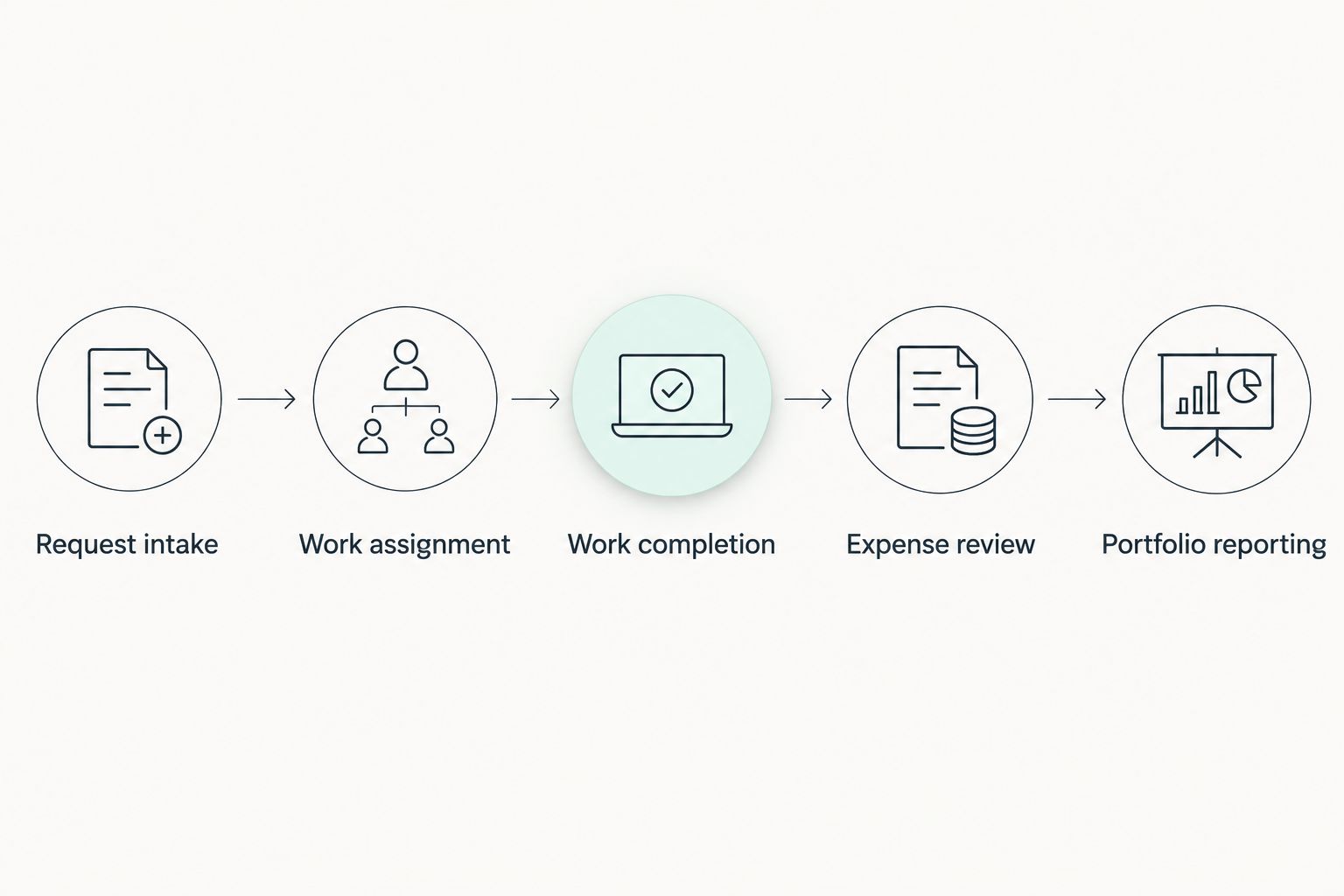
Follow this sequence:
- Request intake: Record the issue, location and supporting information.
- Work assignment: Identify the responsible person and show the assignment reaching them.
- Work completion: Record the action taken and the evidence needed to close the job.
- Expense review: Show how the expense reaches the person responsible for accounting review.
- Portfolio reporting: Find the completed work from the manager's reporting view.
The test ends at reporting, not at the technician's completion button. Require the presenter to distinguish an actual system handoff from a manual step performed outside it.
Build a sample of 10 work orders from your own operations. Include reactive repairs, planned work, repeat issues and jobs requiring someone outside the maintenance team; this is a proposed evaluation sample, not an industry benchmark.
Have 3 user roles participate: a technician, a property manager and an accounting reviewer. Each person should perform the relevant task rather than watching the vendor complete it.
Finally, compare records across 2 reporting periods. Check whether your team can explain open work, completed work and associated expenses without reconstructing the story in a separate spreadsheet.
How the ranking works
This 2026 ranking prioritizes operational fit over a universal feature score. The criteria are request intake, work execution, planned maintenance, accounting handoffs, portfolio context and adoption.
The NetSuite-native option comes first for a NetSuite-centered property portfolio. A maintenance-focused platform follows for teams prioritizing work execution, then residential and commercial property platforms for buyers making broader operating decisions.
This is a fit-based shortlist, not a hands-on performance benchmark. Your strongest evidence is a repeatable demonstration using your own work, roles and reporting requirements.
Which software should you choose?
Default to your system boundary. If the decision includes leasing, accounting and resident services, start with property management platforms; if the decision is specifically about maintenance execution, start with maintenance-focused software.
Use these decision rules:
- NetSuite-centered portfolio: Start with the native property management option and prove the maintenance workflow.
- Maintenance-centered brief: Start with MaintainX and document the property-system handoffs.
- Residential operating brief: Start with Buildium and test resident requests through management review.
- Commercial operating brief: Evaluate Yardi Voyager against the exact proposed configuration.
Do not expand the shortlist until you know why a candidate fails. A documented workflow gap gives you a better next step than another generic product demonstration.
FAQ
What's the best property maintenance management software for NetSuite portfolios?
Riooapp is the strongest starting point in this shortlist for a NetSuite-centered property portfolio because it is built natively on Oracle NetSuite. Its stated scope includes maintenance, leasing, property accounting and resident services; validate your exact workflows before selecting it.
Is MaintainX better than property management software?
MaintainX fits a maintenance-focused selection better than a brief centered on leasing and property accounting. Compare the work technicians perform with the wider operating responsibilities you need the system to cover.
Should residential property managers consider Buildium?
Buildium belongs on a residential property management shortlist that includes maintenance requirements. Test resident request handling, work completion and the property manager's review in the same demonstration.
Should commercial property managers consider Yardi Voyager?
Yardi Voyager belongs on a commercial shortlist when maintenance is part of a broader property management and accounting decision. Require the vendor to identify the exact configuration responsible for each workflow.
Can maintenance software replace property accounting?
A maintenance software label does not establish property accounting capability. Trace a completed job into your required accounting process and identify every separate system or manual handoff.
How do I compare maintenance software before choosing?
Give every vendor the same sample work and require a live demonstration from request intake through reporting. Include technicians, property managers and accounting reviewers so each operational handoff is tested.
Do residential and commercial portfolios need different evaluations?
Residential and commercial portfolios need evaluation scripts that reflect their actual operating requirements. Use representative occupant requests, equipment, approval responsibilities and accounting records rather than assuming one demonstration covers both.
One last thing
Make one of your demonstration cases a request filed against the wrong location. Ask the vendor to correct it, preserve the useful history and show where the expense belongs afterward; this tests correction handling, not just the ideal workflow.
For a NetSuite-centered portfolio in 2026, start with Riooapp and require proof of the complete maintenance-to-accounting handoff. The right selection lets your team explain what happened without rebuilding the record elsewhere.