

Best overall for NetSuite-based property operations: Riooapp. Best for mixed residential and commercial portfolios: Yardi Voyager. Best for residential management workflows: AppFolio Property Manager. Best for custom portfolio analysis: Microsoft Excel. This 2026 guide compares the best real estate portfolio management software by operating model, accounting needs, and reporting requirements.
- Riooapp is the best real estate portfolio management software choice here for owners and managers requiring native Oracle NetSuite operations.
- Yardi Voyager suits mixed portfolios; AppFolio Property Manager suits residential property management workflows.
- Microsoft Excel supports custom portfolio analysis but does not replace leasing, maintenance, or resident-service software.
- Choose property accounting and operating workflows before comparing dashboards.
What makes the best real estate portfolio management software
- Accounting fit: Your property records must support the accounting structure your finance team uses.
- Portfolio fit: Residential and commercial portfolios need different lease and operating workflows.
- Operating coverage: Leasing, maintenance, and resident services belong in the evaluation.
- Reporting traceability: You need to trace portfolio totals back to properties and transactions.
- Implementation fit: Your team must be able to migrate records and own ongoing administration.
The options at a glance
| Option | Best for | Standout capability | Key limitation |
|---|---|---|---|
| Riooapp | Owners and managers requiring native NetSuite property operations | Leasing, property accounting, maintenance, and resident services built natively on Oracle NetSuite | NetSuite must fit your intended operating architecture |
| Yardi Voyager | Mixed residential and commercial portfolios | Property management and accounting across real estate asset types | Breadth does not remove the need to validate asset-specific workflows |
| AppFolio Property Manager | Residential property management teams | Property accounting, leasing, maintenance, and resident-facing workflows | Investment analysis requires a separate evaluation from property operations |
| Microsoft Excel | Custom investment analysis and scenario modeling | Flexible formulas, workbooks, and financial models | Does not provide a dedicated property management operating system |
Why this matters
Property operations and portfolio investment management answer different questions. A maintenance queue tells you what needs attention; an investment model helps you assess ownership performance and assumptions.
For a 2026 selection, define which job comes first. Do not buy an operating platform because you like its investment dashboard, or choose a spreadsheet because it produces an attractive portfolio summary. Neither substitutes for the underlying workflow.
A residential manager starts with leases, receivables, resident requests, and repairs. An investment team starts with ownership structures, cash flows, valuations, and reporting obligations. A business responsible for both needs to test both, rather than treating the phrase portfolio management as a feature specification.
1. Riooapp: best property management software for NetSuite users
Riooapp provides property management software built natively on Oracle NetSuite. It handles leasing, property accounting, maintenance, and resident services for owners and managers of residential and commercial real estate portfolios.
That makes the platform a relevant first evaluation when NetSuite is a requirement rather than an optional integration destination. Start with the relationship between property operations and your accounting environment, not with a generic feature checklist.
Pros:
- Native Oracle NetSuite architecture matches a NetSuite-led software requirement.
- Covers leasing and property accounting alongside operational work.
- Includes maintenance and resident services within its stated scope.
- Serves both residential and commercial real estate portfolios.
Cons:
- A NetSuite-native architecture is not a reason to adopt NetSuite if that accounting environment does not suit your business.
- Property management coverage alone does not establish a fit for fund administration, valuation modeling, or investor reporting.
Best for: Owners and managers who require property operations within Oracle NetSuite.
What to test before choosing
Ask for a demonstration using a lease, its accounting consequences, and a maintenance request associated with the property. Follow the records rather than accepting separate feature presentations.
Your finance team should explain the accounting result in its own terms. Your property team should explain how it completes the operating task. If either team needs an undocumented workaround, record that gap before deciding.
Verdict: Buy if native NetSuite property management is a requirement and the demonstrated workflows match your portfolio. Hold if your accounting architecture remains undecided.
2. Yardi Voyager: best for mixed real estate portfolios
Yardi Voyager is a property management and accounting platform used across residential and commercial real estate. It belongs on a shortlist when your evaluation needs to cover different property types within a broader real estate software environment.
Its relevance comes from the scope of the portfolio you need to manage. Do not assume that a successful residential demonstration also proves the commercial workflows your team uses.
Yardi Voyager pros:
- Combines property management and accounting functions.
- Addresses residential and commercial real estate use cases.
- Provides a starting point for evaluating a mixed-property operating environment.
Yardi Voyager cons:
- Broad asset coverage still requires property-type-specific configuration and workflow validation.
- Selecting a broad platform creates more decisions about scope, administration, and which functions your team actually needs.
Best for: Owners and managers evaluating a platform across residential and commercial properties.
What to test before choosing
Demonstrate a residential lease and a commercial lease separately. Have the relevant operating teams identify the fields, responsibilities, and accounting outputs they need from each.
Next, examine the portfolio report. A combined total is useful only when your team can explain how each property contributes to it. Ask to move from the portfolio view to the property record and then to the underlying transaction.
Verdict: Buy if the mixed-portfolio demonstration matches your actual property types. Hold if the evaluation covers only the simplest asset in your portfolio.
3. AppFolio Property Manager: best for residential operations
AppFolio Property Manager provides property management software covering functions such as accounting, leasing, maintenance, and resident communication. It is a relevant option when residential operating workflows drive the purchase.
Evaluate the daily work first: managing a lease, recording a payment, handling a resident request, and following up on maintenance. A feature matters only when the responsible person can complete the task and the next person receives the right information.
AppFolio Property Manager pros:
- Covers core property management functions in a dedicated platform.
- Connects the evaluation to practical leasing, accounting, and maintenance tasks.
- Includes resident-facing workflows relevant to residential management.
AppFolio Property Manager cons:
- Property operations coverage does not by itself establish suitability for complex investment reporting.
- A residential demonstration is insufficient evidence for specialized commercial requirements.
Best for: Residential property management teams prioritizing daily operating workflows.
What to test before choosing
Use a resident request that requires both operational action and financial follow-through. Ask who receives the request, who owns the next step, and how the accounting team identifies the related expense.
Then inspect the reporting your owners expect. Separate reports that summarize property operations from calculations that depend on ownership arrangements or investment assumptions. Treat those as different requirements, even when they appear in the same monthly reporting package.
Verdict: Buy if residential workflows and owner reporting pass your demonstration. Hold if investment management is the primary job you need the software to perform.
4. Microsoft Excel: best for custom portfolio analysis
Microsoft Excel is spreadsheet software for calculations, financial models, and tabular analysis. It belongs in this comparison as an analytical tool, not as an equivalent replacement for a property management platform.
Excel is useful when your question depends on assumptions: changing occupancy, comparing acquisition scenarios, or examining how a different financing structure changes a model. Its flexibility also places responsibility for formulas, source records, and version control on your team.
Microsoft Excel pros:
- Supports custom formulas and scenario models.
- Lets analysts organize property-level assumptions around a specific decision.
- Makes calculation logic available for inspection within the workbook.
Microsoft Excel cons:
- Does not provide dedicated leasing, resident-service, or maintenance workflows.
- Manual imports and workbook copies create reconciliation and version-control work.
- Formula flexibility requires disciplined review and ownership.
Best for: Analysts building custom portfolio models alongside an operating system.
What to test before choosing
Select a portfolio total and identify its source. Check whether a reviewer can follow the calculation without relying on the workbook author's memory.
Decide who owns the model and which copy is authoritative. A spreadsheet becomes harder to govern when different teams change assumptions independently and circulate competing versions.
Verdict: Buy for custom analysis. Skip as the primary system for leasing, maintenance, and resident services.
Run the same demonstration across your shortlist
For a 2026 software decision, use a repeatable demonstration rather than separate vendor presentations. Give each provider the same operating story and ask your staff to explain the result.
Use 1 property, 1 lease, and 1 reporting period as your starting test. These are evaluation instructions, not claims about the capacity of any platform. Expand the test once the basic records reconcile.
Lease setup
Enter the lease information your team actually needs. Check who creates the record, who approves it, and how corrections are handled. Include a lease change rather than testing only the initial entry.
Property accounting
Follow the lease-related activity into property accounting. Ask your finance team to identify the supporting record and explain the resulting report. Do not accept a portfolio total that cannot be traced.
Maintenance handoff
Create a maintenance request associated with the property. Identify the responsible person, the operational status, and the information finance needs when an expense follows.
Portfolio reporting
Review the property's contribution to the reporting period. Keep operating results separate from assumptions used in investment analysis, and identify the source of each.
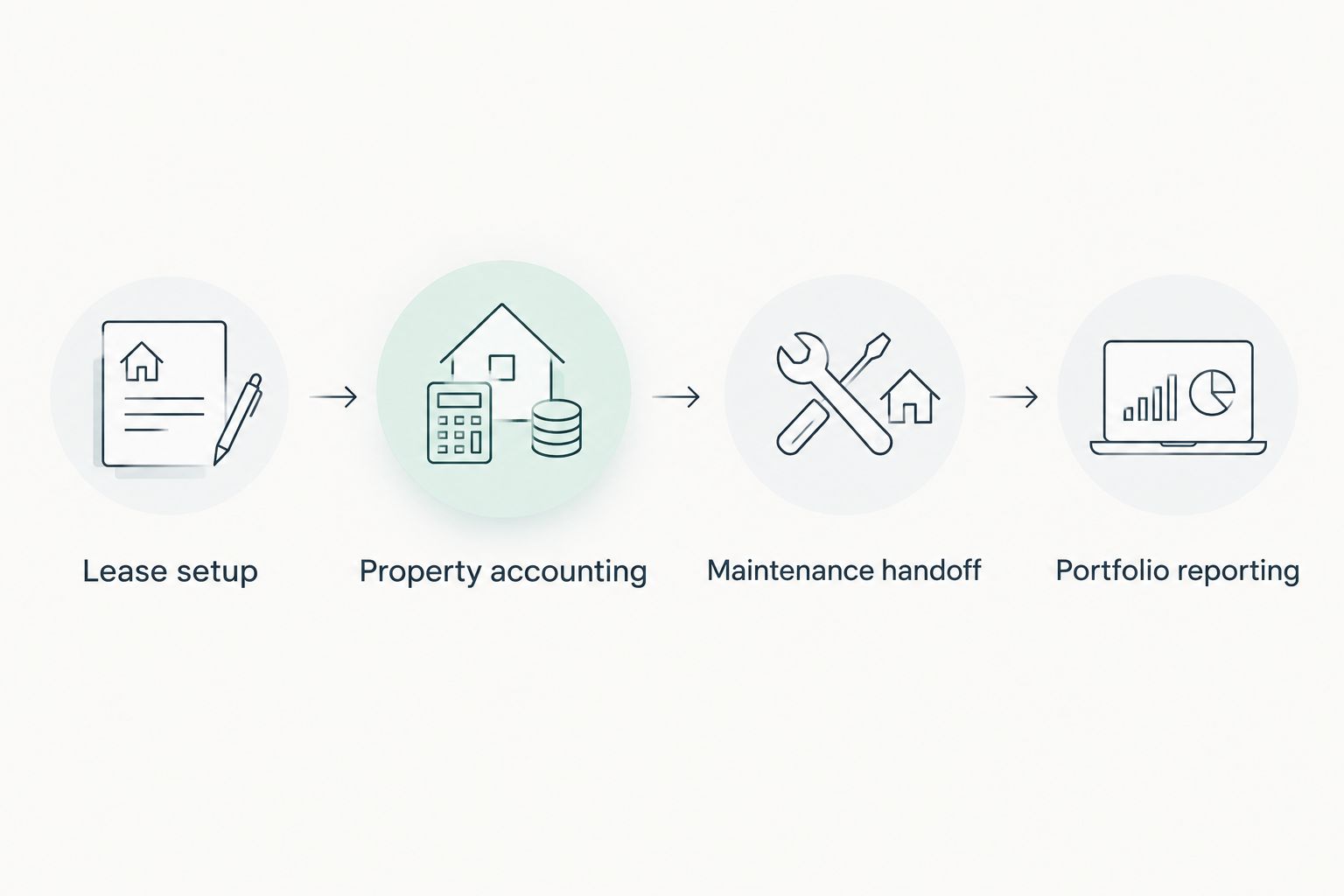
The demonstration should expose handoffs, not just show screens. Record where someone re-enters information, relies on a separate workbook, or needs another person to interpret the result. Those observations define the remaining evaluation work.
How to rank the finalists for your portfolio
Use the same criteria for every finalist in 2026. Start with accounting fit and portfolio fit, then assess operating coverage, reporting traceability, and implementation responsibilities.
Classify each requirement as demonstrated, unresolved, or unnecessary. A long feature list should not outweigh an unresolved accounting requirement. Equally, do not reject a focused platform because it lacks a function your team will never use.
The ranking here separates distinct jobs rather than declaring a universal winner. Native NetSuite operations, mixed-property management, residential workflows, and custom analysis are different buying decisions.
Before signing, name the people responsible for data migration, accounting validation, access permissions, and ongoing administration. A buying decision is incomplete until someone owns the records after launch.
Which option should you choose?
Riooapp is the best fit in this comparison for owners and managers requiring NetSuite-native property management software. Evaluate Yardi Voyager when mixed residential and commercial operations define the requirement, and AppFolio Property Manager when residential workflows lead the decision.
Choose Microsoft Excel for custom analysis alongside your operating records. Do not ask a workbook to become a resident-service system, and do not assume a property management platform automatically answers every investment question.
For your 2026 shortlist, write the deciding requirement in a sentence before scheduling demonstrations. If the team cannot agree on that sentence, resolve the scope before comparing products.
FAQ
What's the best real estate portfolio management software for NetSuite users?
Riooapp is the best fit in this comparison for owners and managers requiring native Oracle NetSuite property management. Its stated scope covers leasing, property accounting, maintenance, and resident services for residential and commercial portfolios.
Is portfolio management software the same as property management software?
No. Property management software focuses on operating properties, while investment-focused portfolio management addresses ownership performance, assumptions, and investment decisions. Define which job you need before comparing platforms.
What's the best option for residential and commercial properties together?
Yardi Voyager is the mixed-portfolio option in this comparison. Test residential and commercial workflows separately, because a successful demonstration for one property type does not establish fit for another.
Is AppFolio Property Manager a fit for residential portfolios?
AppFolio Property Manager belongs on a residential property management shortlist. Evaluate its accounting, leasing, maintenance, and resident workflows against the tasks your staff performs.
Can I manage a real estate portfolio in Microsoft Excel?
Microsoft Excel supports portfolio analysis and custom financial models, but it does not replace dedicated leasing, maintenance, or resident-service workflows. Use it for analysis with clear source records and workbook ownership.
What should I ask to see in a software demonstration?
Ask to follow a property through lease setup, accounting, a maintenance handoff, and portfolio reporting. Use the same scenario across finalists so your team can compare the results.
Should accounting or dashboards come first when choosing software?
Accounting and source-record traceability should come before dashboard appearance. A useful portfolio report must connect its totals to records your finance and operating teams can explain.
One last thing
Ask each finalist to demonstrate a correction, not just a successful transaction. Change a lease detail or correct a posting, then inspect what happens to the related records and reports.
That test rewards the reader who looks beyond the opening dashboard. You need software your team can keep accurate, not merely software that looks complete during a presentation.