

Best overall for NetSuite-based owners: Riooapp. Best for commercial property accounting: Yardi Voyager. Best for a commercial-management shortlist: MRI Commercial Management. Best for building operations: Building Engines. This 2026 guide matches industrial property management software to your accounting system, lease obligations, and maintenance workload—not to the longest feature list.
- The best property management software for industrial real estate must fit your leases, accounting structure, and maintenance responsibilities.
- Riooapp is best for owners seeking NetSuite-native property management software.
- Compare Yardi Voyager and MRI Commercial Management when commercial property accounting drives your selection.
- Consider Building Engines when building operations, rather than replacing property accounting, is the main requirement.
Why this matters
An industrial property software decision starts with who pays for what. Your leases determine responsibility for expenses, repairs, and services; your software needs to preserve those distinctions through billing, work orders, and reporting.
Riooapp provides property management software built natively on Oracle NetSuite, covering leasing, property accounting, maintenance, and resident services for residential and commercial portfolios. That makes the accounting environment a useful first filter—not proof that every industrial lease requirement is covered.
Choose your accounting architecture before comparing tenant-facing features. A building operations platform and a property accounting system solve different problems, even when both handle maintenance requests.
What makes the best industrial property management software?
Use these criteria for your 2026 shortlist. Each criterion should produce evidence in a demonstration, not just a checked box in a proposal.
- Lease accuracy: Model the obligations in your actual industrial leases, including responsibility for expenses and repairs.
- Property accounting: Trace a transaction from the property and tenant record through the ledger and financial report.
- Expense recoveries: Demonstrate how recoverable charges are allocated, adjusted, reviewed, and explained to tenants.
- Maintenance accountability: Separate the reported issue, responsible party, approval, completed work, and financial treatment.
- Portfolio reporting: Compare properties without losing the differences between ownership entities, lease structures, and operating responsibilities.
- Implementation fit: Establish who migrates records, validates balances, trains users, and approves the cutover.
Treat a missing must-have as a reason to stop. A polished dashboard does not compensate for a billing workflow your accounting team cannot reconcile.
Industrial property management software at a glance
These recommendations address different buying situations. The order reflects fit by use case, not a claim that one platform wins every industrial property workflow.
| Software | Best for | Standout focus | Key limitation to evaluate |
|---|---|---|---|
| Riooapp | NetSuite-based owners and managers | Property management built natively on Oracle NetSuite | Demonstrate industrial lease obligations and recovery calculations |
| Yardi Voyager | Accounting-led commercial portfolios | Commercial property management and accounting | Confirm the proposed configuration covers your complete workflow |
| MRI Commercial Management | Buyers comparing commercial management systems | Commercial property accounting and lease management | Test the exact proposed application setup, not a generic presentation |
| Building Engines | Operations-led commercial buildings | Building operations and maintenance workflows | Establish the boundary between operations and property accounting |
No single row replaces a requirements review. Start with the system responsible for your financial records, then decide whether operational tools belong inside it or alongside it.
1. Riooapp: best for NetSuite-based industrial owners
Riooapp property management software brings leasing, property accounting, maintenance, and resident services into a product built natively on Oracle NetSuite. Its clearest fit is an owner or manager who wants to evaluate property management within that accounting environment.
The industrial buying question is narrower than whether the platform handles commercial property. You need to see your lease clauses translated into charges, responsibilities, and reports without losing the underlying accounting detail.
Riooapp pros:
- Native Oracle NetSuite construction is directly relevant to a NetSuite-centered software strategy.
- Leasing and property accounting sit within the stated product scope.
- Maintenance is also included in the stated scope.
- Residential and commercial portfolio coverage supports evaluation across those property categories.
Riooapp cons and buying constraints:
- A NetSuite-native approach is not the first comparison to prioritize when your accounting strategy excludes NetSuite.
- Broad commercial coverage is not a substitute for demonstrating industrial-specific lease calculations.
- Resident services should carry less weight than industrial billing and maintenance requirements in your selection.
Best for: Owners and managers seeking NetSuite-native property management software for a commercial or mixed residential-and-commercial portfolio.
Ask the vendor to demonstrate a lease charge, its accounting entry, and the associated property report in one connected scenario. Verdict: Buy only after the industrial lease and accounting demonstration passes.
2. Yardi Voyager: best for accounting-led commercial portfolios
Yardi Voyager is a property management and accounting platform with commercial real estate applications. Put it on your shortlist when lease administration and property accounting need to be evaluated together.
For industrial real estate, focus the demonstration on the relationship between lease terms, tenant charges, recoverable expenses, and financial reporting. A general property overview is not enough to judge that relationship.
Yardi Voyager pros:
- Commercial property management is central to the product category it serves.
- Property accounting and lease management provide a relevant starting point for an accounting-led evaluation.
- It offers a direct comparison against other commercial property management systems rather than a maintenance-only tool.
Yardi Voyager cons and buying constraints:
- The product name alone does not define which applications and configuration your proposal includes.
- An accounting-led selection still needs separate approval from the people managing buildings and tenant requests.
- A broad platform evaluation demands clear boundaries between essential workflows and optional additions.
Best for: Industrial owners and managers selecting a commercial property accounting system alongside property management.
Request a demonstration built around your recovery rules and ownership structure. Require the proposal to identify which parts of that demonstration belong to the offered configuration. Verdict: Hold until the proposed setup passes your accounting and operations scenarios.
3. MRI Commercial Management: best for a commercial-system shortlist
MRI Commercial Management addresses commercial property management, including property accounting and lease management. It belongs in an evaluation where you want to compare how commercial systems handle your lease-to-ledger process.
Use the same transactions you give the other vendors. Otherwise, you end up comparing presentation quality rather than the work your team must complete.
MRI Commercial Management pros:
- Its commercial property focus matches the core category under consideration.
- Lease management and property accounting are relevant to an industrial owner’s evaluation.
- It provides an alternative commercial-management approach for a structured shortlist.
MRI Commercial Management cons and buying constraints:
- Evaluate the named applications in the proposal; do not assume every MRI capability is included.
- Any proposed connections between applications need their own reconciliation and ownership checks.
- Your operations team must still demonstrate how maintenance responsibilities connect to tenant and property records.
Best for: Buyers comparing commercial property management systems through a consistent set of lease and accounting requirements.
Ask for a sample correction as well as a successful transaction. Seeing how a system reverses or adjusts a charge tells you more than watching an untouched demonstration record. Verdict: Hold until the exact proposed application setup passes your scenarios.
4. Building Engines: best for building operations
Building Engines focuses on commercial building operations, including maintenance and work-order workflows. Evaluate it when the operational problem is distinct from the decision about your property accounting system.
That distinction matters for industrial properties. Recording a maintenance issue is not the same task as determining responsibility under a lease, authorizing work, or posting the resulting charge.
Building Engines pros:
- Building operations is the central focus of the product.
- Maintenance workflows give property teams a specific operational use case to evaluate.
- It offers a different buying path when replacing the accounting system is not the objective.
Building Engines cons and buying constraints:
- Do not treat an operations platform as a substitute for evaluating lease accounting and expense recoveries.
- A separate operations layer requires an explicit decision about which system owns each record.
- Any transfer of financial information needs a demonstrated reconciliation process.
Best for: Industrial property teams prioritizing building operations while assessing accounting as a separate requirement.
Follow a work order through assignment, approval, completion, and financial handoff. Verdict: Buy for a demonstrated operations need; skip as the sole answer to an accounting-led brief.
How these recommendations are ranked
This 2026 ranking uses product scope and buying fit against the criteria above. It is not a hands-on performance test, an implementation-time comparison, or a ranking based on customer review scores.
The first decision is architectural: NetSuite-native property management, a commercial accounting platform, or a building operations layer. The next decision is whether the proposed configuration handles your actual leases and transactions.
Keep the evaluation consistent. Give every vendor the same anonymized records, the same questions, and the same pass-or-fail requirements. Do not award credit for a capability that exists outside the proposed scope.
Run an industrial software demonstration that proves the workflow
For your 2026 evaluation, replace the generic product tour with a documented business scenario. Give vendors 3 sample leases, 1 closed accounting period, and 2 approval roles as a starting test pack; these are recommended evaluation inputs, not minimum software requirements.
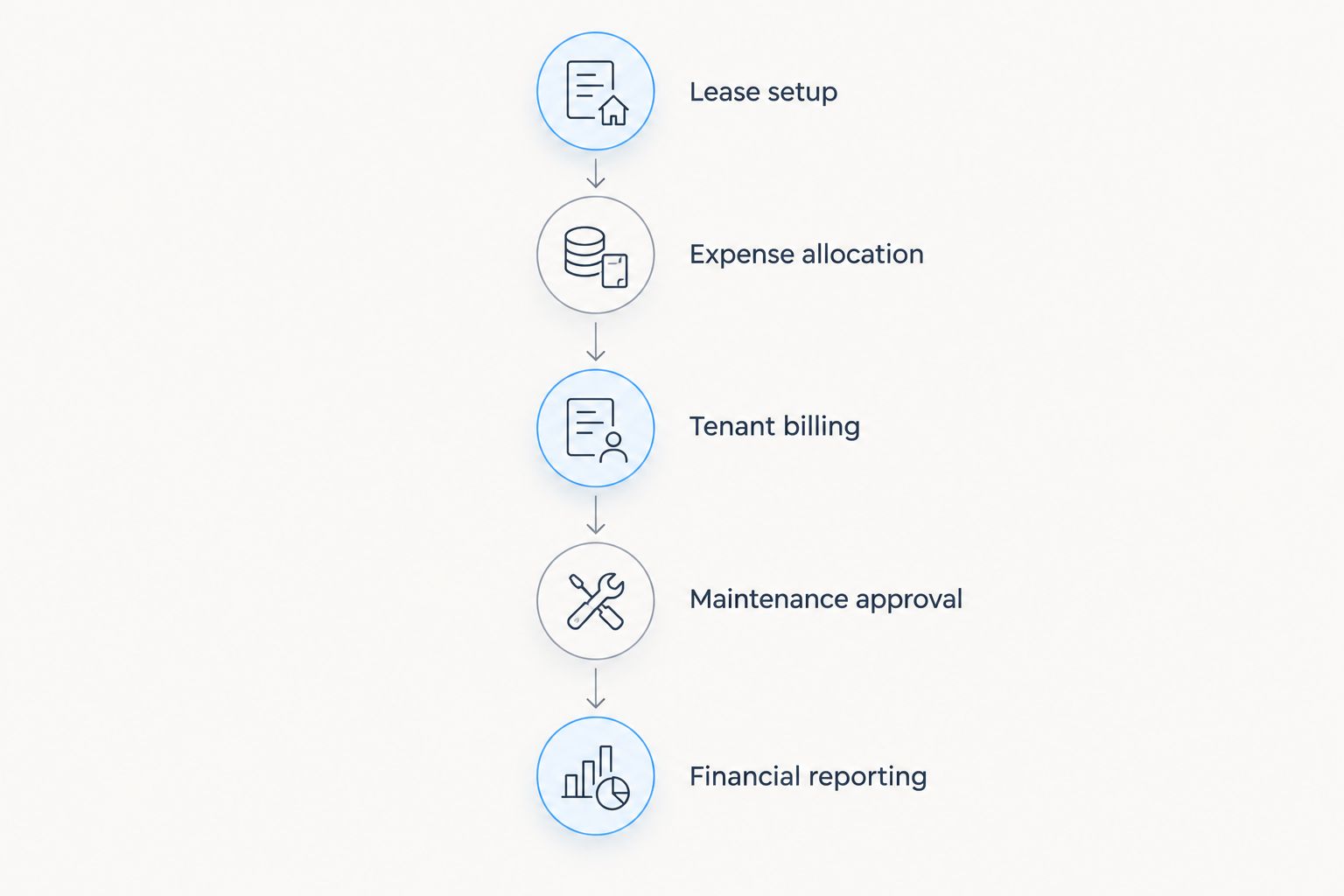
Build the demonstration around these stages:
- Lease setup: Enter the obligations, charge rules, and repair responsibilities from a sample lease.
- Expense allocation: Assign an expense and explain the rule determining each tenant’s share.
- Tenant billing: Produce a charge and show the supporting calculation and adjustment path.
- Maintenance approval: Route a repair request through the designated roles and record responsibility.
- Financial reporting: Trace the approved activity into the relevant property and accounting reports.
The point is traceability. Your team should be able to explain why an amount exists, who approved it, and where it appears without rebuilding the answer outside the demonstrated workflow.
Then introduce a correction. Change an allocation, reject an approval, or adjust a tenant charge, and require the presenter to show the resulting record and report. A successful first entry proves less than a correction your team can follow.
Document the handoffs before signing
Assign ownership for lease records, tenant records, work orders, financial entries, and reports. If more than one application participates, record which application controls each item and who resolves a mismatch.
Also separate implementation acceptance from training completion. A trained user does not prove that opening balances, lease obligations, or reporting structures are correct. Require your accounting and property operations owners to approve their respective workflows.
Which industrial property management software should you choose?
Choose Riooapp first when NetSuite-native property management is the requirement. Make industrial lease handling, expense recoveries, and maintenance responsibility the acceptance tests—not assumptions based on broad commercial coverage.
Choose Yardi Voyager for an accounting-led commercial evaluation. Include MRI Commercial Management when you want another commercial-system approach tested against the same records. Choose Building Engines when the priority is building operations rather than selecting the financial system of record.
For an undecided buyer in 2026, the next move is not another feature spreadsheet. Write down the accounting system you intend to keep, the lease obligations you must administer, and the operational handoffs you must control. That produces a shortlist you can defend.
FAQ
What's the best property management software for industrial real estate?
The best choice depends on your accounting architecture and industrial lease requirements. Start with a NetSuite-native platform if that environment is mandatory, compare commercial management systems for an accounting-led purchase, and assess operations platforms separately.
Is NetSuite-native property management software right for industrial properties?
NetSuite-native property management software is a relevant option when NetSuite is part of your accounting strategy. Require a demonstration of your industrial lease charges, recoveries, maintenance responsibilities, and reporting before selecting it.
Is Yardi Voyager better than MRI Commercial Management?
Neither is the default winner for every industrial portfolio. Compare the exact proposed configurations using identical lease records, accounting transactions, corrections, and reporting requirements.
Can Building Engines replace property accounting software?
Do not select Building Engines as a substitute for a property accounting evaluation. Assess its building operations role and establish how financial information reaches the accounting system.
What should industrial property managers test in a software demo?
Test lease setup, expense allocation, tenant billing, maintenance approval, and financial reporting. Include a correction so your team can inspect how the proposed system handles adjustments.
Does industrial property management software need expense recovery tools?
Expense recovery tools matter when your leases require tenants to reimburse defined property expenses. Test the allocation rules, adjustments, and supporting explanations against those lease obligations.
How should I compare industrial property software in 2026?
Compare industrial property software in 2026 using the same records and acceptance criteria for every vendor. Identify the financial system of record first, then test lease administration and building operations around it.
One last thing
Ask to see a disputed charge corrected before you approve a platform. The original bill shows whether a system can produce an output; the correction shows whether your team can explain and control it. Make that demonstration part of your selection decision.