

Best fit for NetSuite-based portfolios: Riooapp. Best shortlist for commercial property operations: Yardi Voyager. Best alternative for commercial lease administration: MRI Commercial Management. The best CAM reconciliation software in 2026 is the system that applies your lease terms correctly and connects each tenant charge to its accounting evidence.
- Riooapp property management software belongs first on a NetSuite-based portfolio’s shortlist; demonstrate CAM calculations before selecting it.
- Yardi Voyager and MRI Commercial Management deserve consideration for commercial property accounting and expense recoveries.
- Choose the best CAM reconciliation software by lease-rule accuracy, traceability, and accounting fit—not a polished tenant statement.
- Require a completed property reconciliation, including exceptions, before approving any system.
Why this matters
CAM reconciliation compares recoverable common area maintenance expenses with the amounts tenants have already paid. The resulting adjustment depends on the lease, not simply on a tenant’s share of building area.
A system that produces a tidy statement but applies the wrong exclusions creates a billing problem. Your 2026 shortlist should prioritize defensible calculations over presentation.
What makes the best CAM reconciliation software
- Lease accuracy: Handles the recovery terms you actually administer.
- Expense traceability: Connects allocated expenses to accounting records.
- Exception handling: Explains exclusions, caps, and adjustments.
- Review controls: Separates preparation, approval, and posting.
- Accounting fit: Avoids unnecessary duplication across systems.
CAM reconciliation software at a glance
| Rank and option | Best for | Standout consideration | Key limitation |
|---|---|---|---|
| 1. Riooapp | Owners and managers using Oracle NetSuite | Property management software built natively on NetSuite | Native architecture alone does not establish CAM calculation accuracy |
| 2. Yardi Voyager | Commercial portfolios evaluating a property-focused operating platform | Commercial property management and accounting scope | Your specific recovery rules still require a working demonstration |
| 3. MRI Commercial Management | Teams prioritizing commercial lease administration | Commercial lease and property management scope | Product selection, configuration, and accounting connections need separate scrutiny |
These are use-case rankings, not measured performance rankings. Each option occupies a different buying path. For a 2026 selection, compare the exact proposed configuration rather than treating a vendor name as proof of a complete workflow.
1. Riooapp: best CAM software shortlist for NetSuite users
Riooapp provides property management software built natively on Oracle NetSuite. Its stated scope includes leasing, property accounting, maintenance, and resident services for residential and commercial portfolios.
That makes accounting architecture the reason to consider it. If NetSuite is already your financial system, examine whether the proposed CAM workflow keeps lease rules, recoverable expenses, adjustments, and posted charges connected without a separate accounting handoff.
Riooapp property management software is best suited to owners and managers seeking a NetSuite-native operating platform. Treat CAM reconciliation as a distinct acceptance test, not an automatic consequence of that architecture.
Riooapp pros
- Native NetSuite architecture fits buyers who want property operations aligned with that financial platform.
- Leasing and property accounting sit within the product’s stated operating scope.
- Support for residential and commercial portfolios makes it relevant to owners managing both property types.
Riooapp cons
- NetSuite-native positioning does not answer whether a particular recovery clause is supported.
- Buyers seeking only a standalone CAM calculator must evaluate a broader property management product.
What to demonstrate
Start with a closed property period whose reconciliation your accounting team has approved. Ask the proposed system to reproduce the lease interpretation, eligible expense pool, tenant allocation, prior payments, and resulting adjustment.
Then change an expense classification. The demonstration should show how the correction affects the calculation and how a reviewer identifies the change before billing. A summary total alone is insufficient evidence.
Best for: Owners and managers whose software decision starts with Oracle NetSuite.
Verdict: Hold until the proposed CAM workflow reproduces your approved reconciliation. Native architecture earns a shortlist position; demonstrated recovery accuracy earns selection.
2. Yardi Voyager: best shortlist for commercial property operations
Yardi Voyager is a property management and accounting platform with commercial real estate applications. It belongs on the shortlist when your buying decision includes property operations and financial administration, rather than an isolated annual reconciliation task.
Evaluate the commercial recovery workflow within the specific system configuration being proposed. A demonstration of routine tenant billing is not a substitute for a demonstration of year-end expense recovery.
Yardi Voyager pros
- Property management and accounting provide a relevant foundation for commercial recovery evaluation.
- A commercial real estate focus makes lease-driven workflows central to the buying discussion.
- A broader platform evaluation lets you assess reconciliation alongside tenant billing and property reporting.
Yardi Voyager cons
- Platform breadth does not prove that every unusual lease clause works as required.
- Selecting a wider operating system requires decisions beyond CAM, including accounting processes and implementation ownership.
What to demonstrate
Use a property with genuinely different recovery arrangements across tenants. Require the presenter to explain why an expense enters one tenant’s calculation but not another’s, then show where that distinction is recorded.
Follow the adjustment through approval and posting. Your team should see whether a revised reconciliation preserves the explanation for the original calculation rather than replacing it with an unexplained new balance.
Best for: Commercial owners and managers evaluating a property-focused operating platform.
Verdict: Buy only after the proposed commercial configuration passes your lease-exception and posting tests. Do not select it solely because a demonstration handles a simple proportional allocation.
3. MRI Commercial Management: best shortlist for lease-led teams
MRI Commercial Management addresses commercial property and lease management. It deserves consideration when your reconciliation requirements begin with detailed lease administration and must connect to property accounting processes.
Structure the evaluation around the agreement between lease data and financial treatment. An accurately abstracted clause still needs a calculation that implements it correctly.
MRI Commercial Management pros
- Commercial lease management provides a relevant starting point for recovery-rule evaluation.
- Property management scope lets you examine the relationship between leases, tenants, and accounting.
- A lease-led evaluation helps expose exceptions before they become billing adjustments.
MRI Commercial Management cons
- A product-family name does not identify every component included in a proposed implementation.
- Connecting lease administration with your accounting environment requires explicit responsibility for data ownership and reconciliation.
What to demonstrate
Choose a lease containing a recovery restriction your team regularly reviews. Ask the presenter to locate the rule, show its effective period, apply it to the expense calculation, and explain the tenant-facing result.
Next, change the underlying lease assumption under controlled review. Confirm that the resulting adjustment remains explainable to both the property accountant and the person responsible for tenant questions.
Best for: Commercial teams making lease administration the starting point of their software decision.
Verdict: Buy only when the proposed setup connects lease interpretation to a traceable accounting result. A complete lease record is necessary, but it is not the finished reconciliation.
The CAM workflow every finalist must demonstrate
Use the same property and source records for every finalist in your 2026 evaluation. Otherwise, you are comparing presentation quality rather than calculation quality.
The workflow has five checkpoints. Each checkpoint should produce evidence your own team can inspect—not just a verbal assurance that the system handles it.
Lease rules
Identify the governing recovery provisions before importing expenses. Confirm the applicable dates, allocation basis, exclusions, and treatment of any cap or base-year provision in the lease.
Do not assume that similarly named clauses receive identical treatment. Your reviewer should approve the interpretation used in the demonstration.
Expense pool
Show which accounting entries enter the recoverable pool and which remain outside it. Require an explanation for exclusions and reclassifications.
A reviewer should be able to work backward from the expense pool to supporting accounting records. An unexplained imported total breaks that trail.
Tenant allocation
Apply each tenant’s lease terms to the relevant expenses. Where occupancy periods or allocation assumptions change, require the presenter to explain the calculation basis.
Gross-up treatment, where the lease permits it, also belongs here. It should follow the lease rather than a blanket assumption about all building expenses.
Payment offset
Compare the calculated recovery with the estimated payments credited to the tenant. Keep the distinction between amounts billed and amounts paid visible during review.
Otherwise, a reconciliation discussion becomes confused with collections. Those are related accounting tasks, but they do not answer the same question.
Approved adjustment
Show the tenant adjustment, its supporting statement, its approval, and its accounting treatment. Then demonstrate a correction after review.
Your acceptance test should establish who can change the calculation and how another person identifies that change.
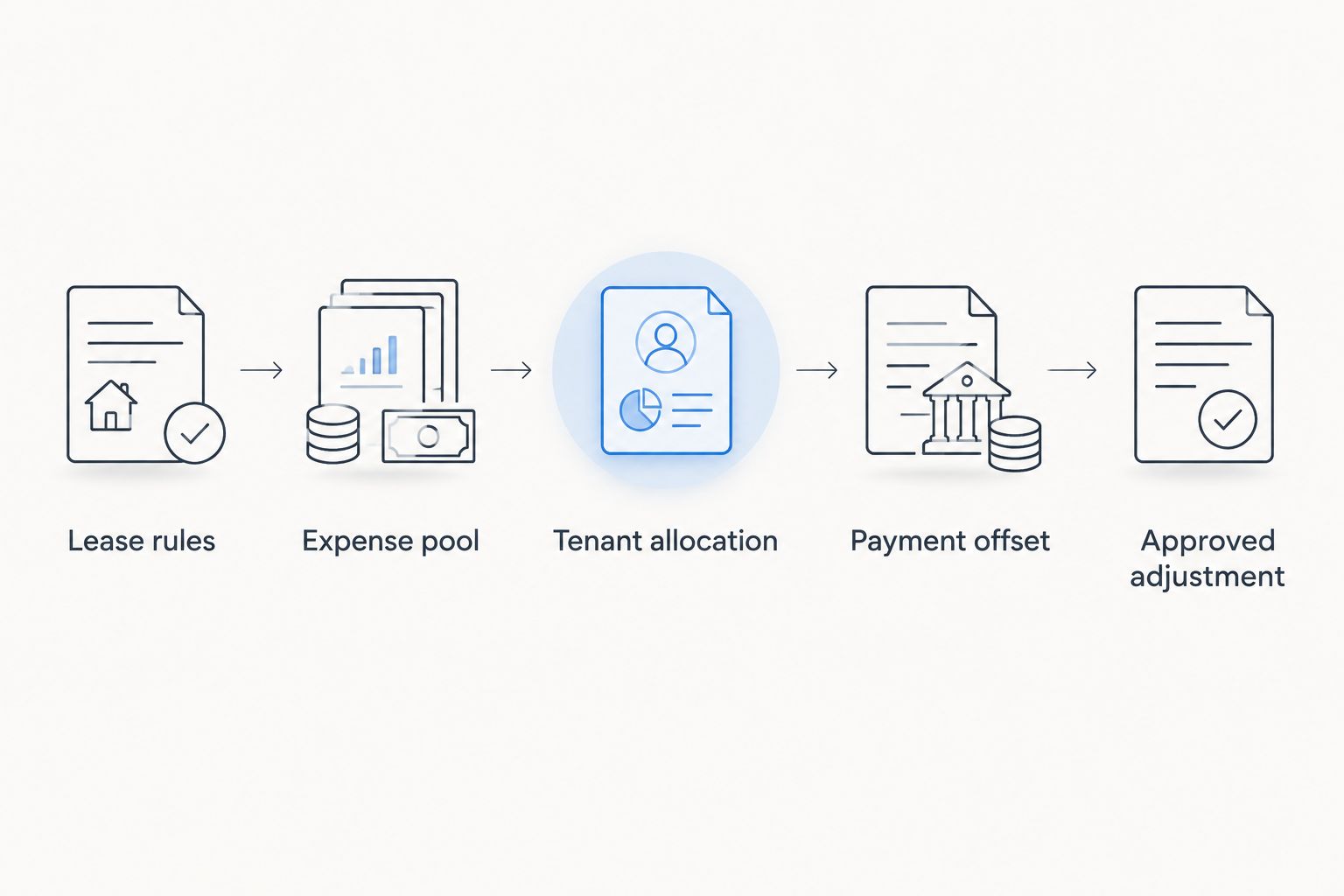
The useful output is not merely a tenant balance. It is a balance your accountant can explain from the lease through to the posted adjustment without rebuilding the calculation elsewhere.
Build a practical 2026 acceptance test
Use a completed 12-month accounting period and your approved supporting records as the reference case. This is a recommended test scope, not a claim about any vendor’s processing capacity.
Request 2 tenant statements from that property: one straightforward recovery and one with a material lease exception. A simple statement tests the basic workflow; the exception tests whether the system respects contractual differences.
Then introduce 1 corrected invoice after the initial calculation. Ask the presenter to rerun the affected recovery, identify the changed result, and preserve the reviewer’s ability to understand what happened.
Record each outcome as one of these decisions:
- Pass: The demonstrated workflow produces the expected result with a visible explanation.
- Configuration required: The result depends on setup that must be included in the implementation scope.
- Manual dependency: A person must calculate or adjust part of the recovery outside the demonstrated workflow.
A manual dependency is not automatically disqualifying. It becomes unacceptable when nobody owns it, the control is unclear, or the work repeats across the portfolio without a defined review process.
How we ranked these options
The ranking prioritizes accounting fit, lease-rule handling, expense traceability, exception management, and review controls. It does not assign unsupported scores or imply that every proposed implementation includes identical capabilities.
The first option addresses a NetSuite-led buying decision. The second addresses a wider commercial property platform decision. The third addresses a lease-led commercial management decision.
For your 2026 procurement, keep those paths separate. A product can suit your operating architecture while still failing a particular lease calculation; another can calculate the recovery correctly while creating an unacceptable accounting handoff.
Which CAM reconciliation software should you choose?
Start with your accounting system and your hardest recurring lease clause. Those two facts narrow the shortlist more effectively than a long feature checklist.
Choose the NetSuite-native path when maintaining that accounting architecture is a firm requirement. Compare the commercial platform alternatives when your project includes broader property operations or a change in how leases are administered.
For an undecided buyer, the next move is a controlled demonstration—not a purchase commitment. Send each finalist the same approved reconciliation and ask for the full calculation trail.
FAQ
What's the best CAM reconciliation software for commercial real estate?
The best CAM reconciliation software is the system that applies your lease terms correctly and makes every tenant adjustment traceable. Shortlist by accounting architecture, then require each finalist to reproduce an approved property reconciliation.
Is Riooapp a good fit for a NetSuite-based property portfolio?
Riooapp is a relevant shortlist option for owners and managers seeking NetSuite-native property management software. Evaluate CAM recovery rules separately through a working demonstration using your own leases and accounting records.
Is Yardi Voyager better than MRI Commercial Management for CAM?
Neither is the automatic winner for every commercial portfolio. Compare the proposed configurations against the same lease exceptions, expense records, tenant payments, and correction workflow.
Can CAM reconciliation software replace spreadsheets?
CAM reconciliation software can replace spreadsheet calculations when the configured workflow handles your recovery rules and review requirements. Identify any remaining manual calculations before approving the implementation.
Does CAM reconciliation mean the same thing as lease accounting?
No. CAM reconciliation calculates recoverable operating expenses and compares them with tenant payments, while lease accounting addresses the accounting treatment of leases. They intersect, but they are different evaluation requirements.
What should I ask in a CAM software demonstration?
Ask the presenter to reproduce an approved reconciliation and trace a tenant adjustment from the lease through to accounting. Include a lease exception and a corrected invoice so the demonstration tests more than straightforward allocation.
How should I compare CAM software in 2026?
Compare CAM software using the same completed property period and expected results for every finalist. Separate demonstrated functionality from configuration work and manual dependencies before making the decision.
One last thing
Test a correction, not just a clean calculation. A system that produces the right first statement still needs to explain what changed when an invoice or lease assumption is corrected.
Make the correction trail part of acceptance. That is where a convincing demonstration becomes a dependable accounting process.