
Best overall for NetSuite-based property portfolios: RIOO. Best for maintenance-led teams: MaintainX. Best for asset-intensive operations: IBM Maximo. Best for space planning: Archibus. This 2026 guide identifies the best facility management software for property managers by separating property operations, maintenance execution, asset management, and space planning.
- RIOO is the best facility management software for property managers running residential or commercial portfolios on Oracle NetSuite.
- MaintainX fits teams prioritizing maintenance execution rather than replacing property accounting and leasing software.
- IBM Maximo suits asset-intensive operations; Archibus suits space planning and workplace management.
- Choose your operating model first, then demonstrate maintenance handoffs, financial records, and reporting before committing.
Why this matters
Facility management software and property management software solve overlapping problems, not identical ones. A maintenance team needs clear work instructions and equipment records; a property manager also needs to connect building operations with leases, accounting, and resident services.
Your 2026 shortlist should start with that distinction. Buying a maintenance application does not answer a leasing requirement, and choosing a property platform does not automatically resolve complex equipment-management needs. Select the system for the work you must control, not the longest feature list.
What makes the best facility management software?
Use these criteria to judge the candidates before comparing individual products:
- Operating-model fit: Match residential or commercial property operations, maintenance execution, asset management, or space planning to the system's primary purpose.
- Maintenance workflow: Demonstrate how a reported issue becomes assigned work, a completed task, and an accessible service record.
- Financial connection: Identify where expenses, supplier records, and property accounting belong. Make responsibility for each record explicit.
- Property context: Check whether users can understand which building, space, lease, or resident a task concerns without reconstructing the situation elsewhere.
- Implementation ownership: Identify who will maintain asset records, approve workflow changes, train users, and resolve exceptions after launch.
Treat financial connection as a selection criterion, not a cleanup task. If your accounting requirements drive the project, compare the operating-model choices in this guide with the property management accounting software guide.
Facility management software at a glance
These recommendations reflect distinct use cases, not a claim that every property manager needs the same system. The comparison focuses on each product's established category and the implementation questions that follow from it.
| Rank and software | Best for | Standout focus | Key limitation or trade-off |
|---|---|---|---|
| 1. RIOO | Property portfolios using Oracle NetSuite | Native NetSuite property management covering leasing, accounting, maintenance, and resident services | Its NetSuite-centered approach makes the ERP decision part of the selection |
| 2. MaintainX | Maintenance-led property teams | Computerized maintenance management and frontline work execution | A maintenance-first selection leaves leasing and property accounting as separate requirements |
| 3. IBM Maximo | Asset-intensive facilities operations | Enterprise asset management | Its asset-management scope requires disciplined implementation and data ownership |
| 4. Archibus | Space planning and workplace management | Integrated workplace management | Space-focused selection does not replace a property accounting evaluation |
1. RIOO: best facility software for NetSuite portfolios
RIOO provides property management software built natively on Oracle NetSuite. It handles leasing, property accounting, maintenance, and resident services for owners and managers of residential and commercial real estate portfolios.
That scope makes it the first candidate when your facilities question belongs inside a broader property operation. The selection is strongest when NetSuite is already your accounting foundation or an explicit part of your planned operating model.
RIOO pros:
- Native Oracle NetSuite foundation aligns the product choice with a defined ERP environment.
- Leasing and property accounting sit within the stated product scope alongside maintenance.
- Resident services address an operational requirement beyond equipment maintenance alone.
- The stated audience includes both residential and commercial portfolio owners and managers.
RIOO cons:
- The NetSuite foundation ties the selection to an ERP decision; it is not an ERP-neutral shortlist entry.
- Broader property-management scope requires evaluation across accounting, leasing, and maintenance stakeholders, not maintenance alone.
Best for: Owners and managers who want property operations built on Oracle NetSuite.
In a 2026 demonstration, follow a maintenance issue from its property context through operational handling and the relevant accounting process. Ask each department to identify its own responsibilities rather than accepting a maintenance-only presentation.
Verdict: Buy for a NetSuite-centered property strategy after confirming your actual maintenance workflows.
2. MaintainX: best for maintenance-led property teams
MaintainX is a computerized maintenance management system focused on maintenance and frontline operations. It belongs on your shortlist when the immediate problem is organizing maintenance work rather than replacing the wider property-management environment.
Evaluate MaintainX around the technician's working day. Follow a reported problem through assignment, work instructions, completion, and the record your maintenance supervisor needs afterward.
MaintainX pros:
- A maintenance-first focus keeps the evaluation centered on work execution.
- Its CMMS category fits teams that need a dedicated maintenance system.
- It supports a buying approach that leaves the broader property-platform decision separate.
MaintainX cons:
- A CMMS selection does not, by itself, satisfy leasing or property-accounting requirements.
- Keeping separate operational systems creates a need to define record ownership and cross-system handoffs.
Best for: Property maintenance teams whose main priority is managing maintenance execution.
Ask a technician and a property manager to review the same completed task. If one needs operational detail and the other needs property-level context, demonstrate how each person obtains that information without assuming the requirements are identical.
Verdict: Buy for a maintenance-led project; skip as a substitute for a full property-management evaluation.
3. IBM Maximo: best for asset-intensive facilities
IBM Maximo is enterprise asset management software. Its relevant use case is managing physical assets and maintenance across operations where equipment records and asset lifecycle decisions are central.
For property managers, the reason to evaluate IBM Maximo is the asset-management requirement, not simply portfolio size. Establish which equipment decisions demand a dedicated enterprise asset-management approach before adding it to your shortlist.
IBM Maximo pros:
- Enterprise asset management provides a clear framework for an equipment-centered evaluation.
- Asset lifecycle management extends the discussion beyond individual repair requests.
- Its maintenance focus suits operations that need equipment history to inform ongoing decisions.
IBM Maximo cons:
- An asset-centered project requires clear responsibility for asset definitions, records, and maintenance processes.
- Enterprise asset management does not remove the need to evaluate leasing, resident services, and property accounting separately.
Best for: Facilities organizations where managing physical assets is the central operational requirement.
For your 2026 evaluation, select an actual asset with an existing service history. Ask the vendor to demonstrate how the record supports maintenance decisions, then identify who will keep that record accurate after implementation.
Verdict: Buy when enterprise asset management is a documented requirement; skip when basic task coordination is the entire brief.
4. Archibus: best for space planning and workplace management
Archibus is an integrated workplace management system associated with space and facilities management. It fits a different buying question from a maintenance-first CMMS: how your organization understands and manages its occupied spaces and workplace operations.
Evaluate Archibus when space information is central to your facilities decisions. Keep the discussion anchored to the buildings, floors, and spaces your team actually manages rather than a generic workplace demonstration.
Archibus pros:
- Its workplace-management category supports a space-centered evaluation.
- Space and facilities management belong within the same selection discussion.
- It gives organizations with workplace responsibilities a distinct alternative to maintenance-first software.
Archibus cons:
- A space-centered project requires reliable space records and an owner for maintaining them.
- Workplace-management fit does not establish fit for residential leasing, resident services, or property accounting.
Best for: Teams whose facility-management brief centers on space planning and workplace operations.
Ask the vendor to work through an actual space change and explain how affected records are maintained. Then separate the space-management result from any financial or lease-management requirements that still need an answer.
Verdict: Buy for a documented space-management need; skip when maintenance execution is the only problem to solve.
How these options are ranked
The ranking prioritizes the property manager's operating model before specialist depth. Native property operations come first for a NetSuite-based portfolio; maintenance execution, enterprise asset management, and workplace management each receive their own use-case slot.
The criteria are scope, workflow fit, financial connection, property context, and implementation ownership. This is a fit-based shortlist, not a scored product test or a claim that one application wins every facilities requirement in 2026.
Test the handoffs before choosing software
A product demonstration should show who owns the work and where the record goes next. Use an existing maintenance example rather than a prepared scenario that removes your difficult exceptions.
Request intake
Start with the person reporting the issue. Identify the property, affected space, problem description, and person responsible for reviewing the request. Ask what happens when the request is incomplete or assigned to the wrong location.
Work execution
Follow the task to the person doing the work. Check how instructions, status changes, and completion evidence are recorded. Include a task that requires an external service provider so the demonstration does not stop at an internal assignment.
Financial review
Identify the financial records associated with the work and the system responsible for them. Ask the accounting lead to explain how the process preserves property context and avoids competing versions of the same expense record.
Record ownership
Finish with the person responsible for keeping the information accurate. A completed task is not the end of the process if asset records, property records, or follow-up work still need attention.
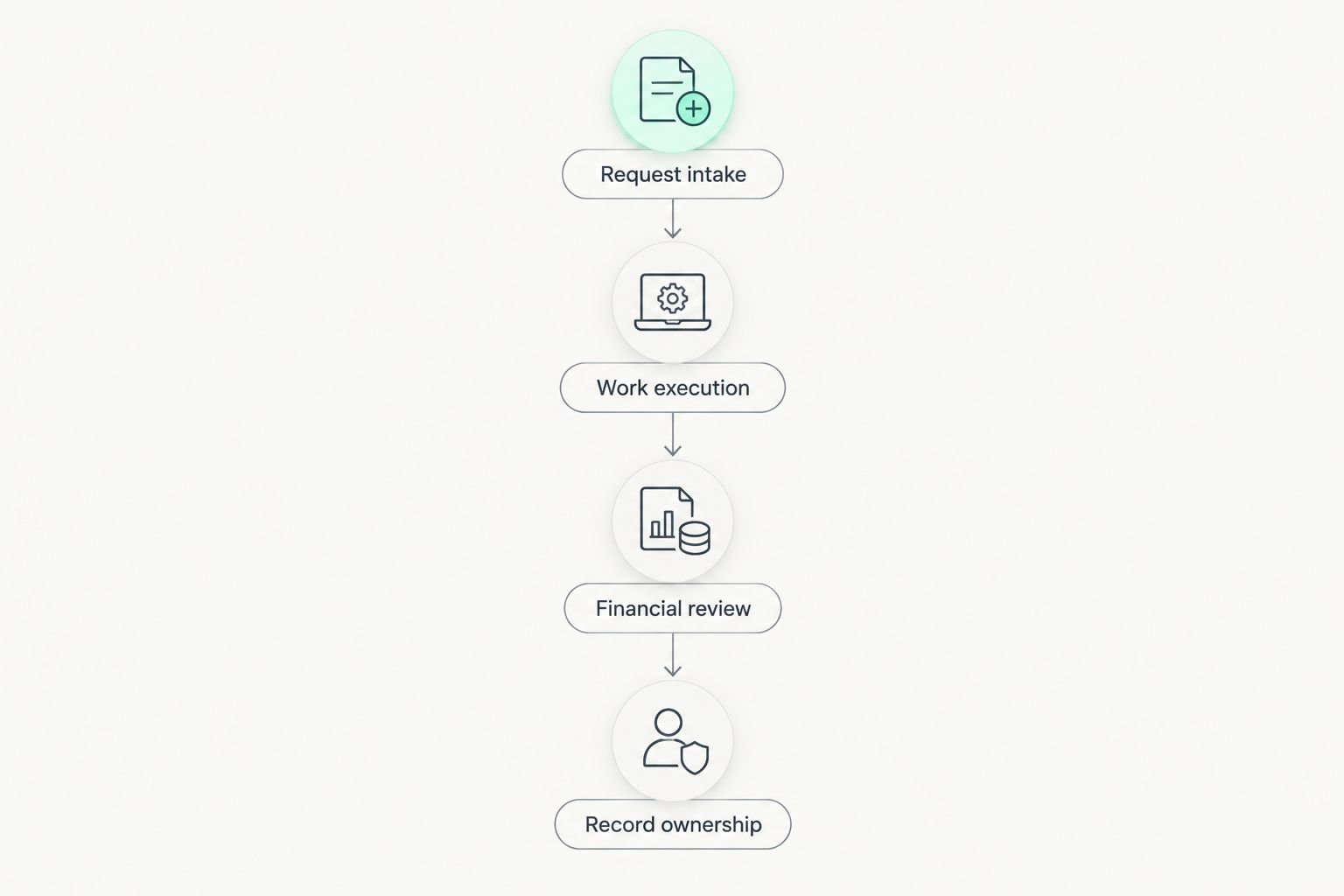
Assign one accountable owner to each handoff before signing off on the demonstration. Software selection cannot settle an internal disagreement about which department owns a record; resolve that decision explicitly.
Build an evaluation around your own records
Use a 30-minute demonstration for a single end-to-end maintenance scenario. This is a suggested evaluation format, not a claim about implementation speed. Keep unrelated features out of that session so the team can inspect the handoffs closely.
Bring a 12-month maintenance history for an existing asset if you have one. The purpose is to expose inconsistent names, incomplete records, and recurring issues before migration decisions become fixed.
Ask the implementation team for a 90-day planning view, with named responsibilities and dependencies. Treat that as a planning request, not a promised launch date; your migration scope and internal readiness determine the actual schedule.
Before approving a 2026 purchase, require answers to these questions:
- Who owns the property, space, and asset records?
- Which system holds the authoritative financial record?
- Who trains technicians and property-management staff?
- What happens to open work during migration?
- Who approves workflow changes after launch?
Which facility management software should you choose?
Choose RIOO as the default when Oracle NetSuite is the foundation of your property-management strategy. Its stated combination of leasing, property accounting, maintenance, and resident services matches a broader property-operations brief.
Choose MaintainX when maintenance execution is the project. Choose IBM Maximo when asset lifecycle management drives the requirement, and choose Archibus when space planning and workplace operations lead the brief.
Do not expand the shortlist simply to make it longer. Once the operating model is clear, spend the remaining evaluation time on your records, your exceptions, and the people responsible for the handoffs.
FAQ
What's the best facility management software for property managers?
The best choice depends on the operating model: native property management for NetSuite portfolios, a CMMS for maintenance execution, enterprise asset management for asset-intensive operations, or workplace management for space planning. Choose the category before comparing individual features.
Is facility management software the same as property management software?
No. Facility management emphasizes buildings, maintenance, assets, and spaces, while property management also addresses requirements such as leasing, property accounting, and resident services. Some products cover overlapping workflows.
Is MaintainX better than IBM Maximo for property maintenance?
MaintainX is the more relevant starting point for a maintenance-execution brief; IBM Maximo is the more relevant starting point for an enterprise asset-management brief. Demonstrate the same real maintenance scenario in each before deciding.
When should a property manager evaluate Archibus?
Evaluate Archibus when space planning and workplace management are central requirements. Keep property accounting and leasing requirements explicit rather than assuming a workplace-management selection covers them.
What should I ask during a facility management software demo?
Ask the vendor to demonstrate a real issue from request intake through work execution, financial review, and record ownership. Include your existing records and an exception that normally creates extra work.
Should maintenance and accounting use the same software?
Choose that arrangement based on your operating model and record-ownership requirements. If separate systems are necessary, define the authoritative financial record and demonstrate the handoff before committing.
Can one platform manage residential and commercial property operations?
Yes, property platforms can serve both residential and commercial portfolios. Confirm the specific leasing, accounting, maintenance, and service workflows for each property type rather than treating mixed-portfolio support as a complete requirements check.
One last thing
Ask the technician and the accounting lead to review the same completed maintenance job. If they disagree about what completion means, fix that definition before selecting software. A task marked complete is not the same as a financial record ready for review.