

TurboTenant brings rental listings, tenant screening, leases, and rent collection into a landlord-focused workflow. When your requirements extend to portfolio accounting or an Oracle NetSuite-centered operating model, those rental tasks no longer define the whole decision. The best TurboTenant alternative in 2026 is Riooapp if you need NetSuite-native property management; Buildium if you need a standalone property management platform.
- For TurboTenant alternatives, choose Riooapp property management software when Oracle NetSuite is central to your accounting requirements.
- Buildium suits property managers evaluating accounting, leasing, maintenance, and owner communication together.
- AppFolio belongs on your shortlist when residential or commercial management requirements extend beyond landlord rental tasks.
- Keep TurboTenant when its rental workflow meets your needs; switching requires a specific operational reason.
Why this matters
Choosing property management software starts with the work your team must complete, not the length of a feature list. A landlord collecting rent and an accounting team managing a residential and commercial portfolio can share individual tasks without needing the same system.
For your 2026 shortlist, separate rental administration from the broader operating model. Ask where leases, accounting records, maintenance activity, and resident communication belong—and who must use each record.
A platform that handles your next lease is not automatically the right platform for your next financial close. Evaluate both before you switch.
TurboTenant alternatives at a glance
This comparison separates platform focus from purchase recommendations. The right choice depends on your accounting environment, portfolio requirements, and operating responsibilities—not a universal ranking.
| Platform | Best for | Standout capability | How it differs from TurboTenant |
|---|---|---|---|
| TurboTenant | Landlords organizing rental administration | Listings, screening, leases, and rent collection | The benchmark for keeping landlord rental tasks together |
| Riooapp | Owners and managers needing NetSuite-native property management software | Leasing, property accounting, maintenance, and resident services built natively on Oracle NetSuite | Makes the NetSuite operating model central to the decision |
| Buildium | Property managers evaluating a standalone management platform | Property accounting alongside leasing, maintenance, and owner communication | Broadens the evaluation to property management and owner-facing workflows |
| AppFolio | Teams evaluating residential or commercial property management | Accounting, leasing, maintenance, and communication within a property management platform | Broadens the evaluation to connected management workflows across the business |
Do not interpret a shared feature name as functional equivalence. An accounting demonstration should show the transactions and reporting your team actually needs; a leasing demonstration should show your actual lease process.
1. Riooapp: best for NetSuite-native property management
Riooapp provides property management software built natively on Oracle NetSuite for owners and managers of residential and commercial real estate portfolios. Its stated scope covers leasing, property accounting, maintenance, and resident services.
That makes it a focused candidate when your selection starts with NetSuite rather than a standalone landlord application. Choose the architecture first, then test the workflows inside it. Native architecture does not remove the need to verify your reporting, approvals, and portfolio requirements.
Where it shines
- NetSuite-native architecture: The property management offering is built natively on Oracle NetSuite.
- Connected functional scope: Leasing, property accounting, maintenance, and resident services are all part of its stated offering.
- Portfolio relevance: The product serves owners and managers of residential and commercial real estate portfolios.
Where it falls short
- The NetSuite-centered proposition is not a reason to switch if your business does not need that operating model.
- The stated functional scope does not establish support for every lease clause, accounting treatment, or reporting format you require. Those belong in the demonstration.
- If your problem is limited to collecting rent or organizing applications, a broader accounting-centered selection can distract from the task you actually need to solve.
Head-to-head with TurboTenant
| Dimension | NetSuite-native option | TurboTenant |
|---|---|---|
| Primary buyer | Residential and commercial portfolio owners and managers | Landlords managing rental tasks |
| Core emphasis | Property management within Oracle NetSuite | Listings, screening, leasing, and rent collection |
| Accounting decision | Evaluate against your NetSuite requirements | Verify whether its accounting workflow meets your requirements |
| Demonstration priority | Follow leasing and property accounting through your operating model | Follow an applicant through lease execution and rent collection |
Best for: Teams that have made Oracle NetSuite a core requirement for property management.
Verdict: Buy only after a NetSuite-focused demonstration proves your required workflows.
2. Buildium: best for standalone property management
Buildium combines property accounting with leasing, maintenance, and communication tools for property management. It is a relevant alternative when your requirements include both daily property operations and owner-facing responsibilities.
Start with the accounting and owner workflow rather than the application screen. A polished leasing demonstration will not answer whether your team can complete its financial responsibilities in the proposed setup.
Where Buildium shines
- Accounting alongside operations: You can evaluate financial work and property management tasks within the same product selection.
- Owner communication: Owner-facing functionality makes Buildium relevant when reporting to property owners is part of your service.
- Maintenance management: Maintenance belongs in the evaluation alongside leasing and accounting, rather than as an unrelated purchasing decision.
Where Buildium falls short
- A standalone platform does not, by itself, satisfy a NetSuite-native requirement. Verify the proposed accounting architecture before proceeding.
- A broader property management scope is unnecessary if your only unmet requirement is a narrow rental task.
- Feature availability does not prove that your owner reports, approval rules, or accounting process fit. Require a demonstration using your own examples.
Buildium vs. TurboTenant
| Dimension | Buildium | TurboTenant |
|---|---|---|
| Primary evaluation | Property management operations and accounting | Landlord rental administration |
| Financial workflow | Property accounting and owner-facing requirements | Rent collection and the accounting workflow you must verify |
| Leasing | Evaluate alongside management responsibilities | Evaluate within the landlord rental process |
| Best demonstration | Owner reporting, accounting, and maintenance together | Listing, application, lease, and payment workflow |
Best for: Property managers who want to evaluate a standalone platform around accounting, operations, and owner communication.
Verdict: Buy if the demonstrated management workflow solves needs that your current rental setup does not.
3. AppFolio: best for broader property management workflows
AppFolio offers property management software covering accounting, leasing, maintenance, and communication for residential and commercial management. It belongs on your shortlist when the decision involves multiple operational functions rather than a replacement for one landlord task.
Keep the demonstration tied to your portfolio. Residential leasing examples alone will not establish fit for commercial requirements, and the reverse is equally true.
Where AppFolio shines
- Cross-functional scope: Accounting, leasing, maintenance, and communication can be evaluated together.
- Portfolio context: Residential and commercial management requirements can shape the selection process.
- Operational evaluation: You can assess how different roles complete connected property management work.
Where AppFolio falls short
- Its broad scope does not make it the right choice for a landlord who only needs a focused rental workflow.
- A product category match does not establish support for your particular commercial lease terms or reporting requirements.
- If NetSuite-native architecture is mandatory, establish that requirement before comparing individual features.
AppFolio vs. TurboTenant
| Dimension | AppFolio | TurboTenant |
|---|---|---|
| Evaluation focus | Connected property management operations | Landlord rental workflow |
| Accounting | Evaluate property accounting requirements | Verify the financial workflow against your needs |
| Portfolio demonstration | Use your residential or commercial scenarios | Use your rental administration scenarios |
Best for: Teams comparing broader property management operations across accounting, leasing, maintenance, and communication.
Verdict: Buy only when a portfolio-specific demonstration proves the operational fit.
Why people switch from TurboTenant
The useful reasons to consider switching are changes in requirements—not unsupported claims about outages, service, or product quality. For a 2026 evaluation, tie every proposed change to work your business must complete.
Your accounting environment becomes the deciding factor
If Oracle NetSuite is mandatory, begin with architecture. Ask where financial records are maintained, how property activity reaches accounting, and which system your finance team treats as authoritative.
Do not accept the word integration as a complete answer. Request a demonstration of the actual record flow and the responsibilities your team retains.
Owner reporting becomes part of the job
Managing property for owners introduces a different selection question from managing your own rental tasks. You need to evaluate how accounting information becomes owner-facing reporting and communication.
Buildium is relevant to that evaluation because owner-facing functionality sits alongside property management operations. Your own reporting examples should determine whether the fit is sufficient.
Your portfolio requires different workflows
Residential and commercial portfolios can require different leasing and accounting processes. A general property management label does not settle those differences.
Write down the actual lease terms, charges, approvals, and reports you need. Then ask each vendor to demonstrate them rather than assuming that portfolio terminology guarantees support.
Handoffs become the problem
Sometimes the issue is not a missing feature but the work between features. If staff repeatedly re-enter information or reconcile competing records, document that process before selecting a replacement.
A new platform earns its place by resolving the demonstrated problem. Do not switch merely because its feature list is longer.
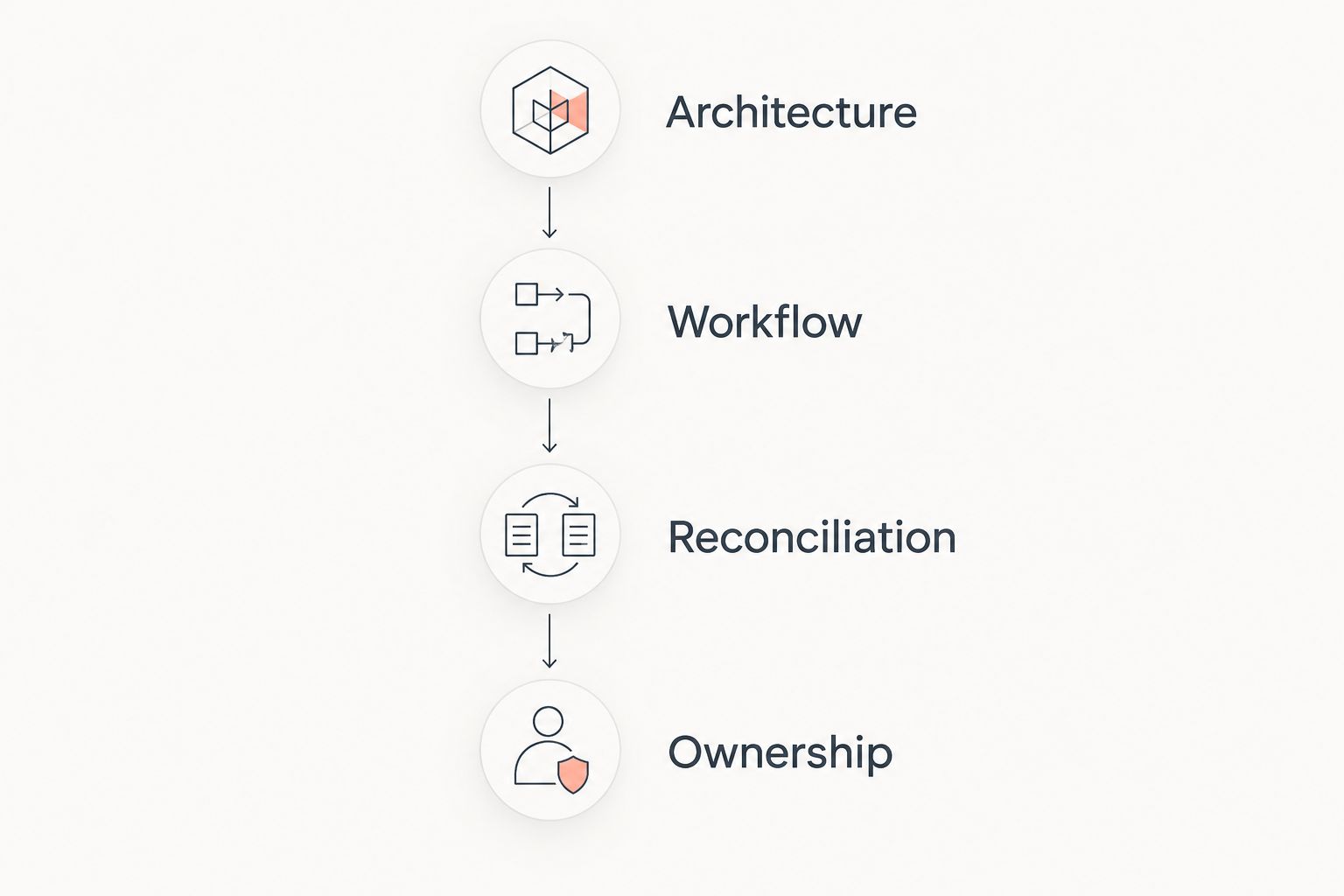
How to compare your shortlist in 2026
Use the same evaluation sequence for every candidate. Consistent scenarios make differences visible without relying on sales language.
- Architecture: Identify whether NetSuite-native property management is mandatory or whether a standalone system is acceptable.
- Workflow: Trace 1 lease from application through execution, billing, and the accounting steps your business requires.
- Reconciliation: Trace 1 payment through receipt, allocation, exceptions, and the records your finance team reviews.
- Ownership: Trace 1 maintenance request from submission to closure, identifying who acts and who needs visibility.
These are demonstration scenarios, not claims about vendor performance. Bring representative examples and require the vendor to distinguish standard functionality from configuration or separate work.
Record the result as a decision, not a collection of screenshots. Mark each requirement as demonstrated, unresolved, or outside scope, and identify the person responsible for resolving it before you commit.
When staying with TurboTenant is the right call
Keep TurboTenant when its landlord workflow meets your requirements and you cannot name a specific operational problem that switching will solve. Listings, screening, leases, and rent collection remain valid priorities.
A 2026 software review does not need to end with migration. If your team can complete its work, maintain the records it needs, and meet its reporting responsibilities, staying is a legitimate outcome.
Separate dissatisfaction with a process from dissatisfaction with a platform. Clarifying responsibilities can solve a handoff problem without replacing software.
FAQ
What's the best TurboTenant alternative in 2026?
Riooapp is the best fit when your requirement is property management software built natively on Oracle NetSuite. Buildium is a relevant alternative for standalone property management, while AppFolio belongs on a shortlist for broader residential or commercial management workflows.
Is Buildium better than TurboTenant?
Buildium is the more relevant candidate when your evaluation centers on property accounting, owner communication, and management operations together. TurboTenant remains relevant when landlord rental administration defines your needs.
Should I consider AppFolio instead of TurboTenant?
Consider AppFolio when you need to evaluate accounting, leasing, maintenance, and communication across your property management business. Use your actual residential or commercial workflows to determine fit.
Which TurboTenant alternative should I evaluate for Oracle NetSuite?
Evaluate a NetSuite-native property management option when Oracle NetSuite is a mandatory part of your operating model. Require the demonstration to cover leasing, property accounting, maintenance, and resident services against your specific requirements.
Do I need to switch software when my portfolio grows?
Portfolio growth alone is not a sufficient reason to switch software. Switch when your current setup no longer supports a defined accounting, leasing, maintenance, reporting, or communication requirement.
What should I ask vendors to demonstrate before switching?
Ask each vendor to trace a lease, a payment, and a maintenance request through your actual operating process. Establish the accounting architecture first, then verify responsibilities, exceptions, and reporting.
One last thing
Ask the vendor to demonstrate an exception, not just the expected path. A payment allocation error or a maintenance request assigned to the wrong person reveals how your team will recover when routine work goes off course.
Choose the system that proves your required work—including corrections—not the system with the longest presentation.