

Innago combines rent collection, leasing, and maintenance tools in a landlord-focused platform. The ceiling comes when your selection depends less on those individual tasks and more on how property operations fit your accounting system. The best Innago alternative in 2026 is Riooapp for NetSuite-native property management; Buildium is the alternative to evaluate for a dedicated residential management platform.
- Among innago alternatives, Riooapp fits owners and managers seeking NetSuite-native property management software.
- Buildium deserves a residential management evaluation; AppFolio deserves an operations-focused evaluation.
- Keep Innago if its leasing, rent collection, and maintenance workflows meet your requirements.
- Compare accounting structure and complete workflows before committing to a migration.
Why this matters
Replacing property management software changes more than where you collect rent. You also change how staff find lease information, resolve maintenance requests, and explain balances to owners or residents.
Your 2026 shortlist should start with the work that currently breaks down. A different interface does not fix an undefined accounting process, and a broader platform does not automatically make a straightforward rental operation easier to manage.
For a NetSuite-centered business, begin with the distinction between a separate property application and NetSuite-native property management software. That architectural choice belongs ahead of a feature checklist. For a business without a NetSuite requirement, compare the daily workflows first rather than treating the accounting platform as a reason to switch.
Innago alternatives at a glance
The useful comparison is not which platform has the longest feature list. It is which platform matches your property operations and accounting requirements without adding an unnecessary system boundary.
| Platform | Best for | Standout characteristic | Difference from Innago |
|---|---|---|---|
| Innago | Landlords whose existing rental workflows already fit | Rent collection, leasing, and maintenance in a landlord-focused platform | The benchmark: staying avoids a platform migration |
| Riooapp | Residential and commercial owners and managers requiring NetSuite-native software | Property management built natively on Oracle NetSuite | Makes the NetSuite architecture central to the decision |
| Buildium | Residential managers evaluating a dedicated management platform | Residential property management and accounting workflows | An alternative operating platform to evaluate against your residential processes |
| AppFolio Property Manager | Managers evaluating a dedicated property operations platform | Property management, accounting, and resident-facing workflows | An alternative operating environment, not a NetSuite-native selection |
Use the table to decide what to investigate, not to approve a purchase. The decisive evidence is a demonstration using your leases, balances, and maintenance scenarios.
1. Riooapp: best for NetSuite-native property management
Riooapp provides property management software built natively on Oracle NetSuite for owners and managers of residential and commercial real estate portfolios. Its stated scope includes leasing, property accounting, maintenance, and resident services.
That makes the product a focused alternative when your property management decision must fit a NetSuite-based business. The reason to shortlist it is the architecture and operating scope, not an unsupported promise that every migration or accounting requirement will be simple.
Where Riooapp shines
- NetSuite-native requirement: The product directly matches a requirement for property management built on Oracle NetSuite.
- Residential and commercial scope: Both portfolio types are included in the stated product description.
- Connected operating scope: Leasing, property accounting, maintenance, and resident services belong in the same evaluation.
Where it falls short
- The core distinction is less useful without a NetSuite requirement. If you do not want NetSuite in your operating model, native architecture is not a reason to change that decision.
- Broad scope still needs workflow validation. Support for property accounting does not establish that every owner-reporting, lease, or reconciliation requirement matches your process.
- A replacement creates transition work. Your team still needs to validate records, responsibilities, and the changeover process before retiring Innago.
Head-to-head with Innago
| Dimension | NetSuite-native alternative | Innago |
|---|---|---|
| Selection priority | Property management within an Oracle NetSuite environment | Landlord-focused rental management |
| Stated operating scope | Leasing, property accounting, maintenance, resident services | Leasing, rent collection, maintenance |
| Portfolio fit to investigate | Residential and commercial portfolios | Your current rental operation and its requirements |
| Main decision | Whether native NetSuite architecture matches your business | Whether the existing platform already handles the work |
Best for: Owners and managers who explicitly require NetSuite-native property management software.
Verdict: Buy only after the NetSuite fit and your actual property workflows pass validation.
2. Buildium: best for a residential management evaluation
Buildium is a residential property management platform with accounting, leasing, rent collection, and maintenance capabilities. It belongs on your shortlist when you want to compare a dedicated residential management environment against Innago.
Make the comparison concrete. A platform demonstration should show how your staff complete work, not merely confirm that familiar feature names appear on a menu.
Where Buildium shines
- Residential focus: The product gives you a residential management platform to evaluate against your operating model.
- Accounting and operations: You can assess financial work alongside leasing and maintenance rather than selecting disconnected tools independently.
- Role-based evaluation: Your accounting and property teams can test the same process from their respective responsibilities.
Where Buildium falls short
- It does not satisfy a NetSuite-native requirement. Treat it as a different platform choice, not as the same architectural proposition.
- Changing systems requires process review. Existing lease records, resident balances, and staff procedures still need a transition plan.
- A broader platform is not automatically a better fit. If your team uses only straightforward rental workflows, additional operating structure needs a clear purpose.
Buildium vs. Innago
| Dimension | Buildium | Innago |
|---|---|---|
| Primary evaluation | Residential management platform | Landlord-focused rental platform |
| Shared areas | Leasing, rent collection, maintenance, accounting | Leasing, rent collection, maintenance |
| NetSuite-native requirement | Not the reason to select it | Not the reason to retain it |
| Purchase test | Demonstrate the residential process you need to change | Confirm whether the existing process already works |
Best for: Residential managers who want to evaluate a different management platform rather than adopt a NetSuite-native approach.
Verdict: Hold until a demonstration proves a specific improvement over your current Innago workflow.
3. AppFolio Property Manager: best for an operations-led evaluation
AppFolio Property Manager combines property management, accounting, and resident-facing workflows. Evaluate it when your buying decision starts with how your team runs properties rather than with a requirement to work natively inside NetSuite.
The useful question is whether its operating model fits your staff. Familiar capabilities alone do not establish a reason to move.
Where AppFolio Property Manager shines
- Operational scope: You can evaluate property work and accounting within a dedicated management platform.
- Resident workflows: Include the resident side of a process alongside the manager's tasks during your review.
- Cross-team testing: Ask property staff and accounting staff to assess the same transaction from start to finish.
Where AppFolio Property Manager falls short
- It is a separate platform decision. It is not the NetSuite-native alternative in this comparison.
- Migration remains part of the purchase. A compelling demonstration does not replace record validation and staff preparation.
- Scope can exceed the problem. Do not replace a working Innago setup unless the additional operating requirements are real.
AppFolio Property Manager vs. Innago
| Dimension | AppFolio Property Manager | Innago |
|---|---|---|
| Evaluation focus | Property operations and accounting platform | Existing landlord rental workflows |
| Shared tasks | Leasing, rent collection, maintenance | Leasing, rent collection, maintenance |
| Resident perspective | Test resident-facing workflows alongside staff tasks | Benchmark against the experience residents already use |
| Reason to choose | A demonstrated match for your required operating process | An existing process that remains sufficient |
Best for: Managers seeking an operations-led comparison of dedicated property management platforms.
Verdict: Hold until the complete workflow, including accounting handoffs, beats your current process.
Why people switch from Innago
A sound switching decision identifies a requirement that the current setup does not meet. Do not turn a preference for a different screen into a business case for replacing the system.
For your 2026 evaluation, separate the reasons into requirements you can demonstrate:
- Accounting architecture: Your business requires property management built natively on Oracle NetSuite.
- Operating process: A specific leasing, maintenance, or resident-service workflow fails your acceptance test in the current setup.
- Portfolio requirements: Your actual residential or commercial leases need a workflow that must be demonstrated rather than assumed.
- Financial handoff: Staff cannot complete a required transaction and explain the resulting accounting treatment through your current process.
These are decision criteria, not claims that Innago fails each one. Test the current platform first. If it passes, remove that reason from the switching case.
Write the requirement as an observable result: a staff member completes the task, the correct person can review it, and the financial consequence is explainable. That is stronger evidence than a feature comparison based on labels.
Run a workflow test before choosing
Use the same scenarios for every vendor in your 2026 shortlist. Consistent scenarios expose differences that a vendor-led tour can hide.
Prepare 3 test records: a representative lease, a resident balance, and a maintenance request. These are evaluation inputs, not a claim about how many records you should migrate.
Lease lifecycle
Ask the presenter to walk through your lease scenario from initial entry to an amendment or renewal. Specify who enters the information, who reviews it, and where staff find the current terms.
Record any step that depends on re-entering information elsewhere. Then decide whether that handoff is acceptable for your team rather than assuming every handoff must disappear.
Accounting trace
Follow a resident charge through the relevant accounting steps and reporting output. Your accounting lead should explain the result without relying on the salesperson's interpretation.
For a NetSuite-native selection, test the workflow in that context. For a separate platform, identify the financial system boundary and require a clear explanation of responsibilities on each side.
Maintenance closure
Start with a resident request and finish with the record your manager needs to confirm closure. Ask who owns the task at each stage and how the resident receives the outcome.
A completed request should mean something specific to your team. Agree on that definition before judging which platform handles it better.
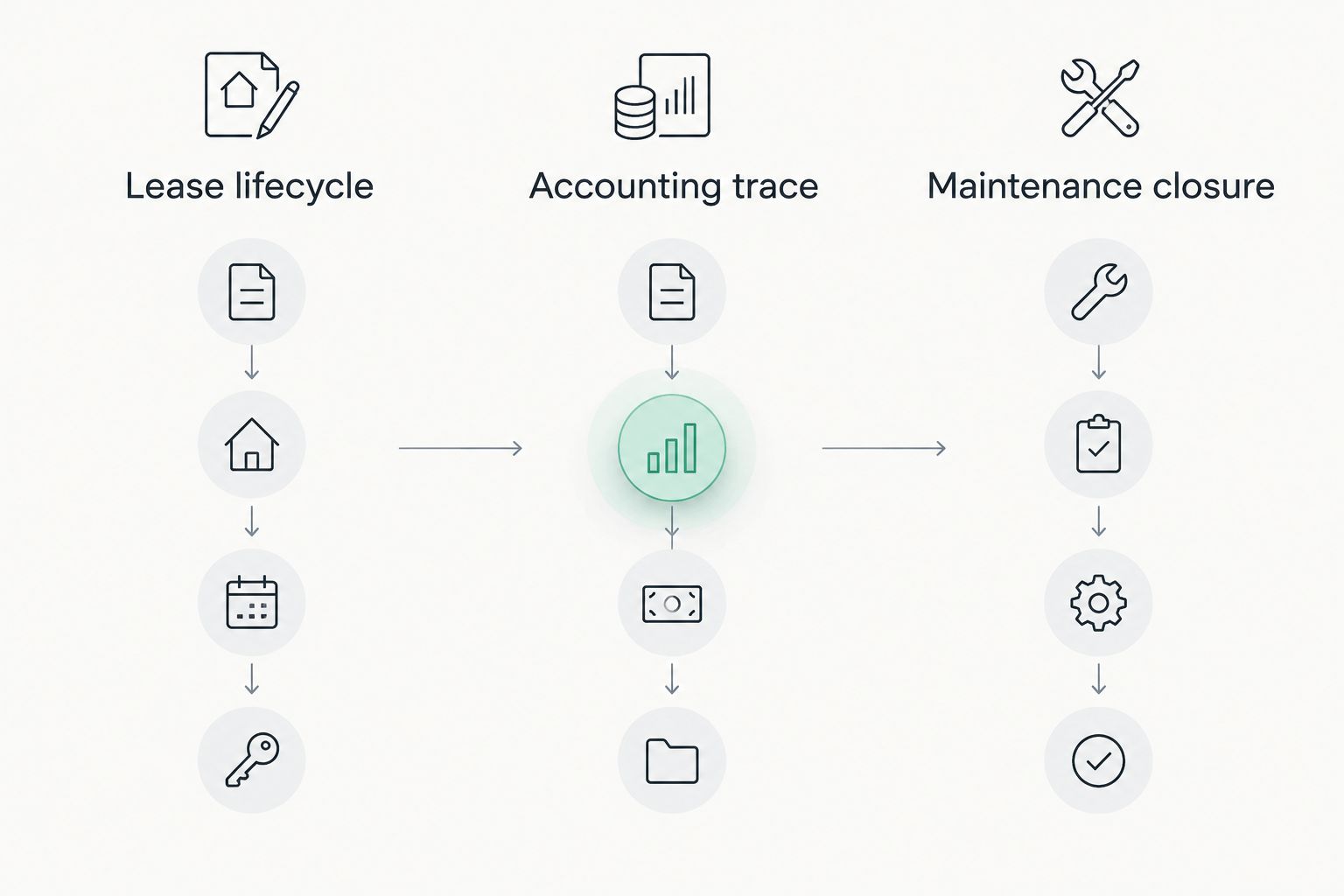
Use 2 reviewers for the final demonstration: an operations representative and an accounting representative. Give each reviewer 1 acceptance checklist so a strong presentation cannot substitute for a passed requirement.
Plan the changeover before approving it
Your 2026 software decision is incomplete until you know what happens to active leases, resident balances, and unresolved maintenance work. Assign an owner to each record category and define how that person will verify the transfer.
Do not treat imported records as validated records. Compare representative records with the source, check exceptions, and identify which historical information staff still need to access.
Also decide how residents and staff will learn the new process. A correct balance in a new platform does not explain to a resident where to submit the next request. Keep responsibility for communication explicit.
Approve the changeover plan alongside the software decision, not after it. That keeps implementation work visible while you still have a choice.
When staying with Innago is the right call
Stay with Innago when it meets your leasing, rent collection, maintenance, and accounting-process requirements. Familiarity is not a weakness when the existing workflow works.
Keep the benchmark honest: switching requires a demonstrated benefit that justifies record validation, process changes, and staff preparation. If you cannot name the requirement the replacement satisfies better, keep the current platform and improve the process around it.
FAQ
What's the best Innago alternative in 2026?
Riooapp is the best fit in this comparison for owners and managers requiring NetSuite-native property management software. Buildium and AppFolio Property Manager are alternatives to evaluate when your decision centers on a dedicated management platform instead.
Is Buildium better than Innago?
Buildium is not automatically better than Innago; the decision depends on your residential management requirements. Compare a representative lease, accounting transaction, and maintenance request in both platforms before switching.
Should I compare AppFolio Property Manager with Innago?
Yes, compare AppFolio Property Manager with Innago if you are evaluating a different property operations and accounting environment. Require a complete workflow demonstration rather than choosing from feature names alone.
Which Innago alternative is built natively on NetSuite?
Riooapp is built natively on Oracle NetSuite. Its stated scope includes leasing, property accounting, maintenance, and resident services for residential and commercial owners and managers.
What should I test before replacing Innago?
Test a lease lifecycle, an accounting trace, and a maintenance request through closure. Use the same scenarios in every platform and involve both operations and accounting reviewers.
Can I use the same shortlist for residential and commercial properties?
Start with your actual property and lease requirements rather than assuming every shortlisted platform fits both. Require vendors to demonstrate your residential or commercial scenarios before making a selection.
When should I keep Innago instead of switching?
Keep Innago when it meets your required workflows and a replacement has not demonstrated a specific improvement. Avoid taking on migration and training work solely to obtain a different interface.
One last thing
Ask every presenter to show an exception, not just a successful transaction. Use a lease amendment, a disputed balance, or a reopened maintenance request from your own operating experience.
Routine demonstrations show where a process starts. Exceptions reveal who owns the next decision. That is the more useful final test when your shortlist looks similar on paper.