

Best overall for association-focused accounting: CINC Systems. Best for mixed rental and HOA management: Buildium. Best for a NetSuite-based property operation: Riooapp. This 2026 guide compares the best HOA accounting software by accounting fit, management workflow, and the checks you should complete before selecting a system.
- CINC Systems leads this best HOA accounting software shortlist for association-focused management.
- Buildium suits managers handling both rental properties and community associations.
- QuickBooks Online fits general bookkeeping, not a complete HOA management workflow.
- Riooapp property management software is best suited to owners and managers operating on Oracle NetSuite.
- Require separate association records, reconciled bank accounts, and usable board reports before choosing.
Why this matters
An HOA accounting system must explain where association money belongs, what homeowners owe, and how recorded balances match the bank. Collecting payments is only part of the job. Your treasurer, manager, and accountant also need records they can review without rebuilding the books in spreadsheets.
Choose association accounting first and convenience features second. A polished resident experience does not compensate for unclear fund balances or reports the board cannot interpret.
The key distinction is between software built around community associations, general bookkeeping software, and broader property management systems. Each can belong on a shortlist, but each starts from a different operating model.
What makes the best HOA accounting software?
Use these six criteria to evaluate your 2026 shortlist before comparing demonstrations:
- Association separation: Keep each association's books, bank activity, and reporting distinct. Ask how users avoid posting transactions to the wrong association.
- Fund accounting: Demonstrate how operating and reserve activity remain identifiable. Match the accounting treatment to your accountant's requirements and governing documents.
- Homeowner balances: Trace assessments, payments, credits, and adjustments from the homeowner record into accounting reports.
- Bank reconciliation: Reconcile recorded activity to bank statements and investigate differences without hiding adjustments.
- Board reporting: Produce a balance sheet, income statement, budget comparison, and receivables detail that agree with one another.
- Controls and handover: Show permissions, transaction history, exports, and the process for transferring records when a manager or treasurer changes.
No feature checklist replaces a transaction demonstration. Ask the presenter to show the accounting entries behind a homeowner payment, not just the payment confirmation screen.
HOA accounting software at a glance
The ranking below assigns each option a distinct use case. It is a workflow-based shortlist, not a claim that every product meets every association's accounting requirements.
| Rank | Software | Best for | Standout fit | Key limitation or decision gate |
|---|---|---|---|---|
| 1 | CINC Systems | Association-focused management | Community association accounting and management focus | Confirm the setup and reporting match your association's practices |
| 2 | Buildium | Mixed rental and HOA management | Rental and association management in one product family | Rental workflows do not establish HOA accounting fit |
| 3 | AppFolio Property Manager | Management companies standardizing operations | Property and community association management scope | Check association-specific workflows separately from the wider platform |
| 4 | QuickBooks Online | Treasurer-led bookkeeping | General ledger and financial reporting | Not a complete HOA management system |
| 5 | Riooapp | NetSuite-based real estate operations | Property management built natively on Oracle NetSuite | Prove HOA-specific assessment and fund workflows before selection |
1. CINC Systems: best HOA accounting software for association focus
CINC Systems serves community association management, making it the most direct starting point on this list for an HOA-centered evaluation. Its accounting and management focus aligns with associations rather than treating the HOA as a rental property.
CINC Systems is the best starting point for managers seeking association-focused accounting software. Your demonstration should follow the association's accounting cycle, from assessment posting through reconciliation and board reporting.
CINC Systems pros:
- Community association management is central to the product's purpose.
- Accounting and association administration belong in the same evaluation.
- Its category focus gives you a direct basis for testing homeowner and board workflows.
CINC Systems cons:
- Association-focused software still requires a defined chart of accounts and posting rules.
- Product category alone does not establish that your reports, bank relationships, or data migration will fit.
Best for: HOA management teams prioritizing association-specific operations over a general rental-management starting point.
Ask the demonstrator to post an assessment, receive a partial payment, reverse an incorrect charge, and produce the resulting homeowner balance. Then compare that balance with the relevant accounting report.
Verdict: Buy only after CINC Systems passes your association's accounting demonstration.
2. Buildium: best HOA accounting software for mixed portfolios
Buildium serves rental property and community association management. That makes it a relevant option when your management company handles both types of business and wants to evaluate them within the same system.
The strongest reason to shortlist Buildium is portfolio overlap, not the assumption that rental accounting and HOA accounting are interchangeable. Association assessments, owner records, and board reporting need their own acceptance tests.
Buildium pros:
- Rental and community association management are both part of its product scope.
- Mixed-portfolio managers can evaluate a common operating environment.
- Accounting and management workflows can be reviewed together rather than as unrelated purchases.
Buildium cons:
- Rental-management suitability does not prove reserve-accounting suitability.
- Combining property types requires clear reporting boundaries and staff procedures.
Best for: Managers whose operating model includes both rental properties and community associations.
For a 2026 evaluation, prepare separate rental and HOA demonstration scripts. Require the HOA script to show homeowner assessments and association reports without relying on rental terminology to explain the result.
Verdict: Buy for mixed management only when the HOA workflow stands on its own.
3. AppFolio: best HOA accounting software for management standardization
AppFolio Property Manager includes community association management within its broader property management scope. Consider it when your buying decision includes how a management company organizes accounting and day-to-day work, not just how a treasurer maintains books.
Standardization needs evidence. Use the same accounting scenario across the associations you manage and check whether staff can complete it consistently with appropriate permissions.
AppFolio pros:
- Community associations sit within a broader property management offering.
- The evaluation can cover accounting alongside management operations.
- Management companies can assess shared procedures across their portfolio.
AppFolio cons:
- Broad platform scope makes an unfocused demonstration easy to mistake for accounting validation.
- A standardized process still needs exceptions for different association documents and accounting policies.
Best for: Professional management companies selecting a common operating system for association management teams.
Ask an accounting user and a property manager to complete different parts of the same workflow. Confirm that each can see what the role requires without gaining unnecessary authority over financial records.
Verdict: Buy when AppFolio demonstrates repeatable association workflows, not just broad functionality.
4. QuickBooks Online: best HOA accounting software for basic bookkeeping
QuickBooks Online is general accounting software, not a dedicated HOA management system. It belongs on this shortlist when bookkeeping is the primary requirement and your association has a separate, documented process for homeowner administration.
The decision is about operational boundaries. A general ledger can record financial activity, but it does not automatically provide an association's assessment, communications, approval, and homeowner-service workflow.
QuickBooks Online pros:
- General bookkeeping and financial reporting are its core purpose.
- It supports an accounting-first evaluation without requiring a broader property management decision.
- It creates a clear discussion with your accountant about ledger structure and reporting.
QuickBooks Online cons:
- It is not a complete community association management platform.
- Homeowner administration outside the ledger creates additional handoffs to control.
- Separate tools require a clear source of truth for balances and adjustments.
Best for: Treasurer-led associations seeking bookkeeping software rather than an integrated management platform.
Before choosing, write down where homeowner balances originate and who updates them. If the answer involves re-entering transactions in another system, include that work in your decision.
Verdict: Buy for bookkeeping; skip as a substitute for complete HOA management.
5. Riooapp: best property accounting fit for NetSuite operations
Riooapp property management software is built natively on Oracle NetSuite and handles leasing, property accounting, maintenance, and resident services for residential and commercial real estate owners and managers. Its strongest fit here is an organization whose property operation is based on NetSuite.
Riooapp is best suited to real estate owners and managers seeking NetSuite-native property management software. That is a distinct buying requirement from selecting a dedicated HOA accounting platform.
Riooapp pros:
- Oracle NetSuite is the native foundation of the software.
- Property accounting sits alongside leasing and maintenance.
- Residential and commercial portfolios are within its stated scope.
Riooapp cons:
- NetSuite alignment alone does not establish suitability for HOA assessment accounting.
- Buyers must validate operating and reserve reporting against their association requirements.
- A broad property management scope is not a reason to replace a satisfactory association-specific process.
Best for: NetSuite-based property owners and managers evaluating association needs alongside a wider real estate operation.
Use a demonstration to establish how association records, assessments, homeowner balances, and fund reporting would work. Keep the selection conditional on those results rather than treating native accounting architecture as proof of HOA fit.
Verdict: Hold until the HOA-specific workflow is demonstrated.
How the ranking works
This 2026 ranking prioritizes association focus, then separates the remaining options by operating model. Mixed rental management, management-company standardization, standalone bookkeeping, and NetSuite-native property operations solve different buying problems.
The comparison does not assign unverified performance scores. Your final selection should depend on completed accounting scenarios and reports your accountant accepts, not the order of a shortlist.
Run an accounting acceptance test
Use your own records for the final demonstration, with personal information removed. A polished sample account is not enough to establish whether your accounting process will work.
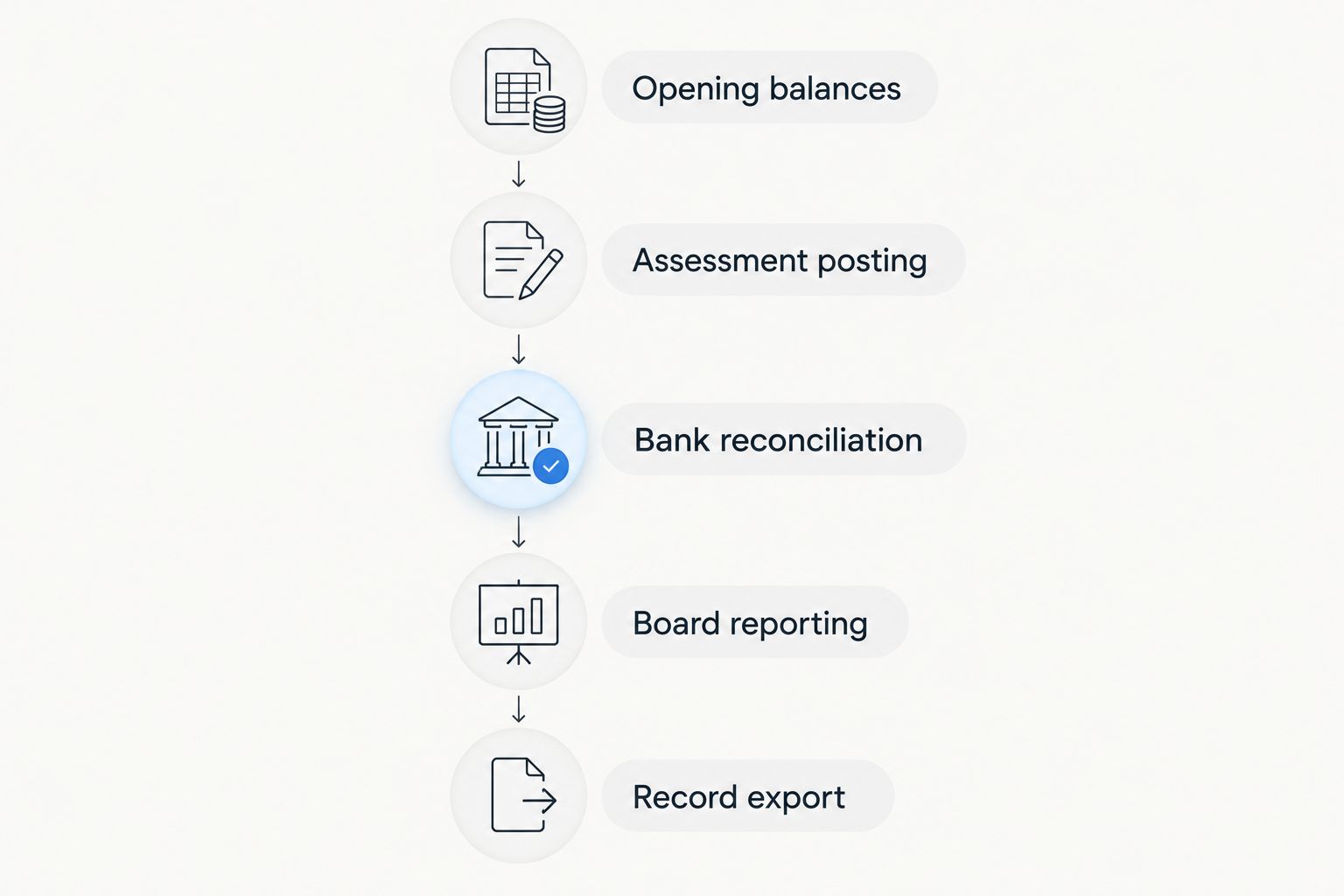
- Opening balances: Supply 12 months of historical activity and identify the balances that must carry into the new system.
- Assessment posting: Post an assessment, a payment, a credit, and a correction. Trace each transaction into the homeowner record and ledger.
- Bank reconciliation: Use 2 bank accounts representing operating and reserve activity. Reconcile them without unexplained balancing entries.
- Board reporting: Reproduce 1 closed month and compare the reports with your accepted records.
- Record export: Export the supporting records and confirm that another accountant can understand them.
These are recommended test inputs, not vendor capacity limits. Define who approves each result before the demonstration starts.
Document every unresolved issue against the relevant test. Separate configuration work from missing functionality, and identify who owns each correction before approving migration.
Which HOA accounting software should you choose?
Start with CINC Systems when association accounting is the central requirement. Choose Buildium for a mixed rental-and-association evaluation, AppFolio for management-company standardization, or QuickBooks Online when the requirement is bookkeeping rather than full HOA operations.
For a NetSuite-based organization, evaluate the native property management option against the same association tests. Do not relax your accounting requirements because the wider architecture fits.
Your 2026 decision should end with accepted reports, reconciled balances, and named responsibility for migration. A successful demonstration is evidence; a feature list is only a starting point.
FAQ
What's the best HOA accounting software in 2026?
CINC Systems is the first option on this shortlist for association-focused accounting. Buildium, AppFolio, QuickBooks Online, and NetSuite-native property management address different operating models, so choose against your association's accounting tests.
Can an HOA use QuickBooks Online?
An HOA can use QuickBooks Online for general bookkeeping, but it is not a complete HOA management system. Define how homeowner balances, assessments, and administrative records will be maintained alongside the ledger.
Is Buildium better than AppFolio for HOA accounting?
Neither is the automatic winner for every HOA. Evaluate Buildium for mixed rental and association management, and AppFolio for management-company standardization, then compare the same accounting scenarios.
Does HOA software need to separate operating and reserve money?
Your software should make operating and reserve activity identifiable and support the accounting treatment your association requires. Have your accountant confirm the setup against governing documents and applicable requirements.
What reports should an HOA accounting demonstration include?
Request a balance sheet, income statement, budget comparison, receivables detail, and bank reconciliation. Confirm that the balances agree and that each report can be traced to supporting transactions.
Should we choose HOA software just because it collects payments?
No. Payment collection does not establish accurate assessment posting, fund reporting, reconciliation, or board reporting. Test the accounting entries behind each payment.
What should we check before moving HOA accounting records?
Approve opening balances, homeowner balances, bank reconciliations, historical records, and export requirements before migration. Assign responsibility for correcting differences rather than carrying unexplained balances into the new system.
One last thing
Ask for a correction, not just a successful payment. Have the demonstrator reverse an assessment posted to the wrong homeowner after the original report has been produced.
The useful evidence is the correction trail: who changed the record, what changed in the ledger, and how the revised report explains the result. Make that demonstration part of your 2026 selection, not a problem discovered after migration.