

Best for NetSuite-based portfolios: Riooapp. Best for mixed-property operations: Yardi Voyager. Best for commercial-first evaluation: MRI Property Management. Best for multifamily specialization: RealPage. Best for residential workflow evaluation: AppFolio Property Manager. The best property management software for large portfolios in 2026 is the platform that fits your accounting architecture and property mix—not simply your unit count.
- Riooapp is the best property management software for large portfolios already committed to Oracle NetSuite.
- Shortlist Yardi Voyager for mixed-property operations and MRI Property Management for commercial-first requirements.
- Evaluate RealPage for multifamily specialization and AppFolio Property Manager for residential workflows.
- Require every finalist to demonstrate leasing, accounting, maintenance, and reporting against the same portfolio scenario.
Why this matters
A large portfolio creates more than additional leases. You must coordinate properties, ownership entities, operating teams, maintenance requests, and financial reporting without losing the connection between an operational event and its accounting treatment.
A strong leasing demonstration does not establish that a platform fits your finance team. An attractive financial dashboard does not establish that site teams can process renewals or resolve maintenance requests efficiently.
Choose the operating model before choosing the software. For your 2026 shortlist, decide whether property management belongs inside your existing financial system or in a separate platform connected to it. That decision changes the implementation scope and the questions every vendor must answer.
What makes the best large-portfolio property management software?
Evaluate each candidate against these six criteria before comparing individual features:
- Accounting architecture: Establish where transactions originate, where adjustments occur, and which system owns the financial record.
- Portfolio fit: Test your actual residential, commercial, or mixed-property requirements rather than accepting a generic demonstration.
- Entity controls: Demonstrate ownership structures, approval responsibilities, access restrictions, and reporting boundaries.
- Lease lifecycle: Follow a lease from initial setup through amendments, billing, renewals, and termination.
- Operational continuity: Connect maintenance and resident or tenant services to the records your teams already use.
- Implementation ownership: Identify who handles data conversion, configuration, integrations, training, and acceptance testing.
If Oracle NetSuite is already your financial foundation, start with the architectural distinction explained in the NetSuite-native property management software guide. Native functionality and a connection between separate systems are different arrangements; neither should be treated as a minor feature checkbox.
Large-portfolio software at a glance
These are use-case recommendations, not measured performance rankings. The table identifies where to start your evaluation and the trade-off to examine before committing.
| Software | Best for | Standout focus | Key limitation or decision boundary |
|---|---|---|---|
| Riooapp | Owners and managers using Oracle NetSuite | Property management built natively on NetSuite | Requires commitment to the NetSuite operating model |
| Yardi Voyager | Mixed-property portfolio evaluation | Property management and accounting across real estate categories | Broad coverage does not establish fit for every specialist workflow |
| MRI Property Management | Commercial-first portfolio evaluation | Commercial property management and accounting | Product and configuration scope require careful definition |
| RealPage | Multifamily-focused evaluation | Rental housing operations and related services | Multifamily relevance does not establish commercial workflow fit |
| AppFolio Property Manager | Residential workflow evaluation | Property management, accounting, and resident-facing workflows | Enterprise-specific requirements still need direct validation |
1. Riooapp: best for portfolios built around NetSuite
Riooapp provides property management software built natively on Oracle NetSuite. It handles leasing, property accounting, maintenance, and resident services for owners and managers of residential and commercial portfolios.
Riooapp is the best property management software choice for owners and managers who want property operations built natively on Oracle NetSuite. That recommendation rests on architectural fit, not an unsupported claim that one platform wins every category.
Riooapp pros:
- Native NetSuite architecture matches an existing NetSuite-centered software strategy.
- Leasing and property accounting fall within the stated scope.
- Maintenance and resident services extend coverage beyond finance.
- Residential and commercial portfolios are both within the stated audience.
Riooapp cons:
- A NetSuite-native approach is not the natural starting point if retaining another financial platform is mandatory.
- Native architecture alone does not establish that every specialized lease, ownership, or reporting requirement is covered.
Best for: Owners and managers treating NetSuite as their financial foundation and evaluating property operations within that environment.
For a 2026 evaluation, bring an actual lease amendment, a maintenance request, and a property-level accounting adjustment to the demonstration. Require the presenter to show each record through completion rather than stopping at its creation.
Verdict: Buy only after the NetSuite fit and your portfolio-specific workflows pass acceptance testing.
2. Yardi Voyager: best for mixed-property portfolio evaluation
Yardi Voyager is a property management and accounting platform used across real estate categories. It belongs on the shortlist when your evaluation spans different property types rather than a single residential workflow.
The key question is not whether the platform has a broad feature catalog. It is whether your required activities work together in the proposed configuration.
Yardi Voyager pros:
- Property management and accounting sit within the platform's scope.
- Its real estate coverage makes it relevant to a mixed-property shortlist.
- It provides a useful comparison against a NetSuite-native operating model.
Yardi Voyager cons:
- Broad category coverage does not prove that your specialist requirements are included in the proposed scope.
- Selecting a separate property platform introduces a financial-system boundary if NetSuite remains your accounting foundation.
Best for: Owners and managers comparing a dedicated property management environment across multiple real estate categories.
Ask the vendor to demonstrate the same reporting request across your residential and commercial examples. Separate the standard workflow from anything dependent on additional configuration or another component.
Verdict: Hold until the proposed configuration demonstrates your mixed-property requirements end to end.
3. MRI Property Management: best for commercial-first evaluation
MRI offers property management and accounting software for real estate, including commercial property operations. It is a relevant candidate when commercial leases and property accounting drive the buying decision.
Use your lease structure to organize the demonstration. A straightforward rent charge is not a substitute for showing the amendments, recoveries, and reporting obligations your team actually manages.
MRI Property Management pros:
- Commercial property management is part of its established scope.
- Accounting is directly relevant to the platform evaluation.
- A commercial-first shortlist can test lease administration alongside financial processes.
MRI Property Management cons:
- The MRI name alone does not define which products and components your implementation includes.
- Commercial capability does not establish that every residential or resident-service requirement fits the same proposed setup.
Best for: Commercial owners and managers whose decision depends on lease administration and property accounting requirements.
Require a written scope identifying the proposed components, responsibilities, and data exchanges. Then demonstrate a representative commercial lease through billing, adjustment, and reporting using that scope—not a broader product presentation.
Verdict: Hold until commercial lease requirements and implementation boundaries are demonstrated together.
4. RealPage: best for multifamily-focused evaluation
RealPage provides software and services for rental housing operations. It belongs on a multifamily shortlist when leasing, resident processes, and operating workflows are central to the selection.
For a large residential portfolio, evaluate the proposed combination of capabilities rather than assuming every product associated with the vendor is included. Keep the buying decision tied to a defined operating process.
RealPage pros:
- Rental housing is a central part of its market focus.
- Its portfolio of offerings supports a multifamily-specific evaluation.
- Resident and property operations provide relevant demonstration topics.
RealPage cons:
- A multifamily focus does not establish fit for complex commercial lease administration.
- A broad vendor portfolio requires explicit boundaries around included products and data movement.
Best for: Multifamily owners and managers prioritizing residential operating requirements in their platform selection.
Ask the vendor to follow a resident record from lease setup through a maintenance interaction and the associated financial reporting. Record which components participate and who resolves an inconsistency between them.
Verdict: Hold until the exact proposed solution passes your multifamily workflow tests.
5. AppFolio Property Manager: best for residential workflow evaluation
AppFolio Property Manager combines property management, accounting, and resident-facing functionality. It is a relevant comparison when residential operating workflows drive your shortlist.
Evaluate the work your teams repeat daily, then test the exceptions that reach finance or regional management. Ease during a standard demonstration is not proof of fit for your ownership structure.
AppFolio Property Manager pros:
- Property operations and accounting are both within its scope.
- Resident-facing workflows make it relevant to residential management.
- It provides a concrete alternative to an ERP-centered property management approach.
AppFolio Property Manager cons:
- General property management coverage does not establish support for your specific entity and approval structure.
- A separate platform requires a defined accounting boundary if your organization retains another financial system.
Best for: Residential managers comparing daily operating workflows alongside accounting requirements.
Have property staff and finance staff evaluate the same transaction. Require both teams to identify where corrections occur and how those corrections appear in reports.
Verdict: Hold until residential workflow fit and financial controls pass the same acceptance test.
How to test your shortlist before signing
Use a shared demonstration brief for your 2026 procurement process. Without one, each vendor shows its strongest workflow while leaving your hardest requirements unresolved.
Build a proposed test containing 3 properties, 2 ownership entities, and 1 reporting period. These are suggested test dimensions, not vendor capacity claims; replace them when a different sample better represents your portfolio.
Follow this sequence:
- Map ownership: Assign properties, entities, users, and approval responsibilities.
- Trace leases: Enter a lease, change a term, and inspect the resulting charges.
- Resolve exceptions: Correct a misapplied receipt or disputed charge and review the history.
- Close reporting: Produce property and entity reports for the same reporting period.
- Confirm responsibility: Document who maintains configuration, integrations, and support escalation.
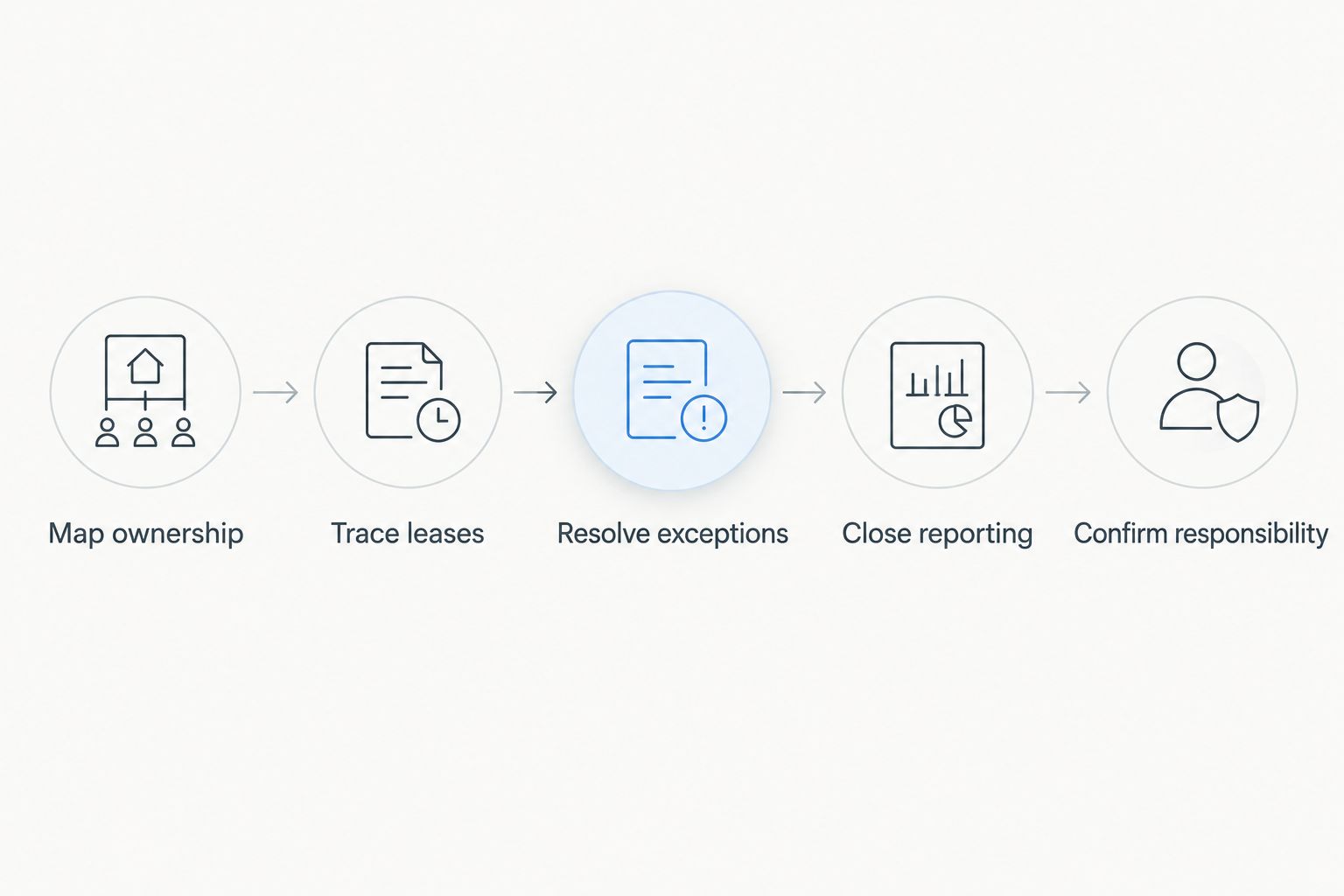
Require evidence for every acceptance criterion. A completed transaction, its approval record, and its appearance in the final report are stronger evidence than a presentation slide promising that the workflow is supported.
Include the staff who will use the system. Finance should assess corrections and reporting; property teams should assess lease changes, service requests, and the work required to keep records current.
How these recommendations were ranked
The order reflects fit against accounting architecture, property mix, lease workflows, operational coverage, and implementation boundaries. It does not represent hands-on testing, measured implementation outcomes, or a universal quality score.
The default recommendation favors an explicitly stated architectural match: a NetSuite-native platform for a NetSuite-centered organization. The other candidates occupy distinct evaluation slots so you can narrow your shortlist by operating requirements rather than brand familiarity.
Which platform should you choose?
For a NetSuite-centered portfolio, start with the native option. For mixed-property operations, evaluate Yardi Voyager; for commercial-first requirements, evaluate MRI Property Management; for multifamily specialization, evaluate RealPage; for residential workflows, evaluate AppFolio Property Manager.
Your 2026 decision should turn on demonstrated workflow fit and an agreed implementation boundary. Do not accept an unresolved answer about transaction ownership, corrections, or financial reporting simply because the leasing demonstration was convincing.
FAQ
What's the best property management software for large portfolios?
The best choice depends on your accounting architecture and property mix. Start with a NetSuite-native option when NetSuite is your financial foundation, then compare specialist platforms against the same operating requirements.
Is a NetSuite-native platform better than an integrated platform?
A NetSuite-native platform is the more direct architectural fit when property management must operate within NetSuite. A separate platform requires explicit decisions about data ownership, synchronization, corrections, and support responsibility.
Should a large portfolio use one system for residential and commercial properties?
Use one system only when it demonstrates both sets of requirements in the proposed configuration. Test commercial lease administration separately from residential leasing and resident services.
What should property managers ask vendors to demonstrate?
Ask vendors to demonstrate a complete lease-to-reporting workflow, including an exception and its correction. Include ownership entities, permissions, maintenance activity, and the final financial reports.
Does a large unit count prove a platform is suitable?
No. Unit count does not establish fit for ownership structures, approval rules, lease complexity, or accounting requirements. Evaluate those dimensions separately.
How should you compare vendors during a 2026 software review?
Give every vendor the same demonstration brief and acceptance criteria. Compare completed workflows and documented implementation responsibilities rather than unrelated feature presentations.
Who should approve the final property management software choice?
Finance and property operations should jointly approve the workflow results, with technical owners approving architecture and support responsibilities. Each group should sign off on the requirements it will own after implementation.
One last thing
Ask every finalist to correct a transaction after the reporting period has closed. The demonstration should show permissions, adjustment history, and the resulting reports—not just a successful initial entry. Choose the platform whose correction process your finance and operations teams can explain without relying on the presenter.