

DoorLoop brings leasing, accounting, payments and maintenance into a property management platform, but a broader feature list is not the same as a requirement to operate inside Oracle NetSuite. The best DoorLoop alternative in 2026 is Riooapp if you need NetSuite-native property management; Buildium if you want a residential-focused platform without making NetSuite the center of the decision.
- For DoorLoop alternatives in 2026, choose Riooapp when NetSuite-native property management is the deciding requirement.
- Consider Buildium for residential property management and AppFolio for residential and commercial portfolio operations.
- Keep DoorLoop when your leasing, accounting and maintenance workflows already meet your requirements.
- Compare property accounting and lease management through complete workflows, not isolated feature checkboxes.
Why this matters
Replacing property management software changes how your team records leases, collects rent, handles maintenance and closes the books. A replacement that looks better during a presentation still has to support those connected tasks after your records move.
Start with the requirement DoorLoop no longer meets. If that requirement is native operation within NetSuite, evaluate that architecture first; if it is a leasing or maintenance workflow, evaluate the workflow instead.
For a 2026 shortlist, separate necessary changes from preferences. A different dashboard is a preference; a required accounting environment is a selection constraint.
DoorLoop alternatives at a glance
The strongest shortlist compares different operating models rather than treating every property management platform as interchangeable. DoorLoop belongs in the comparison because staying is a valid outcome.
| Platform | Best for | Standout characteristic | How it differs from DoorLoop |
|---|---|---|---|
| DoorLoop | Teams whose current property workflows already fit | Leasing, accounting, payments and maintenance in a property management platform | The baseline: keep it when replacement does not solve a defined problem |
| Riooapp | Owners and managers requiring NetSuite-native property management | Built natively on Oracle NetSuite, with leasing, property accounting, maintenance and resident services | Makes the NetSuite environment central to the selection |
| Buildium | Residential property managers | Residential property management, including rental and association management | A residential-focused alternative to evaluate against your actual workflows |
| AppFolio Property Manager | Residential and commercial property managers | Property management across residential and commercial portfolios | Another portfolio-management option to assess against your operating requirements |
Do not read the table as a universal ranking. The right choice depends on the work your team must complete and the system in which your accounting needs to live.
1. Riooapp: best for NetSuite-native property management
Riooapp provides property management software built natively on Oracle NetSuite for owners and managers of residential and commercial portfolios. Its stated scope covers leasing, property accounting, maintenance and resident services.
That makes architecture the reason to shortlist it. If your selection starts with a NetSuite requirement, evaluate whether property operations fit that environment before comparing individual screens.
Where it shines
- NetSuite-native foundation: The platform is built on Oracle NetSuite, rather than presenting native operation as a separate integration question.
- Connected operational scope: Leasing, property accounting, maintenance and resident services are included in its stated remit.
- Residential and commercial relevance: The product serves owners and managers of both portfolio types.
Where it falls short
- Not a platform-neutral choice: A NetSuite-native product is the wrong starting point when your requirement is to avoid making NetSuite part of property operations.
- Breadth is not workflow proof: The stated functional areas do not establish that every lease exception, reporting requirement or approval process fits your business.
Ask for a demonstration using your own lease structure and accounting requirements. Do not treat the word native as proof that a particular report, permission or transaction behaves exactly as you need.
| Decision dimension | This alternative | DoorLoop benchmark |
|---|---|---|
| Operating foundation | Native Oracle NetSuite environment | Existing property management environment |
| Functional scope to demonstrate | Leasing, property accounting, maintenance and resident services | Your current leasing, accounting, payments and maintenance workflows |
| Portfolio fit | Residential and commercial owners and managers | The properties and processes you currently manage |
| Acceptance test | Required work completes within the intended NetSuite setup | Required work completes without replacing the current platform |
Best for: Owners and managers selecting property management software around an Oracle NetSuite requirement.
Verdict: Buy only when NetSuite-native operation is a requirement and the workflow demonstration passes.
2. Buildium: best for residential property management
Buildium is a residential property management platform serving rental and association management. It belongs on your shortlist when residential operations, rather than a NetSuite-native requirement, define the search.
The useful comparison is not whether Buildium has a familiar feature name. It is whether your staff can complete the same residential workflows with the controls and records you require.
Where Buildium shines
- Residential focus: Its product scope directly addresses residential property management.
- Rental and association context: It is relevant when your management work includes these operating models.
- A like-for-like evaluation: You can compare everyday property management tasks against your current DoorLoop process.
Where Buildium falls short
- Residential positioning is not proof of commercial fit: A residential-focused shortlist does not settle commercial lease requirements.
- It does not remove migration work: Switching platforms still requires you to establish how records, balances and open transactions will move.
Bring a real residential lease, an accounting exception and a maintenance request to the demonstration. A clean example proves less than an exception your staff handles regularly.
Best for: Residential managers comparing rental and association workflows against DoorLoop.
Verdict: Hold until Buildium demonstrates a specific improvement in the residential work that prompted your search.
3. AppFolio Property Manager: best for a portfolio-wide evaluation
AppFolio Property Manager serves residential and commercial property management. Include it when your decision needs to address operations across those portfolio categories rather than solve only a narrow leasing task.
Where AppFolio Property Manager shines
- Portfolio breadth: Residential and commercial management are part of its product scope.
- Operational relevance: It is a property management platform, not a general accounting product presented as a property system.
Where AppFolio Property Manager falls short
- Category coverage is not lease-level proof: Residential and commercial support does not establish that your particular lease clauses or accounting treatments fit.
- A broader evaluation requires discipline: Separate the workflows you need from capabilities that do not affect your decision.
Best for: Managers evaluating a replacement across residential and commercial operations.
Verdict: Hold until AppFolio Property Manager passes your portfolio-specific acceptance tests.
Why people switch from DoorLoop
A defensible reason to switch identifies a requirement and shows where the current workflow fails to satisfy it. It does not depend on assuming DoorLoop is a poor product.
For your 2026 decision, use these as qualification tests—not claims that every DoorLoop customer experiences the same problem.
You need a NetSuite-native operating model
A requirement to run property management natively on Oracle NetSuite changes the shortlist. Establish whether this is a firm architectural requirement or simply a preference for exchanging information with your accounting environment.
Those are different projects. Ask your finance lead to define which records and transactions must live in NetSuite before evaluating replacements.
Your actual workflow fails an acceptance test
Write down the task, the expected result and what prevents completion today. Examples to test include applying a payment, handling a lease amendment or closing a maintenance request with the necessary accounting record.
Switch only after the proposed replacement completes that same task correctly. A feature checklist cannot establish that result.
Your portfolio requirements have changed
Adding a different property type or management responsibility creates a reason to reassess software. It does not automatically create a reason to replace it.
Document the new requirement, test DoorLoop against it, and then test alternatives using identical records. This keeps the comparison tied to your business rather than the presentation style of each vendor.
How to evaluate the shortlist in 2026
Use 3 connected workflows and 4 acceptance checks. These are evaluation steps, not performance claims about any vendor.
Run these 3 workflows
- Lease lifecycle: Enter a lease, record a change and follow the resulting charges through the accounting process.
- Accounting close: Trace a charge, a payment and an adjustment into the records your finance team uses to close.
- Maintenance handoff: Open a request, assign the work and follow it through completion and the associated expense record.
Use representative examples from your portfolio. Remove resident identifiers and other sensitive information before sharing sample records with vendors.
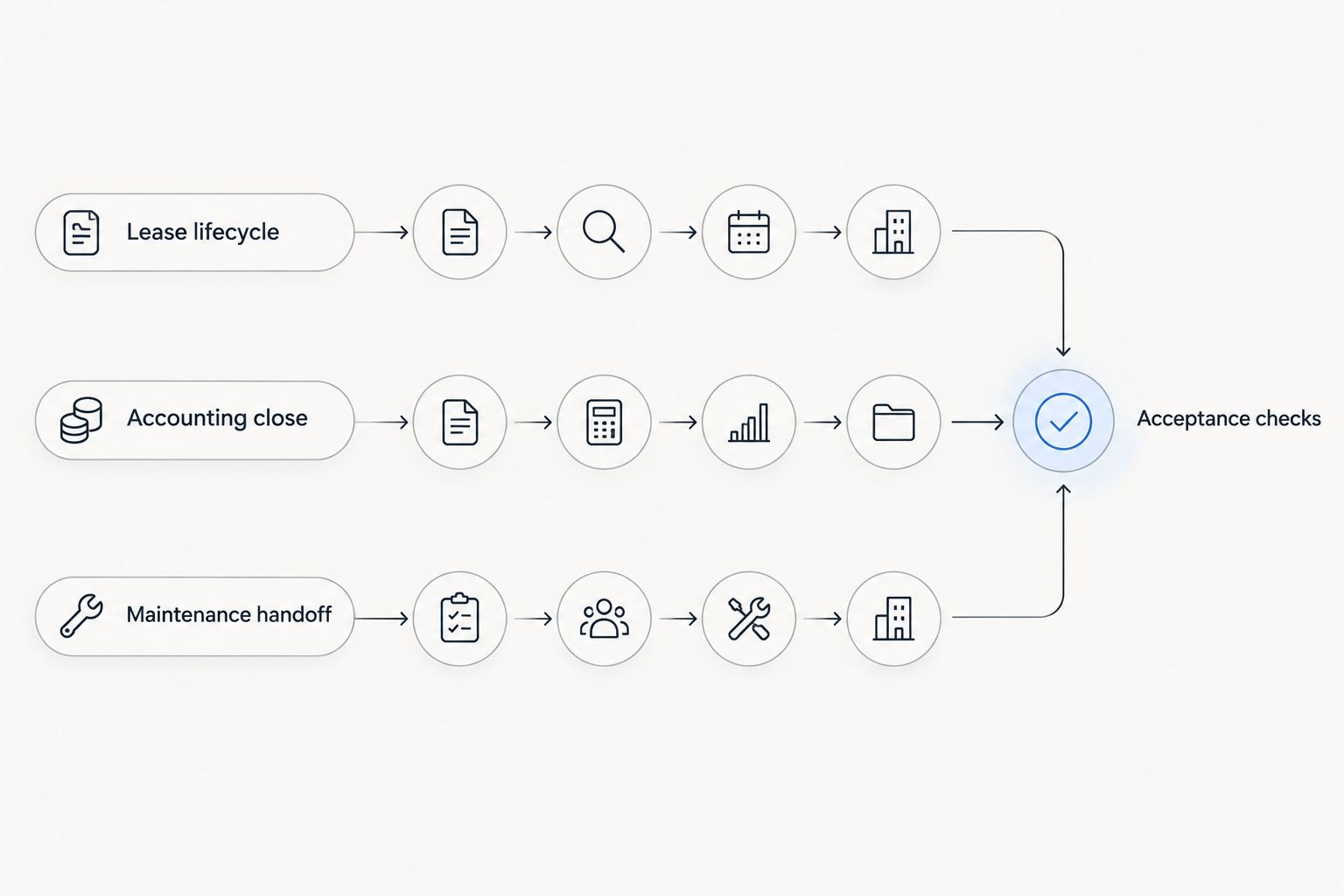
Apply these 4 acceptance checks
- Record continuity: Can your team follow the same transaction across the necessary operational and accounting records?
- Role ownership: Is it clear who creates, approves, corrects and completes the work?
- Exception handling: Can staff resolve the irregular cases your portfolio actually encounters?
- Reporting output: Does the completed workflow produce the information required by management and finance?
Record the outcome as demonstrated, not demonstrated or failed. Keep unanswered questions separate from failures; a missing demonstration is not evidence that a product lacks the capability.
The most useful 2026 comparison document is a list of completed tests with supporting records. Keep screenshots and sample outputs with each result so the final decision is not based on recollection.
Plan the change before committing
A replacement decision is incomplete until you know what will happen to your existing records. Ask each shortlisted vendor to explain the proposed transition using your actual record categories.
- Historical records: Identify which leases, statements, attachments and completed requests must remain accessible.
- Open transactions: Define how outstanding balances, deposits, credits and unpaid expenses will be represented.
- Responsibilities: Assign an internal owner to validate accounting records and another to validate operational records.
- Approval to switch: Require reconciliation of the agreed records before the replacement becomes the working system.
Do not assume that transferring a tenant list transfers the full accounting history. Specify the records you require and agree on how your team will verify them.
Keep an accessible copy of the information you must retain. Confirm retention requirements with the people responsible for your accounting and legal obligations rather than relying on a software demonstration.
When staying with DoorLoop is the right call
Stay with DoorLoop when it completes your required workflows and the alternatives do not demonstrate a necessary improvement. A replacement creates work even when the new product is suitable.
Revisit configuration and operating procedures before blaming a platform for an unclear process. If staff cannot explain who owns an adjustment or approves a maintenance expense, changing software does not answer that management question.
For 2026, make staying an explicit shortlist outcome. Require the replacement to solve the documented problem, not merely look different.
FAQ
What's the best DoorLoop alternative in 2026?
Riooapp is the best fit when your deciding requirement is property management built natively on Oracle NetSuite. Buildium and AppFolio Property Manager belong on the shortlist when residential or broader portfolio operations define the evaluation instead.
Is Buildium better than DoorLoop for residential properties?
Buildium is a residential-focused alternative, but that does not establish that it is better for your portfolio. Compare the same lease, payment, accounting and maintenance workflows before choosing.
Which DoorLoop alternative should I evaluate for NetSuite?
Evaluate a property management product explicitly built natively on Oracle NetSuite when native operation is mandatory. Ask the vendor to demonstrate your required transactions, reports and permissions inside the proposed setup.
Can I compare DoorLoop alternatives for commercial properties?
Yes. AppFolio Property Manager serves commercial as well as residential property management, but you still need to test your actual commercial lease requirements. Category coverage alone does not prove that a particular calculation or reporting process fits.
What should I ask during a property management software demo?
Ask the vendor to complete a lease lifecycle, an accounting close workflow and a maintenance handoff using representative examples. Check record continuity, role ownership, exception handling and reporting output.
Do I need to move all my historical property records?
Define the historical records you must retain before agreeing to a migration. Separate records that must enter the replacement system from records that need to remain accessible in an archive.
When should I stay with DoorLoop instead of switching?
Stay with DoorLoop when it meets your required workflows and no replacement demonstrates a necessary improvement. Treat a documented operational or architectural requirement as the reason to switch, not a different interface.
One last thing
Ask your accounting lead to bring an unresolved transaction to the final demonstration. A disputed payment, lease adjustment or incomplete maintenance expense reveals more about workflow fit than another tour of the dashboard.
Then ask the proposed replacement to carry that transaction through to a usable record. If the demonstration ends before your team can verify the outcome, the selection test is not finished.