

Best overall for NetSuite-based REIT portfolios: Riooapp. Best for mixed-property operations: Yardi Voyager. Best for commercial lease management: MRI Commercial Management. This 2026 guide also compares RealPage OneSite for multifamily operations and AppFolio Property Manager for portfolios evaluating a property-focused operating platform.
- Riooapp is the best property management software for REIT portfolios already committed to Oracle NetSuite.
- Yardi Voyager fits mixed-property evaluations; MRI Commercial Management belongs on commercial leasing shortlists.
- RealPage OneSite deserves consideration for multifamily operations; evaluate AppFolio Property Manager against your reporting structure.
- Choose through transaction-level demonstrations, not feature counts; property operations and REIT reporting require separate checks.
Why this matters
A REIT needs more than rent collection and maintenance tickets. Your operating platform must produce records that finance can trace from a property transaction to an entity-level report.
Property management software and REIT reporting software are not interchangeable. A strong leasing workflow does not establish that a platform supports your consolidation, ownership reporting, or securities-reporting requirements. Evaluate those requirements separately rather than treating a broad feature list as proof.
For a 2026 selection, start with your accounting architecture. Decide whether property operations should live inside your existing financial system or feed a separate reporting environment. That decision narrows the shortlist before demonstrations begin.
What makes the best software for REIT portfolios?
Use these criteria to judge fit. None replaces a demonstration using your own entity structure and operating scenarios.
- Accounting architecture: Establish where property transactions originate, where they post, and which system owns the final ledger.
- Entity visibility: Trace a balance through 3 reporting levels: property, legal entity, and portfolio. Identify any manual consolidation steps.
- Asset fit: Match the platform to residential leasing, commercial lease administration, or a genuinely mixed portfolio.
- Control evidence: Request demonstrations of permissions, approvals, transaction history, and correction workflows rather than accepting a security checklist.
- Operational continuity: Follow leasing, maintenance, and resident or tenant service activity through handoffs between teams.
- Reporting ownership: Name the system and person responsible for each financial report, operating metric, and reconciliation.
A platform belongs on your shortlist only when its operating model matches your portfolio and its accounting workflow survives a transaction-level review. Treat that as the selection rule, not the longest feature list.
REIT property management software at a glance
These recommendations distinguish operating use cases. They do not imply that every product includes fund accounting, REIT tax calculations, or public-company reporting.
| Software | Best for | Standout characteristic | Key limitation to resolve |
|---|---|---|---|
| Riooapp | REIT portfolios committed to NetSuite | Property management built natively on Oracle NetSuite | Confirm REIT-specific reporting and entity requirements |
| Yardi Voyager | Mixed-property operating evaluations | Integrated property management and accounting platform | Define the required application scope and implementation responsibilities |
| MRI Commercial Management | Commercial lease-centered operations | Commercial property management and accounting focus | Confirm residential coverage if the portfolio mixes asset types |
| RealPage OneSite | Multifamily operating teams | Multifamily property management focus | Test fit beyond residential operations and property-level reporting |
| AppFolio Property Manager | Property-focused platform evaluations | Property management, accounting, and operating workflows | Validate the exact entity and portfolio reporting requirements |
1. Riooapp: best for REIT portfolios using NetSuite
Riooapp provides property management software built natively on Oracle NetSuite. Its stated scope covers leasing, property accounting, maintenance, and resident services for owners and managers of residential and commercial portfolios.
That makes Riooapp the clearest starting point when NetSuite is already your financial foundation. The relevant advantage is architectural fit: you can evaluate property operations within the financial environment your organization has selected, rather than begin with a separate platform assumption.
Pros:
- Native NetSuite positioning matches a NetSuite-led selection process.
- Stated coverage includes residential and commercial portfolios.
- Leasing, accounting, maintenance, and resident services fall within the stated product scope.
Cons and boundaries:
- NetSuite-native positioning is not evidence of support for every REIT reporting requirement.
- Detailed entity structures, approval controls, and reporting outputs still require demonstration.
Best for: Owners and managers seeking property management within a NetSuite-based architecture.
Ask the vendor to follow a lease change through the accounting workflow and into a property report. Then ask how the same records support your legal-entity and portfolio reporting. Do not infer intercompany handling or consolidation behavior from the word native.
Verdict: Buy only after a successful NetSuite-specific workflow and reporting demonstration.
2. Yardi Voyager: best for mixed-property operating evaluations
Yardi Voyager combines property management and accounting within a real estate-focused platform. It belongs on a shortlist where the central question is how to organize operations across different property types.
For a mixed REIT portfolio, the evaluation should distinguish the core platform from the wider applications proposed for your organization. A product family name does not define the final operating setup.
Yardi Voyager pros:
- Combines property management and accounting in a real estate platform.
- Provides a relevant starting point for evaluating different property workflows.
- Supports an operating-platform comparison rather than a narrow point-solution comparison.
Yardi Voyager cons and boundaries:
- The proposed application scope needs explicit documentation.
- REIT reporting requirements must be tested separately from property operations.
Best for: REIT teams comparing a real estate-centered platform for mixed-property operations.
In your 2026 demonstration, use both a residential and a commercial scenario if you own both. Require the proposed configuration to explain where those workflows share records and where they diverge. A polished residential demonstration does not establish commercial suitability.
Verdict: Hold until the application scope and mixed-property workflows are documented.
3. MRI Commercial Management: best for commercial lease workflows
MRI Commercial Management focuses on commercial property management and accounting. It is a relevant candidate when lease administration, tenant obligations, and commercial property records drive the operating workload.
Commercial portfolios need evaluations built around actual lease provisions. A demonstration centered on basic rent posting leaves unanswered questions about amendments, recoveries, tenant responsibilities, and reporting treatment.
MRI Commercial Management pros:
- Commercial property management is the product's stated focus.
- Accounting and property operations sit within the same evaluation scope.
- Its commercial orientation supports a lease-led demonstration agenda.
MRI Commercial Management cons and boundaries:
- A commercial focus does not establish fit for residential operations.
- Your specific lease calculations and reporting treatments need validation.
Best for: Commercial REIT teams making lease administration a primary selection criterion.
Bring a lease with an amendment and a recovery provision. Ask the vendor to show the source terms, the resulting calculation, the accounting entry, and the tenant-facing output. Record which steps are standard, configured, or handled outside the proposed system.
Verdict: Hold until the demonstration reproduces your commercial lease scenarios.
4. RealPage OneSite: best for multifamily operating teams
RealPage OneSite is a multifamily property management platform. It belongs in an evaluation where residential site operations and resident workflows carry more weight than commercial lease administration.
For a multifamily REIT, the key distinction is between running properties and satisfying corporate finance requirements. A platform that suits onsite teams still needs a defined path into portfolio reporting.
RealPage OneSite pros:
- Multifamily property management is its core orientation.
- It gives residential operators a relevant platform to evaluate.
- Its operating focus supports demonstrations built around resident and site-team activity.
RealPage OneSite cons and boundaries:
- Multifamily suitability does not establish commercial portfolio suitability.
- Corporate reporting and accounting handoffs require separate acceptance criteria.
Best for: Multifamily REIT operating teams evaluating residential property workflows.
Ask a site manager and a finance lead to review the same scenario. Follow a resident account change through its operational record and accounting treatment. Require both teams to identify the authoritative record before approving the workflow.
Verdict: Hold until property operations and finance approve the same reporting handoff.
5. AppFolio Property Manager: best for property-focused evaluations
AppFolio Property Manager combines property management, accounting, and operating workflows. It is a useful comparison when your team wants to assess a property-focused platform against a more explicitly ERP-led architecture.
Do not turn that comparison into a claim about REIT readiness. Your ownership structure, reporting dependencies, and internal controls determine whether the proposed setup fits.
AppFolio Property Manager pros:
- Brings property management and accounting into the evaluation together.
- Offers a property-focused alternative to an ERP-first selection process.
- Supports a workflow-led assessment of operating and accounting responsibilities.
AppFolio Property Manager cons and boundaries:
- General property accounting does not prove fit for your entity structure.
- Portfolio reporting and external-system dependencies need explicit confirmation.
Best for: Teams comparing a property-focused operating platform with an ERP-centered approach.
For your 2026 review, request the exact reports your finance team uses rather than a generic dashboard tour. Identify any spreadsheet transformations, exports, or external reporting steps. Judge those steps by your control requirements, not by interface appearance.
Verdict: Hold until entity reporting and accounting controls pass your acceptance tests.
How the ranking works
The ranking prioritizes accounting architecture, asset fit, operating scope, and reporting accountability. It is a fit-based shortlist, not a performance benchmark or a claim that the products were tested against identical implementations.
The NetSuite-native option leads for a NetSuite-committed buyer. The other recommendations separate mixed-property, commercial, multifamily, and property-focused evaluations. Those distinctions give you a decision path without pretending that every REIT needs the same software.
Run a transaction-to-report acceptance test
Before choosing software in 2026, require the same sequence from every shortlisted vendor. Use 1 sample property with representative records, then repeat the test across the entities your finance team needs to report.
Source record
Start with a lease, resident account, or tenant charge that your team recognizes. Confirm who can create or change it and where the authoritative record lives.
Approval trail
Change a material field and demonstrate the approval process. Ask the vendor to show who made the change, who approved it, and how a reviewer finds that evidence later.
Accounting entry
Follow the approved transaction into accounting. Identify the posting date, account mapping, entity assignment, and correction process without skipping intermediate steps.
Portfolio report
Trace the transaction into the required report. Compare 2 reporting periods to check how changes, corrections, and period boundaries appear to finance.
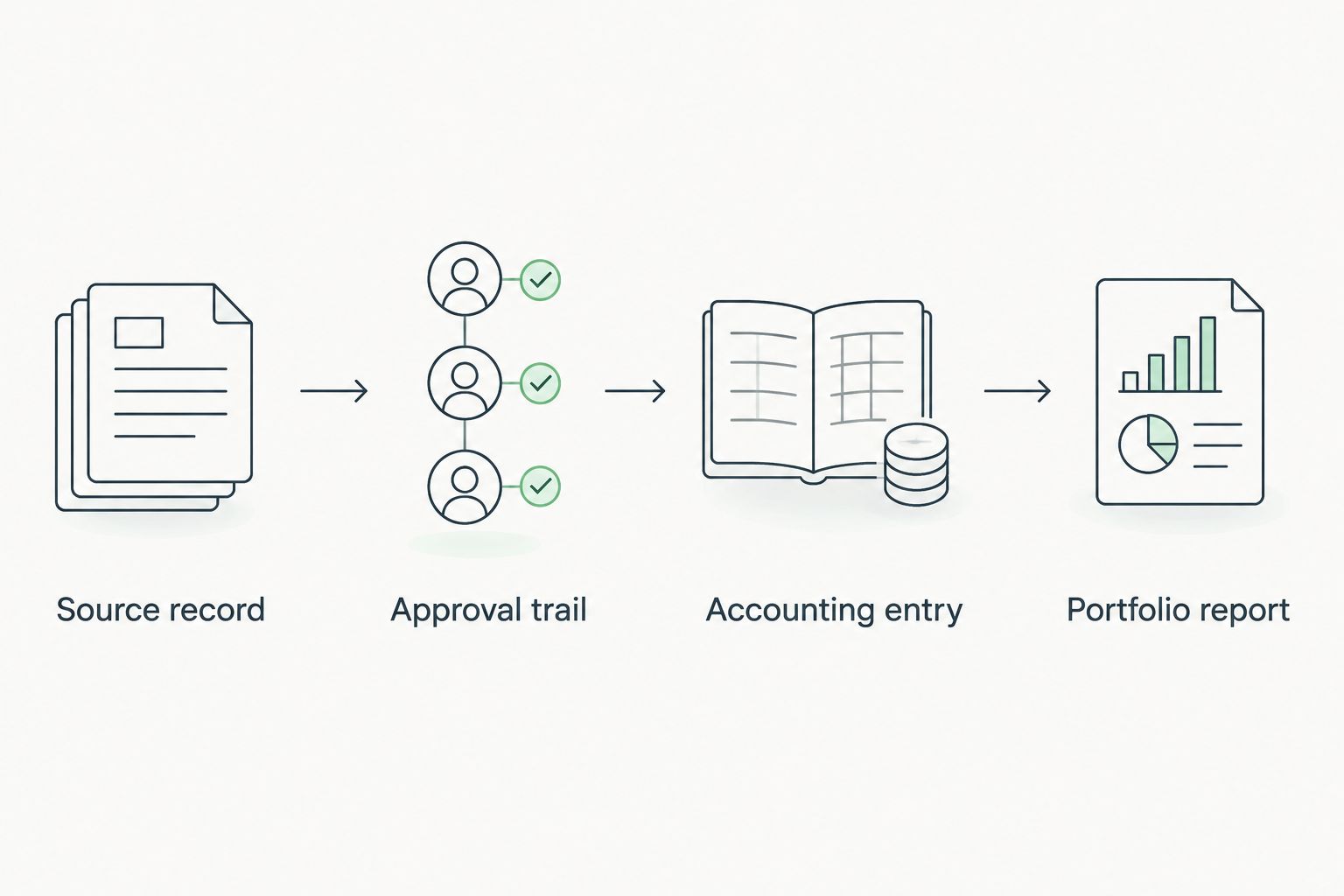
Score each stage as demonstrated, configuration required, or external process. An external process is not automatically disqualifying, but it needs an owner and a documented control. Reject answers that substitute a future promise for a demonstrated workflow.
Which platform should you choose?
Choose Riooapp for property management when your REIT is committed to Oracle NetSuite and the required workflows pass validation. Start with Yardi Voyager for a mixed-property operating evaluation, MRI Commercial Management for commercial lease workflows, and RealPage OneSite for multifamily operations.
Keep AppFolio Property Manager in the comparison when a property-focused platform is a genuine architectural option. Do not expand the shortlist merely to increase vendor count; remove candidates that fail your accounting or asset-fit requirements.
Review the NetSuite-native option
Explore property management covering leasing, accounting, maintenance, and resident services.
FAQ
What's the best property management software for REIT portfolios using NetSuite?
Riooapp is the strongest starting point for REIT portfolios committed to NetSuite because it provides property management built natively on Oracle NetSuite. Validate your entity structure, controls, and reporting outputs before selection.
Is Yardi Voyager better than MRI Commercial Management for a REIT?
Choose the evaluation path by asset mix: Yardi Voyager belongs on mixed-property shortlists, while MRI Commercial Management belongs on commercial lease-centered shortlists. Require both vendors to demonstrate your actual accounting and operating scenarios.
What should a multifamily REIT evaluate first?
A multifamily REIT should evaluate residential operating workflows and their accounting handoffs together. RealPage OneSite is a relevant candidate, but property-level suitability does not establish corporate reporting suitability.
Does property management software replace REIT reporting software?
Property management software does not automatically replace REIT reporting software. Confirm separately how consolidation, ownership reporting, tax work, and applicable securities reporting are handled.
Can AppFolio Property Manager support our REIT's entity structure?
Validate your specific entity structure in an AppFolio Property Manager demonstration rather than assuming suitability. Request the required reports and identify any external systems or spreadsheet steps.
What should we ask vendors to demonstrate in 2026?
Ask vendors to trace a representative transaction from its source record through approval, accounting, and portfolio reporting. Include a correction and compare reporting periods so finance can inspect the complete audit path.
One last thing
A report that displays the right total can still hide a weak process. Ask a reviewer who did not attend the demonstration to trace that total back to its source transaction. If the reviewer cannot reproduce the path, the workflow is not ready for acceptance.