

Best overall for a residential-management shortlist: Buildium. Best NetSuite-native option to evaluate: Riooapp. Best for a focused landlord workflow: Avail. The best rent collection software for property managers in 2026 is the system that connects tenant payments to accurate property accounting—not simply the one that accepts payments online.
- Buildium leads this residential shortlist for combining online rent collection with property-management accounting.
- Riooapp belongs on the NetSuite-native shortlist; verify payment processing and settlement workflows before selecting it.
- AppFolio suits teams evaluating rent collection alongside broader property operations.
- The best rent collection software for property managers must handle payment exceptions, ledger accuracy, and reconciliation.
Why this matters
A tenant submitting a payment and your accounting team closing the books are different milestones. Your evaluation needs to cover the steps between them: payment status, tenant allocation, bank settlement, and reconciliation.
For a 2026 selection, start with your accounting environment. A residential manager replacing several disconnected processes has a different buying decision from an owner already running financial operations on Oracle NetSuite. Choose the accounting fit first, then inspect the collection experience.
This guide separates full property-management platforms from a more focused landlord option. It also distinguishes confirmed product scope from capabilities you need demonstrated before signing.
What makes the best rent collection software?
Use these criteria to compare products against the same operating requirements:
- Payment visibility: Your team needs to distinguish submitted, pending, settled, and returned payments. Ask each vendor to demonstrate the statuses its system actually supports.
- Ledger accuracy: A receipt must reach the correct tenant, lease, property, and accounting period. Inspect how corrections affect the original entry.
- Reconciliation: Trace the relationship between tenant receipts, processor activity, and bank deposits. Do not accept a dashboard balance as proof of reconciliation.
- Exception handling: Test partial payments, overpayments, returns, reversals, and adjustments against your policies.
- Operating fit: Evaluate permissions, resident communication, reporting, and connections to your existing accounting environment.
For your 2026 shortlist, treat these as demonstration requirements rather than a checklist of promises. A feature name does not establish how the workflow behaves when something goes wrong.
Rent collection software at a glance
The order below prioritizes the NetSuite-specific use case first, followed by broader residential management and more focused collection needs. It is a fit-based ranking, not a measured performance leaderboard.
| Rank | Software | Best for | Standout scope | Key limitation or buying constraint |
|---|---|---|---|---|
| 1 | Riooapp | Owners and managers using Oracle NetSuite | NetSuite-native property management covering leasing, accounting, maintenance, and resident services | Payment processing, settlement, and exception handling require demonstration |
| 2 | Buildium | Residential managers seeking collection and accounting together | Online rent collection within a property-management platform | Broader scope than a payment-only requirement |
| 3 | AppFolio | Teams evaluating collection alongside property operations | Online payments within property-management software | Requires evaluation of the wider platform, not just its payment interface |
| 4 | Rent Manager | Teams prioritizing accounting workflow evaluation | Property-management accounting and electronic-payment workflows | Configuration and payment-service dependencies need close examination |
| 5 | Avail | Landlords seeking a focused rental-management workflow | Online rent collection alongside landlord-oriented rental tools | Not a substitute for validating complex portfolio-accounting requirements |
No platform wins merely by appearing first. Your accounting environment, property requirements, and payment policies determine the final choice.
1. Riooapp: best for NetSuite-native property management
Riooapp provides property management software built natively on Oracle NetSuite. Its stated scope includes leasing, property accounting, maintenance, and resident services for owners and managers of residential and commercial portfolios.
Riooapp is the best-fit property management shortlist candidate here for owners and managers seeking a NetSuite-native system. That is a platform-fit verdict, not confirmation of specific rent payment methods or processor capabilities.
Riooapp pros:
- Its native NetSuite foundation directly addresses that accounting-environment requirement.
- Its stated scope covers both residential and commercial portfolios.
- Leasing and property accounting sit within the described product scope.
Limitations and checks:
- Establish supported payment methods, processor relationships, and settlement handling during evaluation.
- Confirm how returned payments, corrections, and reconciliation work; native architecture alone does not answer those questions.
Best for: Owners and property managers who want their property-management selection anchored in Oracle NetSuite.
Ask for a complete rent-to-ledger demonstration using your entity structure. Follow a tenant receipt into property accounting, then inspect what happens when that payment is reversed. Do not assume that a native platform eliminates the need to examine permissions, configuration, or payment-service dependencies.
Verdict: Hold until the payment workflow is demonstrated; prioritize this candidate when NetSuite-native architecture is mandatory.
2. Buildium: best for residential collection and accounting together
Buildium is property-management software with online rent collection and accounting functionality. It belongs on the shortlist when you want tenant payments evaluated alongside the work of managing residential rentals.
The central buying question is whether its collection workflow matches your bookkeeping process. Review the connection between the resident payment experience and the records your accounting team uses.
Buildium pros:
- Online rent collection is part of its property-management scope.
- Accounting functionality makes it relevant to a collection-to-ledger evaluation.
- Its residential-management focus fits a broader operational selection.
Buildium cons and checks:
- A full platform evaluation is more involved than selecting a payment tool alone.
- Payment handling still needs testing against your bank setup, permissions, and allocation rules.
Best for: Residential property managers seeking one shortlist candidate for both collection and day-to-day management.
Ask the demonstrator to move beyond a successful payment. Inspect an incorrect allocation, a tenant balance adjustment, and the reports used to resolve discrepancies. The resident-facing interface is only part of the decision.
Verdict: Buy only after the collection-to-accounting demonstration passes; this is the default residential shortlist pick.
3. AppFolio: best for evaluating collection with property operations
AppFolio offers property-management software that includes online payments. Evaluate it when rent collection forms part of a wider decision about how your team manages properties and resident interactions.
A broader platform should be assessed through connected workflows. Your leasing, operations, and accounting users should each inspect the handoffs relevant to their responsibilities.
AppFolio pros:
- Online payments sit within a property-management environment.
- The platform scope supports evaluation beyond payment acceptance alone.
- It gives teams a candidate for a wider property-operations selection.
AppFolio cons and checks:
- A collection-only buyer must separate payment requirements from unrelated platform functions.
- Existing accounting and operational processes need a migration and compatibility review.
Best for: Property-management teams selecting a broader operating platform rather than an isolated rent payment tool.
Give each participating team the same sample tenant record. Ask who sees a payment issue, who can correct it, and which report proves that the correction reached accounting. A connected demonstration is more useful than separate departmental presentations.
Verdict: Hold until the wider operating workflow fits; skip a platform change justified only by its payment screen.
4. Rent Manager: best for accounting-led workflow evaluation
Rent Manager combines property-management accounting with operational functionality and electronic-payment workflows. It belongs on an accounting-led shortlist where the finance team needs to examine how collection activity reaches the books.
Focus your evaluation on the relationship between configuration, payment services, and reporting. A successful demonstration should make those boundaries explicit.
Rent Manager pros:
- Property-management accounting is central to its product scope.
- Electronic-payment workflows make it relevant to rent collection evaluation.
- Its broader management functions allow an operational review alongside accounting.
Rent Manager cons and checks:
- You must establish which services and configurations your proposed workflow requires.
- Your team still needs to validate reporting and exception handling against its own accounting process.
Best for: Property managers whose finance team will lead the collection-system decision.
Ask for a transaction trace rather than a tour of report names. Identify the originating receipt, the ledger entry, the settlement record, and the reconciliation evidence. Have the vendor explain any step that takes place outside the proposed system.
Verdict: Hold until accounting approves the transaction trace and service dependencies.
5. Avail: best for a focused landlord collection workflow
Avail provides landlord-oriented rental tools, including online rent collection. Consider it when the decision centers on managing rentals and receiving tenant payments rather than replacing a portfolio accounting environment.
Keep the evaluation proportional to your needs. A focused workflow still needs clear payment records and a workable handoff to whoever maintains your books.
Avail pros:
- Online rent collection is part of its stated category of rental tools.
- Its landlord orientation makes it relevant to a focused rental-management search.
- It provides an alternative to evaluating a broader property-management platform.
Avail cons and checks:
- Do not assume its accounting workflow matches complex entity or portfolio requirements.
- Confirm how payment records reach your accounting process and how exceptions are documented.
Best for: Landlords prioritizing a focused rental workflow over an enterprise property-accounting selection.
Test the records you would actually retain and share with your bookkeeper. If your decision depends on entity-level controls or specialized commercial accounting, evaluate those requirements separately instead of inferring them from online payment acceptance.
Verdict: Buy only when the landlord workflow fits; skip as a default answer to complex portfolio accounting.
How to test the collection-to-accounting workflow
For a practical 2026 demonstration, use sample records rather than live tenant information. Keep the scenario identical across vendors so differences remain visible.
Lease setup
Create 1 sample lease with the property, tenant, accounting period, and charge categories your team needs. Confirm who can change those fields and how changes are recorded.
Payment allocation
Enter 2 sample payments against that lease. Make one a partial payment and ask the vendor to show the remaining balance, allocation logic, and resident-facing record.
Bank matching
Compare 3 record types: the tenant ledger, the payment-service record, and the bank entry. Ask the vendor to explain differences in timing or amounts without manually rewriting the evidence.
Exception review
Reverse a sample receipt and inspect the resulting balance and accounting entries. Your team should understand both the correction and its history before approving the workflow.
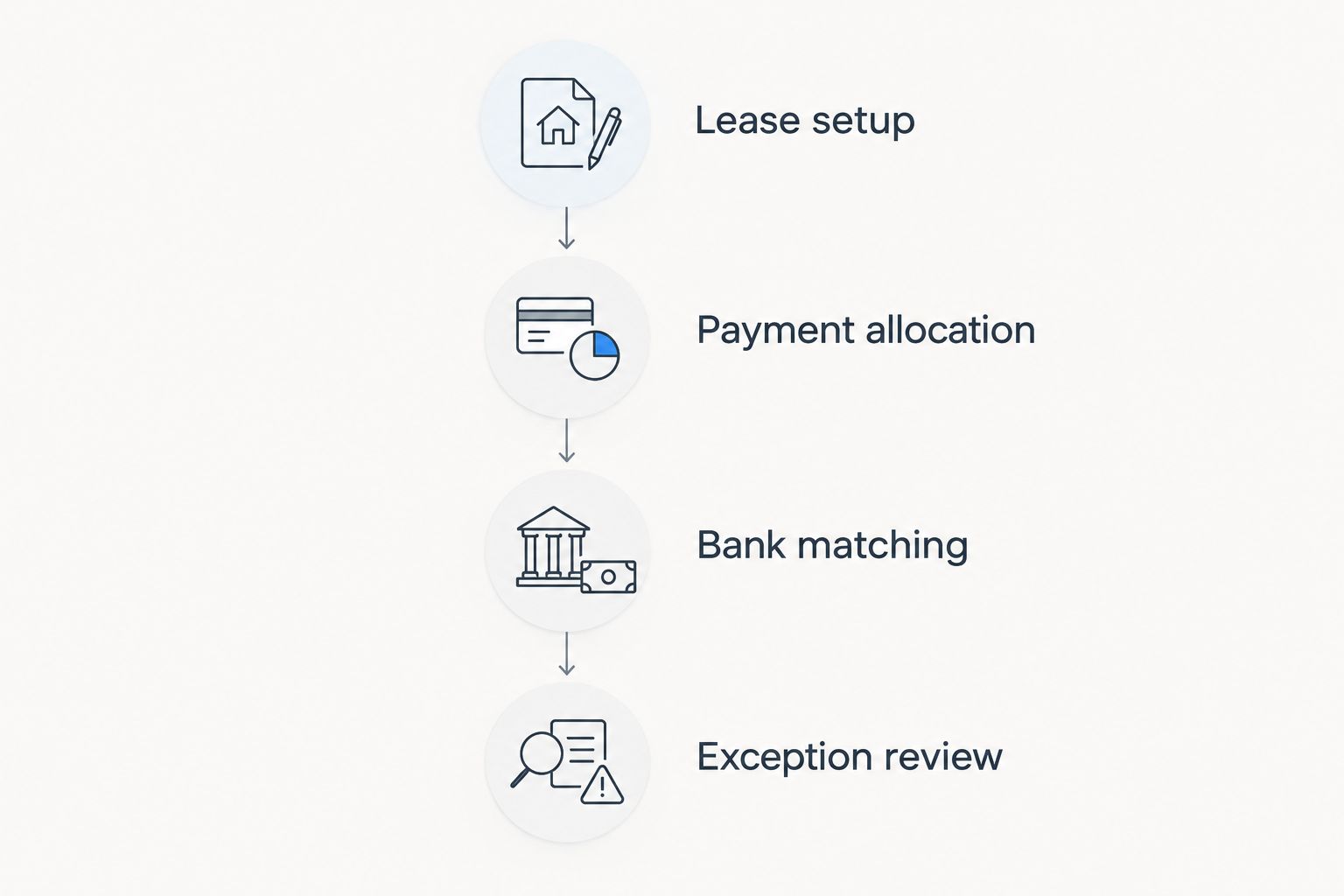
These are demonstration instructions, not performance benchmarks. A vendor passes when your responsible users can explain the resulting records and complete their work without an undocumented workaround.
How the shortlist is ranked
This 2026 ranking uses product scope and distinct buyer needs: NetSuite-native architecture, residential collection with accounting, broader property operations, accounting-led evaluation, and focused landlord workflows. It does not claim hands-on testing, measured processing speed, or customer-satisfaction results.
The deciding evidence belongs in your demonstration. Apply the same criteria to every candidate and document unresolved requirements before approving a purchase.
Which rent collection software should you choose?
Start with Buildium if you manage residential rentals and want collection and accounting evaluated together. Choose AppFolio for a wider property-operations evaluation, Rent Manager for an accounting-led selection, or Avail for a focused landlord workflow.
If Oracle NetSuite is your required foundation, start with the native candidate and insist on payment-specific proof. Do not replace a clear architecture requirement with a generic feature comparison.
FAQ
What's the best rent collection software for property managers in 2026?
Buildium is the default residential shortlist pick in this guide because its scope includes online rent collection and property-management accounting. Your final choice should pass a demonstration covering allocation, settlement, reconciliation, and payment corrections.
Which option should I evaluate if I already use Oracle NetSuite?
Evaluate the NetSuite-native property-management candidate first when that architecture is a requirement. Confirm payment methods, processing arrangements, settlement records, and accounting behavior rather than assuming native architecture answers those questions.
Is AppFolio better than Buildium for collecting rent?
Neither is a universal winner for rent collection. Compare the same tenant-payment and accounting scenarios, then choose the platform that fits your wider operating requirements.
Can rent collection software replace property accounting software?
Online payment acceptance alone does not replace property accounting. Verify ledger posting, corrections, bank reconciliation, reporting, and the accounting controls your organization requires.
What should I ask about partial rent payments?
Ask the vendor to demonstrate how a partial payment changes the tenant balance and reaches the ledger. Also confirm whether its controls support your policies and applicable legal requirements.
What happens when a tenant payment is returned?
The result depends on the platform and payment arrangement. Require a demonstration showing the payment status, tenant balance, accounting correction, and communication record.
Should I choose ACH or card payments for rent collection?
Choose supported payment methods after reviewing tenant needs, processing terms, settlement behavior, and your accounting process. Do not select software based on a payment-method label alone.
One last thing
For your 2026 decision, ask the vendor to finish its demonstration with a failed payment—not a successful one. A clean payment shows the expected path; a reversal exposes how your team will investigate, correct, and explain an exception.
Approve the workflow your accounting team can trace, not the interface your team finds easiest to watch.