

Landlord Studio gives landlords a rental-accounting and expense-tracking starting point. That focus stops being enough when your selection requirement is property management built natively on Oracle NetSuite. The best Landlord Studio alternative in 2026 is Riooapp if you need NetSuite-native property management; Buildium belongs on your shortlist if you want a rental-management platform without making NetSuite-native architecture your deciding criterion.
- For Landlord Studio alternatives, choose Riooapp property management software when Oracle NetSuite is central to your requirements.
- Shortlist Buildium for rental management; assess its workflows against your accounting requirements before committing.
- Keep Landlord Studio when rental accounting and expense tracking still meet your operational needs.
- Compare leasing, property accounting, maintenance, and resident services using your own records, not feature counts.
Why this matters
A replacement should solve a specific operating problem, not simply offer a longer feature list. Your decision changes depending on whether you need better landlord bookkeeping, broader property operations, or property management inside your finance platform.
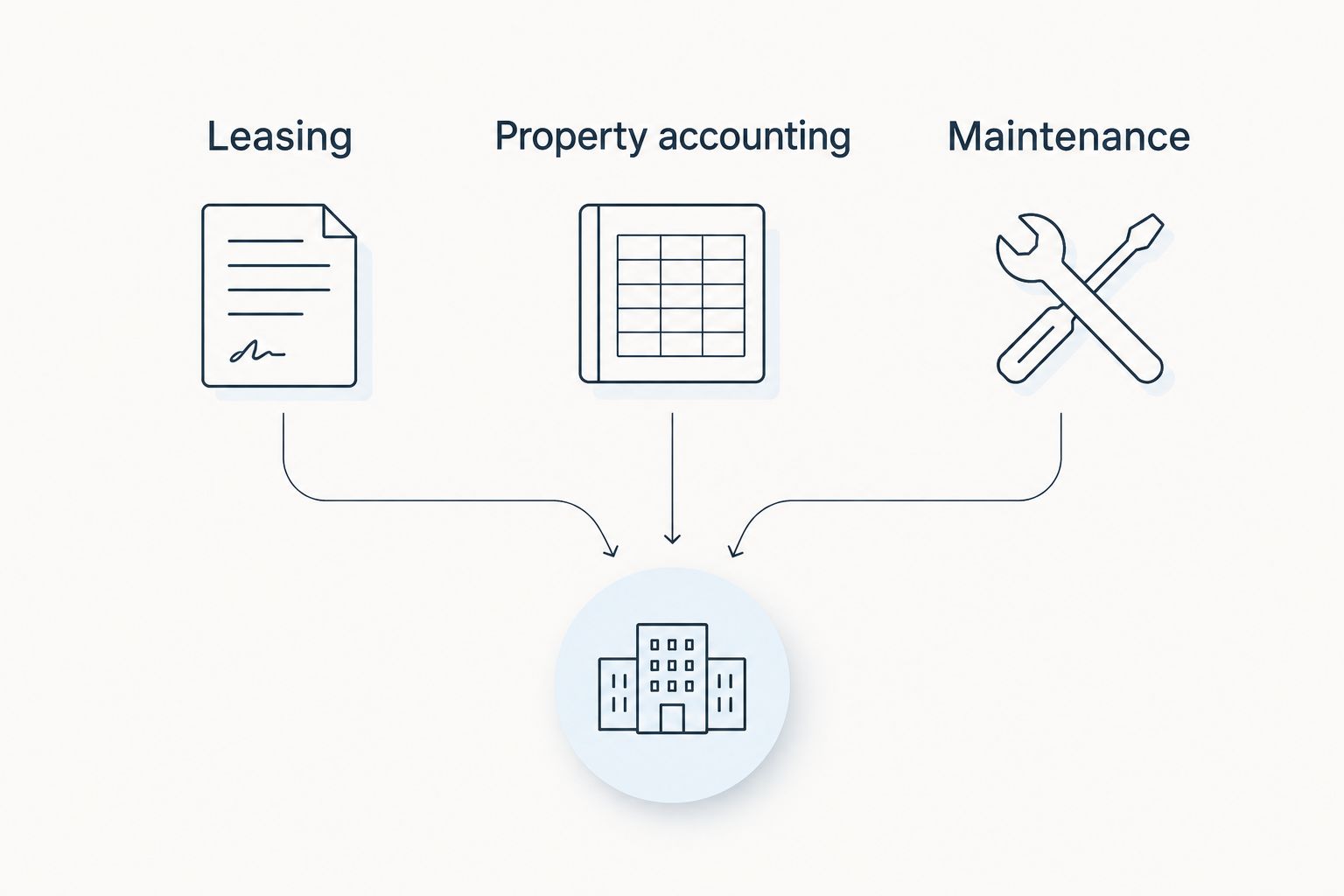
Riooapp provides property management software built natively on Oracle NetSuite for owners and managers of residential and commercial portfolios. Its stated scope covers leasing, property accounting, maintenance, and resident services. That architecture is the reason to evaluate it—not an assumption that every landlord needs an ERP-centered setup.
For your 2026 shortlist, separate two questions: what work must the system handle, and where must that work live? A product can cover familiar property-management tasks and still fail your architectural requirement.
Landlord Studio alternatives at a glance
This comparison separates the incumbent from two replacement candidates. It is a fit assessment, not a claim that the same product wins for every portfolio.
| Software | Best for | Standout focus | Difference from Landlord Studio | Main trade-off |
|---|---|---|---|---|
| Landlord Studio | Landlords prioritizing rental accounting and expense tracking | Landlord-focused financial records | The benchmark for deciding whether replacement is necessary | Keep it only if your required operating workflows are covered |
| Riooapp | Owners and managers seeking NetSuite-native property management | Leasing, property accounting, maintenance, and resident services built on Oracle NetSuite | Makes NetSuite-native architecture the central selection criterion | Poor fit if you do not want a NetSuite-centered approach |
| Buildium | Buyers evaluating a rental-management platform | Property-management workflows spanning accounting and operations | Offers another route to evaluate broader rental management | General workflow coverage does not establish suitability for your finance architecture |
Do not read the table as a migration recommendation by itself. The winning option must handle your records, approval responsibilities, and reporting requirements in a demonstration.
1. Riooapp: best for NetSuite-native property management
Riooapp property management software is built natively on Oracle NetSuite and serves residential and commercial portfolio owners and managers. Its scope brings leasing, property accounting, maintenance, and resident services into the selection conversation. Start here when NetSuite-native architecture is a requirement rather than a preference.
The distinction is architectural. An application built on your chosen finance platform addresses a different buying brief from a standalone landlord bookkeeping tool, but native architecture alone does not prove that every workflow matches your business.
Where it shines
- A clear platform requirement: Oracle NetSuite is explicitly part of the product's foundation.
- A defined operating scope: Leasing, property accounting, maintenance, and resident services are stated capabilities.
- Residential and commercial relevance: Both portfolio types are included in the product description.
- A finance-led evaluation: You can assess property operations against a NetSuite-centered operating model.
Where it falls short
- Wrong architectural priority: If you do not want NetSuite at the center of the decision, this positioning does not match your brief.
- More scope than a bookkeeping-only requirement: Leasing and resident-service coverage should not influence your choice if those functions are unnecessary.
- No substitute for workflow proof: The stated scope does not establish your exact approval rules, reporting outputs, or migration requirements.
Head-to-head with Landlord Studio
| Decision dimension | NetSuite-native option | Landlord Studio |
|---|---|---|
| Primary selection reason | Property management built natively on Oracle NetSuite | Rental accounting and expense tracking |
| Stated operating scope | Leasing, property accounting, maintenance, resident services | Evaluate against the landlord workflows you currently use |
| Portfolio brief | Residential and commercial owners and managers | Evaluate against your own rental-management requirements |
| Proof to request | A connected demonstration of your property and accounting processes | Evidence that your existing setup covers those same requirements |
Best for: Owners and managers whose property-management selection begins with Oracle NetSuite.
Verdict: Buy only after your required workflows pass a demonstration; skip if NetSuite-native architecture is not part of your brief.
2. Buildium: best for a rental-management shortlist
Buildium is a property-management platform covering rental accounting and operating workflows. Include it when you want to compare a rental-management system rather than make an ERP-native requirement the starting point.
Evaluate the actual work, not the category label. A leasing or accounting feature matters only when your team can complete its process and produce the required output.
Where Buildium shines
- A relevant comparison category: It belongs in a property-management evaluation rather than a generic bookkeeping shortlist.
- Accounting and operations together: Its product scope gives you both areas to examine during selection.
- A useful alternative brief: It lets you test whether broader rental management solves the problem that prompted your search.
Where Buildium falls short
- Category fit is not workflow proof: Property-management coverage does not establish support for your exact lease terms, accounting treatment, or approvals.
- Architecture still needs scrutiny: Do not treat an integration discussion as proof that an application is built natively on NetSuite.
- Breadth can distract: Additional functions offer no selection advantage when your only unmet need is a specific accounting task.
| Decision dimension | Buildium | Landlord Studio |
|---|---|---|
| Evaluation emphasis | Rental management across accounting and operations | Rental accounting and expense tracking |
| Reason to shortlist | You want to examine a broader operating workflow | You want to preserve a landlord-focused accounting approach |
| Deciding evidence | Your team completes the required process | Your current setup completes that process without an unresolved gap |
Best for: Buyers comparing rental-management platforms without a mandatory NetSuite-native brief.
Verdict: Hold until Buildium demonstrates the specific workflow your current setup cannot handle.
Why people switch from Landlord Studio
The sound reason to switch is a documented mismatch between your operating requirements and your current setup. These are decision triggers—not claims about customer churn, outages, or product changes.
NetSuite-native architecture becomes mandatory
If your property-management application must be built natively on Oracle NetSuite, start with that requirement. Do not spend the evaluation comparing incidental features before checking the architecture.
Distinguish native construction from data exchange. Ask the vendor to explain where records live, where users perform work, and how property activity reaches accounting.
Your buying brief expands beyond bookkeeping
A search that begins with expense tracking can become a selection for leasing, maintenance, and resident services. Write down which additional workflow you actually need before replacing the accounting tool.
Do not assume the incumbent lacks a capability because your team has not used it. Check the current setup first; replace it only when the requirement remains unresolved.
Your portfolio requires different evidence
A residential and commercial portfolio can bring different lease and reporting requirements into the same evaluation. A broad property-management label is not enough to settle those details.
Use the commercial real estate property management software guide to organize that separate buying brief. Bring representative records to the demonstration rather than asking whether a platform handles commercial property in general.
How to evaluate your 2026 shortlist
Use the same demonstration brief for every candidate. Consistent evidence makes the comparison useful; different sales presentations do not.
Start with an architecture gate
Decide whether NetSuite-native architecture is mandatory, preferred, or irrelevant. Make that decision before scoring individual features.
If it is mandatory, ask for an explanation of the application architecture before scheduling detailed workflow sessions. If it is irrelevant, give more attention to the operating tasks your team must complete.
Test 3 workflows from beginning to end
Use 3 workflows: Leasing, Property accounting, and Maintenance. Include resident communication wherever your process requires it. Choose examples from your own portfolio so the demonstration addresses real work.
- Leasing: Follow a lease record through the operating and accounting outputs your team needs. Ask who creates, checks, and changes the record.
- Property accounting: Follow a charge or expense through posting, review, correction, and reporting. Ask the demonstrator to show the result, not just the entry screen.
- Maintenance: Follow a request through assignment, completion, and any required financial handling. Include the communication your residents or tenants need.
These are test instructions, not promises that every candidate handles each step. Record a pass only when you see the required process completed.
Reconcile 2 accounting periods
Request a migration rehearsal covering 2 accounting periods: a closed period and a current period. This is a practical evaluation exercise, not a universal implementation requirement.
Compare opening balances, activity, and closing balances against your source records. Investigate differences before approving the migration approach; a successful import message is not accounting acceptance.
Use 1 property as a pilot
Choose 1 property with representative transactions and operating requirements. A simple demonstration record will not expose the exceptions your team handles in practice.
Include an exception such as a correction, a changed lease term, or a reopened maintenance request. Test whichever exception genuinely occurs in your portfolio rather than creating artificial complexity.
Assign acceptance owners
Give accounting responsibility for financial acceptance and operations responsibility for workflow acceptance. Ask both teams to identify the evidence they need before the demonstration.
Keep unresolved questions in the decision record. A verbal assurance should not become a passed requirement without an agreed explanation or demonstrated result.
Make the 2026 decision on evidence
Separate a mandatory requirement from a useful convenience. A failed mandatory requirement should stop the purchase; an unfamiliar screen should prompt a usability test, not an immediate rejection.
Use a short acceptance record for each candidate:
| Requirement | Evidence to capture | Decision rule |
|---|---|---|
| Architecture | Explanation of where records and processes live | Reject a mismatch with a mandatory platform requirement |
| Accounting | Reconciled demonstration outputs | Resolve unexplained differences before acceptance |
| Operations | Completed leasing and maintenance examples | Require the actual workflow, including exceptions |
| Ownership | Named responsibility for implementation tasks | Resolve unassigned work before committing |
Do not turn this into a feature-count contest. The right alternative is the one that completes your required work within your chosen architecture and gives your team an acceptable operating process.
When staying with Landlord Studio is right
Keep Landlord Studio if rental accounting and expense tracking still meet your needs and no mandatory requirement remains unresolved. A replacement is not justified simply because another product covers more functions.
Check your current configuration and working practices before authorizing a move. A process problem and a software limitation require different remedies.
Staying also belongs on your 2026 decision sheet as an explicit option. Compare it against the same acceptance criteria as the alternatives, including the work required to change systems.
FAQ
What's the best Landlord Studio alternative in 2026?
Riooapp is the best fit when your requirement is property management built natively on Oracle NetSuite. Its stated scope covers leasing, property accounting, maintenance, and resident services for residential and commercial portfolio owners and managers.
Is Buildium better than Landlord Studio?
Buildium belongs on your shortlist when you want to evaluate rental management across accounting and operations. It is not automatically the better choice if Landlord Studio already completes your required workflows.
Should I replace Landlord Studio just because my portfolio grows?
No—base replacement on an unmet requirement, not growth alone. Document the workflow, reporting, or architecture gap that your current setup cannot resolve.
What should I ask during a property-management software demo?
Ask the vendor to complete your leasing, accounting, and maintenance processes using representative records. Include a correction or exception so the demonstration covers more than the simplest path.
Does a NetSuite integration mean software is NetSuite-native?
No—an integration and native construction describe different architectural arrangements. Ask where the application runs, where records live, and where users complete their work.
How should I check accounting migration before switching?
Reconcile a closed accounting period and a current period against your source records. Resolve differences in opening balances, activity, and closing balances before accepting the migration.
When should I stay with Landlord Studio?
Stay when Landlord Studio meets your rental-accounting and operating requirements without an unresolved mandatory gap. Broader software coverage alone is not a reason to replace a working setup.
One last thing
Ask the demonstrator to correct a mistake, not just complete a clean transaction. A changed lease record or misclassified expense reveals the review and correction process your team will actually use.
For your 2026 selection, make that exception part of acceptance. Choose the system that handles your required work—including corrections—not the presentation with the longest feature list.