

LeaseRunner’s strength is its focus on online rental tasks such as tenant screening and lease paperwork. That focus stops being the deciding factor when your search centers on property accounting, maintenance, resident services, and an existing Oracle NetSuite environment. The best LeaseRunner alternative in 2026 is Riooapp if you need NetSuite-native property management; TurboTenant if you want to evaluate a landlord-focused residential rental platform.
- For LeaseRunner alternatives, choose Riooapp for NetSuite-native property management across residential and commercial portfolios.
- Evaluate TurboTenant for landlord-focused residential leasing; confirm its accounting workflow against your requirements.
- Stay with LeaseRunner when screening and lease paperwork solve your actual problem.
- Compare property accounting and maintenance workflows, not just tenant screening features.
Why this matters
Choosing among LeaseRunner alternatives means deciding whether you need different leasing tools or a different operating system for your properties. Those are separate purchases. A better application process does not, by itself, solve an accounting handoff or an unresolved maintenance request.
Start with the work that breaks after the lease is signed. If your team re-enters information, reconciles conflicting records, or struggles to assign responsibility, make that workflow the center of your evaluation. Do not replace a working screening process simply because another platform has a longer feature list.
LeaseRunner alternatives at a glance
Use this 2026 shortlist to separate a NetSuite-centered requirement from a landlord-centered requirement. The table is a fit guide, not a claim that every platform handles the same work in the same way.
| Option | Best for | Standout focus | How it differs from LeaseRunner |
|---|---|---|---|
| LeaseRunner | Owners prioritizing rental screening and lease paperwork | Online rental transaction tools | The benchmark when those tasks remain your main requirement |
| Riooapp | Owners and managers needing NetSuite-native property management | Leasing, property accounting, maintenance, and resident services built natively on Oracle NetSuite | Centers the decision on property operations within NetSuite rather than rental transactions alone |
| TurboTenant | Landlords evaluating residential rental management | Landlord-focused rental workflows | Another residential rental platform to assess before considering a NetSuite-centered system |
Choose the operating model before comparing individual features. A landlord managing rental tasks and a finance team managing a portfolio can use similar words while expecting very different results.
1. Riooapp: best for NetSuite-native property management
Riooapp provides property management software built natively on Oracle NetSuite for owners and managers of residential and commercial real estate portfolios. Its stated scope covers leasing, property accounting, maintenance, and resident services. That makes it the first option to evaluate when NetSuite is central to your selection criteria.
The meaningful distinction is architectural, not cosmetic. If your goal is to manage property operations in a NetSuite-native environment, begin there rather than assuming any rental platform will satisfy the requirement through an unspecified connection.
Where it shines
- NetSuite-native requirement: Its stated architecture directly matches buyers looking for property management built on Oracle NetSuite.
- Connected operational scope: Leasing, property accounting, maintenance, and resident services all belong in the evaluation.
- Residential and commercial relevance: The stated audience includes owners and managers of both portfolio types.
- Finance-led selection: Property accounting is part of the product’s stated scope, rather than an unrelated consideration added after leasing software is chosen.
Where it falls short
- A narrower architectural fit: A NetSuite-native product is not a neutral choice if your organization has no reason to adopt a NetSuite-centered approach.
- A broader decision: If screening and lease paperwork are your entire requirement, evaluating a wider property management system adds work without establishing a need.
- Scope still needs validation: A category label such as property accounting does not establish support for your particular reporting, approval, or exception-handling requirements.
Head-to-head with LeaseRunner
| Dimension | NetSuite-native option | LeaseRunner benchmark |
|---|---|---|
| Main selection question | Do you need property management built on Oracle NetSuite? | Do you need rental screening and lease paperwork? |
| Work to demonstrate | Leasing, property accounting, maintenance, resident services | The rental tasks you currently use or intend to use |
| Portfolio fit | Stated audience includes residential and commercial owners and managers | Evaluate against your actual properties and rental documents |
| Decision boundary | Choose for a demonstrated NetSuite-centered operating requirement | Stay when the existing rental workflow meets your needs |
For your 2026 evaluation, ask the vendor to trace a leasing event through the relevant accounting and service workflows. Have your finance lead and property manager attend together. Each person should explain what happens next without relying on an undocumented manual handoff.
Best for: Owners and managers whose property management selection depends on Oracle NetSuite. Verdict: Buy only after the required workflows pass a demonstration.
2. TurboTenant: best for a landlord-focused residential shortlist
TurboTenant belongs on a residential landlord’s shortlist when the goal is to compare rental management approaches rather than begin with a NetSuite-native requirement. Evaluate it against the work you perform yourself: preparing a rental, handling applicants, managing lease documents, and keeping rental activity organized.
Keep the comparison narrow. A familiar landlord workflow is useful only if it addresses the specific problem behind your search.
Where TurboTenant shines
- Landlord-focused positioning: It gives residential owners a relevant comparison against LeaseRunner’s rental workflow.
- A different selection path: It belongs in a rental-management evaluation rather than being chosen solely around NetSuite architecture.
- Task-based comparison: You can assess it using the same application and leasing scenarios you bring to LeaseRunner.
Where TurboTenant falls short
- Residential fit is not universal fit: A landlord-oriented evaluation does not establish suitability for your commercial lease requirements.
- Accounting needs separate scrutiny: Do not treat rental management positioning as proof that your finance team’s accounting requirements are covered.
- Switching still creates work: Moving documents, records, and responsibilities requires a plan even when the new platform appears familiar.
Best for: Residential landlords comparing rental-management workflows without making NetSuite the starting requirement. Verdict: Hold until a side-by-side workflow demonstration establishes a reason to switch.
Why people switch from LeaseRunner
A sound switching decision starts with an unmet requirement—not an assumption that LeaseRunner is inadequate. Use the reasons below as decision tests. They are not claims about customer departure rates or undocumented product limitations.
Your requirement now starts with NetSuite
If your organization requires property management built natively on Oracle NetSuite, architecture becomes a selection criterion. Evaluate Riooapp property management software against that requirement directly. Do not substitute a general statement about integrations for a demonstration of the workflow you need.
Ask where information is entered, where it is maintained, and how corrections are handled. Your team needs a clear answer for each record that matters to leasing and accounting.
Your problem extends beyond the rental transaction
Tenant screening and completed lease paperwork are important milestones. They are not the end of property operations. Maintenance requests, resident communication, and accounting responsibilities continue throughout the tenancy.
If those ongoing tasks drive your search, evaluate them explicitly. A replacement that improves application handling but leaves your main operational problem untouched is not a successful switch.
Your portfolio requires a different evaluation
Residential and commercial requirements should not be treated as interchangeable. Bring the documents and accounting scenarios that represent your portfolio. Ask vendors to work through them rather than accepting a generic residential demonstration as evidence of commercial suitability.
The decision is straightforward: switch when a required workflow is demonstrably better served elsewhere. Stay when the difference is limited to presentation or features you will not use.
How to evaluate the shortlist in 2026
Use the same demonstration brief for every vendor. Consistent questions make differences visible; unrelated sales presentations do not.
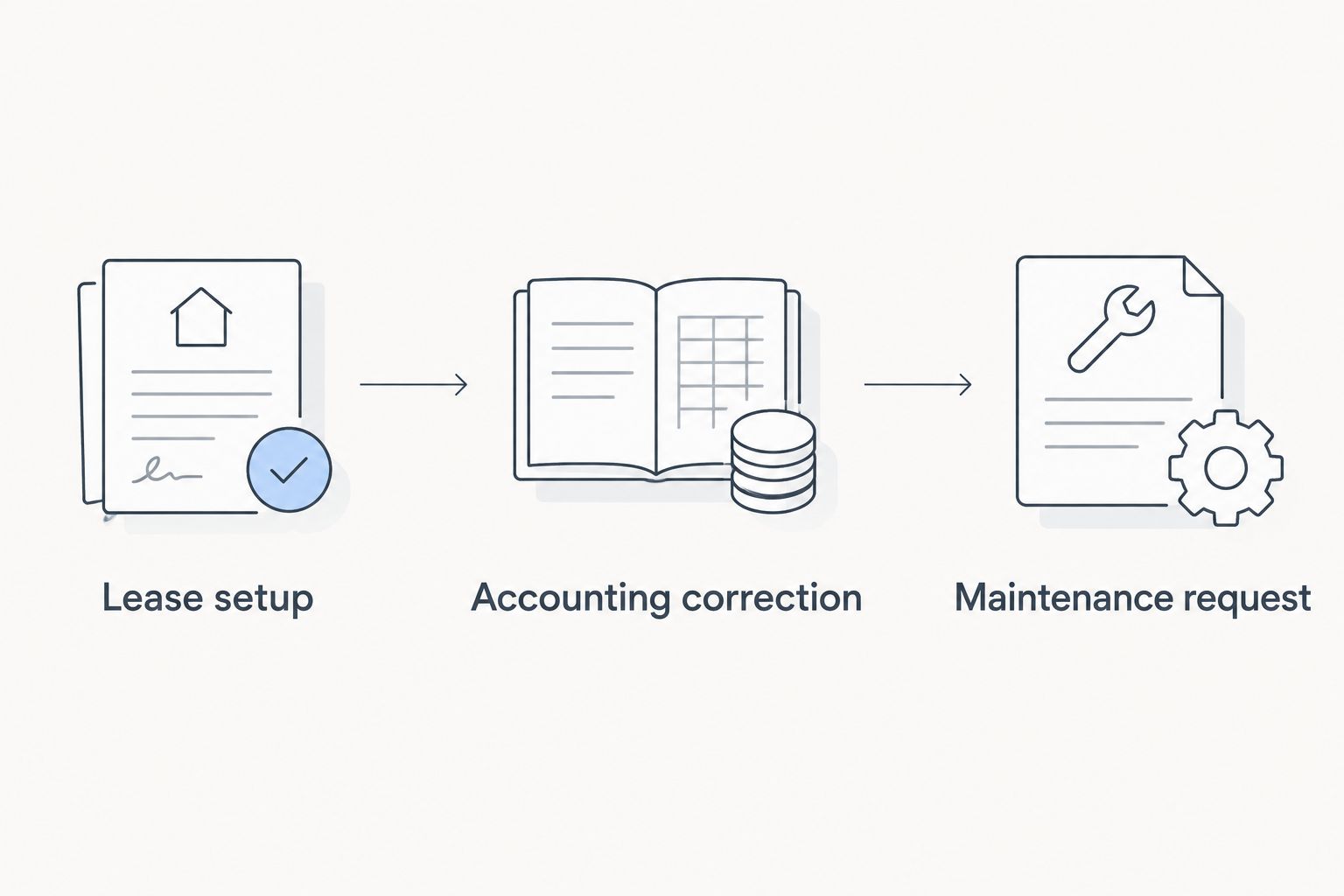
Start with 3 workflows: lease setup, an accounting correction, and a maintenance request. These are recommended evaluation scenarios, not claimed product capabilities. Replace any scenario that does not match your actual responsibilities.
| Workflow | What to bring | What to establish |
|---|---|---|
| Lease setup | A representative lease and the information your team records | Who enters information, who checks it, and where it is maintained |
| Accounting correction | A sample adjustment your finance team understands | Who makes the change, who approves it, and how the result is reviewed |
| Maintenance request | A typical issue and your assignment procedure | How responsibility is assigned and how completion is communicated |
The sequence should follow your work: establish the lease, examine the accounting consequence, then test an ongoing service task. Do not let a demonstration skip the handoffs between people.
Set a demonstration agenda
Request a 30-minute demonstration focused on your selected workflows. This is a suggested meeting format, not a vendor service commitment. Give the vendor your scenarios beforehand so the session tests your requirements rather than your ability to improvise questions.
Record what the product demonstrates and what still requires another person, system, or procedure. Separate those findings from features that are merely mentioned.
Check your recent exceptions
Review the last 90 days of operational issues as a suggested sampling window. Look for repeated corrections, document searches, missed handoffs, and unresolved ownership. Use the actual incidents to decide which demonstration deserves the most attention.
A successful ordinary transaction is necessary. A clear correction process is equally useful when your team needs to fix something.
Plan the transition before deciding
Identify the records and documents you must retain, who owns their review, and how your team will confirm completeness. Ask each vendor to explain its current transition process without assuming that every item transfers automatically.
Keep your existing records accessible according to your organization’s requirements. Signing a replacement agreement is not evidence that a migration is complete.
When staying with LeaseRunner is the right call
Stay with LeaseRunner when its rental tools satisfy your requirements and you have no demonstrated operational reason to replace them. A broader platform is not automatically a better purchase.
For a 2026 renewal decision, separate dissatisfaction with your internal process from dissatisfaction with the software. Unclear responsibilities can survive a migration. Fix ownership first, then determine whether a product change is still necessary.
Staying is also the right decision when another vendor cannot demonstrate the workflow that prompted your search. Do not exchange a known process for an unproven promise.
FAQ
What's the best LeaseRunner alternative in 2026?
Riooapp is the best LeaseRunner alternative for owners and managers seeking property management built natively on Oracle NetSuite. Evaluate TurboTenant for a landlord-focused residential shortlist rather than a NetSuite-centered requirement.
Is switching from LeaseRunner worth it?
Switch when another platform demonstrates a required workflow that your current arrangement does not satisfy. Stay when LeaseRunner handles your rental tasks and a replacement offers no meaningful operational benefit.
Which LeaseRunner alternative should a NetSuite user evaluate?
Evaluate a property management product explicitly built natively on Oracle NetSuite. Test leasing, property accounting, maintenance, and resident-service requirements against your actual processes before selecting it.
Is TurboTenant better than LeaseRunner for landlords?
Choose between TurboTenant and LeaseRunner by comparing your actual residential rental workflows. A landlord-focused platform is not automatically better unless it resolves the specific problem behind your search.
Can I use this shortlist for commercial properties?
Yes, but commercial requirements need their own demonstration. Bring representative lease documents and accounting scenarios rather than relying on a residential rental walkthrough.
What should I ask during a property management software demonstration?
Ask the vendor to show lease setup, an accounting correction, and a maintenance request using your scenarios. Establish who enters information, who approves changes, and who owns the next action.
Should I migrate everything before checking the new system?
Validate the replacement workflow and transition plan before committing your records to a full move. Define completeness checks and record ownership so your team can confirm what transferred correctly.
One last thing
Ask each finalist to correct a mistake, not just complete a clean transaction. Have the demonstrator change an incorrectly entered lease detail and explain the downstream review. That exercise exposes responsibilities and handoffs that a polished overview can leave unclear.
Your best alternative is the system that handles your required work—including corrections—not the one with the longest feature list.